iGaming operators are continually looking for new ways to diversify their product portfolios, increase engagement and create differentiated user experiences.
Prediction market technology offers one potential route.
By adding event-based markets to an existing casino or betting ecosystem, operators can expand beyond traditional gaming products and create new forms of interaction around sports, entertainment, economics and other measurable events.
The opportunity is becoming more visible in 2026 as prediction-market businesses expand and established gaming companies explore integrated casino, sportsbook and prediction experiences.
What Is Prediction Market Technology?
Prediction market technology provides the infrastructure required to create, manage and settle markets based on future events.
Depending on the model, this can include:
- Market creation
- Event contracts
- Price discovery
- Order management
- Liquidity management
- User positions
- Wallets
- Settlement
- Data feeds
- Risk management
- Analytics
For an iGaming operator, these capabilities can potentially be integrated into an existing gaming ecosystem.
1. Expand the Product Portfolio
One of the clearest benefits is product diversification.
Traditional operators may already offer:
- Online casino
- Slots
- Live casino
- Sports betting
- Poker
- Lottery
- Virtual games
Prediction markets can add another category centered on future events.
This can help operators create a broader entertainment proposition.
2. Increase Engagement Around Major Events
Prediction markets can be connected to events that already attract audience attention.
For example, operators could potentially build products around sports tournaments, entertainment events or other permitted event categories.
This gives customers another reason to visit the platform before, during and after major events.
3. Create Cross-Product Opportunities
A unified iGaming ecosystem can create opportunities for cross-selling.
For example, an operator could connect:
Sportsbook → Prediction Markets → Casino → Rewards
The exact implementation depends on regulatory requirements and product strategy.
The objective is to create a connected customer journey rather than isolated products.
4. Increase Content Variety
A conventional sportsbook depends heavily on available sporting events and betting markets.
Prediction technology can potentially expand the content universe to additional event categories.
This can help operators create a more dynamic content calendar.
However, every category should be evaluated for legality, data availability, settlement reliability and responsible-use considerations.
5. Build a Differentiated Brand
Competition in iGaming is intense.
Operators often compete on:
- Product range
- Bonuses
- User experience
- Payment options
- Odds
- Content
- Customer service
Prediction markets provide another potential differentiation layer.
A well-designed prediction experience can help an operator position its brand around interactive event-based products rather than relying exclusively on conventional sportsbook functionality.
6. Improve Data-Led Decision Making
Prediction market platforms can generate valuable behavioral and market data.
Operators can analyze:
- Popular markets
- Trading activity
- Market categories
- User participation
- Session frequency
- Conversion
- Retention
- Liquidity
- Market timing
These insights can inform future content and product decisions.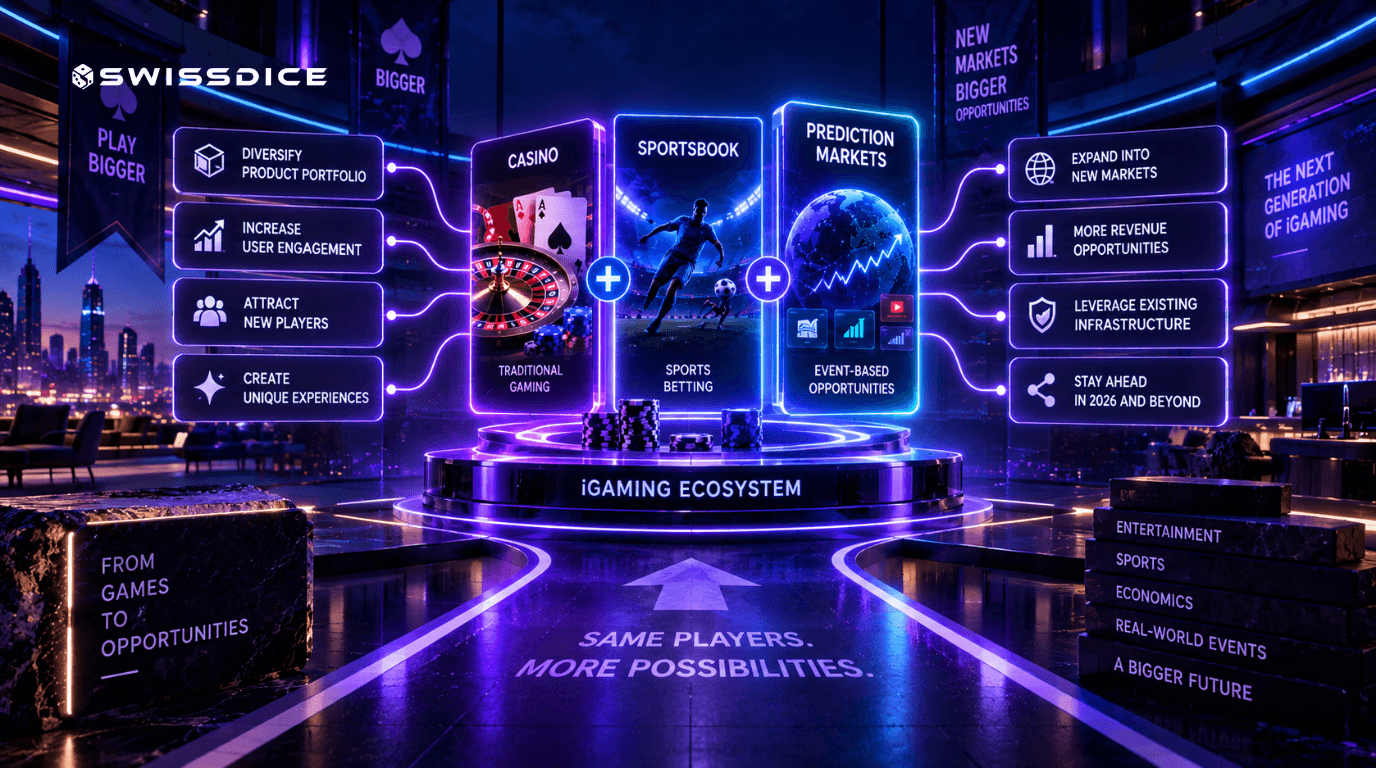
7. Support More Flexible Product Development
A configurable prediction market platform can allow operators to experiment with different market categories and experiences.
Instead of developing each product from scratch, a modular architecture can provide reusable components for:
- User accounts
- Wallets
- Market management
- Settlement
- Payments
- Reporting
- Compliance integrations
This can make future product expansion more efficient.
8. Strengthen the Overall Platform Ecosystem
Prediction market functionality can become part of a larger B2B iGaming technology stack.
For operators, the long-term opportunity may be to create a platform where multiple products share common infrastructure.
For example:
Shared account layer
One customer account across casino, sportsbook and permitted prediction products.
Shared wallet
A unified financial environment subject to the applicable regulatory framework.
Shared analytics
A broader view of customer activity across products.
Shared CRM
Personalized communication based on permitted customer data and behavior.
Shared rewards
Loyalty mechanics that connect multiple products where legally and commercially appropriate.
9. Prepare for Product Convergence
The market is increasingly moving toward integrated gaming experiences.
Recent industry activity illustrates this direction. Fanatics has announced plans to combine sportsbook, casino and prediction-market features in one application.
This suggests that prediction markets may increasingly become a component of broader digital entertainment ecosystems rather than a standalone product.
10. Compliance Must Remain a Priority
The commercial opportunity should not overshadow regulatory requirements.
Prediction markets can sit at the intersection of gambling, financial markets and event-based contracts depending on the jurisdiction and product structure.
The current U.S. legal landscape demonstrates how quickly regulatory questions can emerge around sports prediction markets.
Operators should therefore establish:
- Target jurisdictions
- Licensing requirements
- Customer eligibility rules
- Product restrictions
- KYC procedures
- AML controls
- Responsible gaming measures
- Data requirements
- Settlement rules
before launch.
For regulated remote gambling businesses, customer protection is also an ongoing operational responsibility rather than a one-time compliance exercise. The UK Gambling Commission, for example, expects licensees to identify potential harm, act appropriately and evaluate the impact of interventions.
What Should Operators Evaluate Before Investing?
Before adopting prediction market technology, operators should assess:
| Area | Key Question |
| Market strategy | Which event categories will we offer? |
| Regulation | Where can the product legally operate? |
| Liquidity | How will markets maintain sufficient participation? |
| Data | Which sources will determine event outcomes? |
| Settlement | How will outcomes be verified? |
| Technology | Can the existing platform support the product? |
| Payments | Can the wallet and payment stack support the model? |
| Security | How will accounts and transactions be protected? |
| Responsible gaming | Which customer-protection controls are required? |
| Analytics | How will we measure product performance? |
Why Prediction Market Technology Matters for iGaming
The value of prediction-market technology goes beyond adding another product category.
It can provide operators with a framework for building more interactive, event-driven experiences while creating opportunities for product diversification, customer engagement and platform expansion.
However, the technology should be introduced strategically.
A prediction market should complement the operator’s existing ecosystem rather than become an isolated feature without a clear business purpose.
Final Thoughts
For iGaming operators, prediction markets represent a potentially valuable product-development opportunity in 2026.
The strongest business case comes from combining prediction functionality with an existing technology ecosystem—shared accounts, wallets, analytics, CRM, payments and operational tools—while keeping regulatory requirements at the center of product design.
SwissDice can support businesses exploring prediction market platform development, from architecture and core functionality to integrations, deployment and ongoing technical development.
The goal is to create a flexible foundation that allows operators to test new event-based products while maintaining the scalability and operational control required for a modern iGaming business.
Frequently Asked Questions
1. How can iGaming operators benefit from prediction market technology?
Prediction market technology can help operators diversify their product portfolio, create event-based experiences, expand content and potentially increase engagement by adding a new interactive product category.
2. Can prediction markets increase iGaming customer engagement?
They can create additional engagement opportunities around permitted events and market categories. The actual impact depends on product quality, audience demand, liquidity, content strategy and regulatory factors.
3. Can prediction markets be integrated with an existing casino platform?
Potentially, yes. APIs can connect prediction functionality with existing account management, wallets, payments, CRM, analytics and other platform services.
4. Can a sportsbook operator add prediction markets?
A sportsbook operator may be able to add prediction-market functionality where permitted. The technology should account for the differences between sportsbook betting and prediction-market mechanics.
5. What business benefits can prediction market technology provide?
Potential benefits include product diversification, broader content opportunities, additional engagement channels, data insights, cross-product experiences and differentiation in a competitive iGaming market.
6. What should an operator consider before launching prediction markets?
Operators should evaluate target jurisdictions, licensing, market categories, liquidity, data providers, settlement rules, technology requirements, payments, security, responsible gaming and operational resources.
7. Can prediction markets share wallets with casino and sportsbook products?
A unified wallet may be technically possible, but its suitability depends on the product architecture, accounting requirements, licensing framework and applicable regulations.
8. How can SwissDice help iGaming operators with prediction market technology?
SwissDice can support prediction market development through platform architecture, core technology, integrations, wallet infrastructure, administration, reporting, security and ongoing technical development tailored to an operator’s requirements.