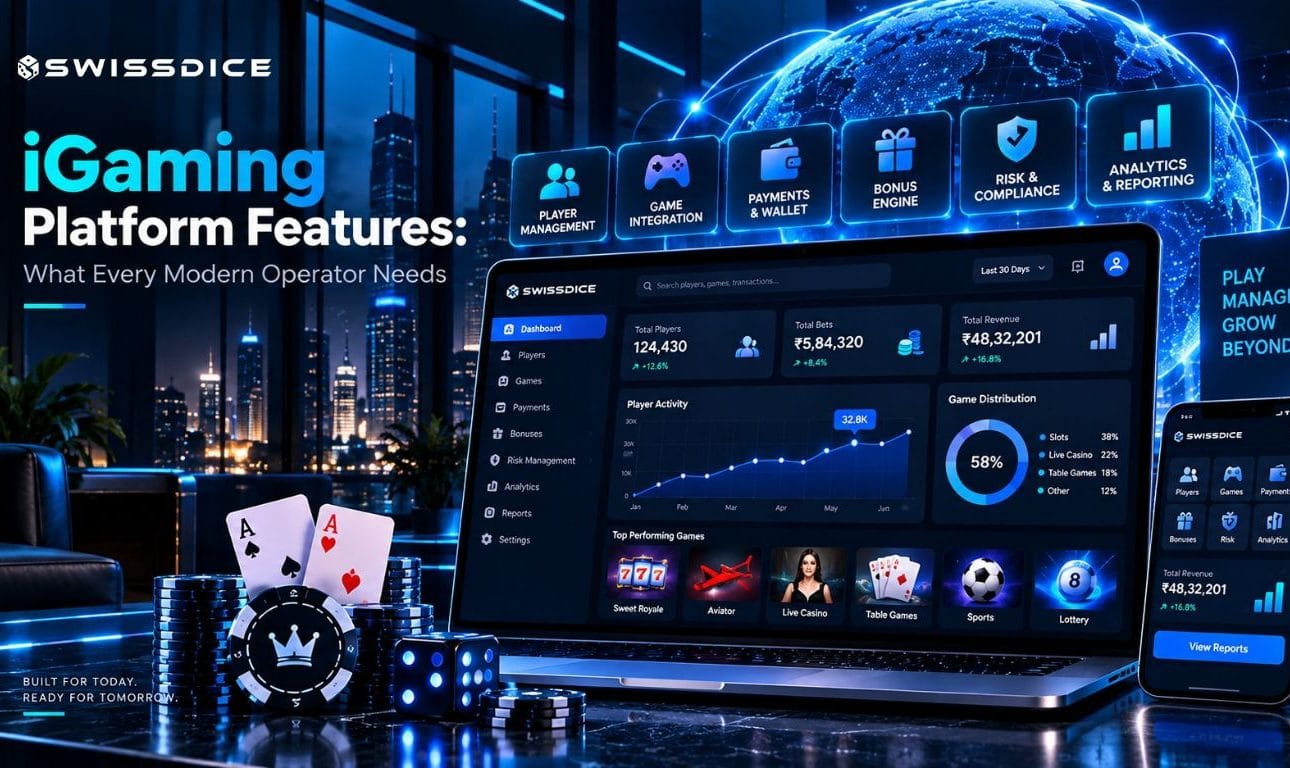
Launching an online casino or sportsbook in 2026 requires more than an attractive website and a payment gateway. Modern operators need an iGaming platform that can manage players, games, payments, bonuses, risk, compliance, data, and day-to-day operations from a connected technology environment.
The right iGaming platform features also depend on the operator’s business model. A startup launching its first casino may prioritize speed to market and ready-made integrations, while an established operator may need flexible APIs, advanced analytics, custom workflows, multi-brand management, and greater control over its technology stack.
A well-designed platform should therefore provide a strong foundation for acquisition, player management, gaming operations, responsible gambling, security, and long-term scalability.
This guide explains the essential features of an iGaming platform, what each feature does, why it matters, and what operators should evaluate before selecting or developing an iGaming solution.
What Is an iGaming Platform?
An iGaming platform is the technology infrastructure that supports the operation of an online gambling or gaming business.
Depending on the business model, it can provide the systems required to operate:
- Online casinos
- Sports betting platforms
- Betting exchanges
- Poker platforms
- Bingo products
- Lottery products
- Prediction markets
- Sweepstakes gaming products
- Hybrid casino and sportsbook businesses
An iGaming platform typically connects the player-facing website or application with backend systems responsible for player accounts, games, payments, bonuses, risk management, reporting, compliance, and third-party integrations.
In simple terms:
Player interface + PAM + Casino/Sportsbook + Payments + Bonuses + CRM + Risk + Analytics + Compliance + Integrations = iGaming platform ecosystem
Why Are iGaming Platform Features Important?
Platform functionality directly affects how efficiently an operator can run its business.
A platform with the right feature set can help operators:
- Launch products faster
- Manage player accounts
- Integrate multiple game providers
- Process deposits and withdrawals
- Configure bonuses
- Improve player retention
- Monitor suspicious activity
- Manage regulatory requirements
- Analyze player behavior
- Scale into additional markets
- Manage multiple brands
- Connect external technology through APIs
However, having more features is not automatically better.
The important question is whether the platform features support the operator’s business model, target markets, player journey, compliance requirements, and growth strategy.
Essential iGaming Platform Features
The following features form the core of a modern iGaming platform.
1. Player Account Management (PAM)
A Player Account Management (PAM) system is one of the most important components of an iGaming platform.
It manages the player’s account throughout the customer lifecycle.
A comprehensive PAM can handle:
- Registration
- Login
- Player profiles
- Account verification
- KYC workflows
- Player balances
- Transaction history
- Session management
- Self-exclusion
- Account restrictions
- Responsible gaming controls
- Player segmentation
A strong PAM should also support integrations with payment providers, identity verification services, CRM systems, gaming platforms, and compliance tools.
Why PAM Matters
Without centralized player management, operators can struggle to maintain consistent player information and operational controls across casino, sportsbook, and other products.
2. Casino Game Management
A modern casino platform needs tools for managing its game portfolio.
The casino management layer may support:
- Game provider integration
- Game categorization
- Game search
- Game filtering
- Game launch configuration
- Lobby management
- Game availability by jurisdiction
- Featured games
- New releases
- Popular games
- Game recommendations
- Provider management
Operators should be able to control how games are presented without requiring developers to make every small content change.
3. Sportsbook Integration
For operators running both casino and betting products, sportsbook integration can provide a unified player experience.
Depending on the platform, sportsbook functionality may include:
- Pre-match betting
- Live betting
- Sports markets
- Odds integration
- Bet slip
- Cash-out functionality
- Betting limits
- Event management
- Settlement
- Risk management
A sportsbook does not necessarily need to be developed entirely from scratch. Operators can integrate specialized sportsbook technology through APIs while using the iGaming platform as the central operational layer.
4. Payment Gateway Integration
Payments are fundamental to the player experience.
A modern iGaming platform should support multiple payment methods based on the target market.
Potential payment integrations include:
- Credit and debit cards
- Bank transfers
- E-wallets
- Instant payment systems
- Mobile payments
- Cryptocurrency payments where legally permitted
- Local payment methods
The payment architecture should support both deposits and withdrawals while maintaining transaction security and appropriate compliance controls.
Important Payment Features
Operators should consider:
- Multiple payment providers
- Currency support
- Transaction monitoring
- Payment routing
- Deposit limits
- Withdrawal management
- Failed-payment handling
- Refund workflows
- Fraud controls
- Transaction reporting
5. KYC and Player Verification
Know Your Customer (KYC) is an important part of operating a regulated iGaming business.
A platform can integrate third-party identity and verification providers to automate workflows such as:
- Identity verification
- Age verification
- Address verification
- Document verification
- Sanctions screening
- Risk checks
The exact requirements vary according to the jurisdiction and license under which the operator operates.
A flexible platform should allow verification workflows to be configured according to market-specific requirements.
6. CRM and Player Management
Player acquisition is only one part of the iGaming business. Retention and lifecycle management are equally important.
An integrated iGaming CRM can help operators segment players based on characteristics and behavior.
Common CRM capabilities include:
- Player segmentation
- Automated campaigns
- Email communication
- SMS campaigns
- Push notifications
- Player tagging
- Promotional targeting
- Lifecycle campaigns
- Reactivation campaigns
- VIP management
For example, an operator could create segments for new players, active players, high-value players, inactive players, and players approaching a defined engagement threshold.
7. Bonus and Promotion Engine
A flexible bonus engine gives operators greater control over promotions.
Common bonus features include:
- Welcome bonuses
- Free spins
- Deposit bonuses
- Cashback
- Reload bonuses
- Loyalty rewards
- Promotional codes
- Wagering requirements
- Bonus expiration
- Campaign rules
The system should also provide controls for eligibility, limits, activation, and reporting.
Bonus logic should be carefully configured to comply with applicable advertising, promotional, and responsible-gambling requirements.
8. Responsible Gaming Features
Responsible gaming should be designed into the platform rather than treated as an optional add-on.
Depending on jurisdiction and operator requirements, features may include:
- Deposit limits
- Loss limits
- Session limits
- Time reminders
- Cooling-off periods
- Self-exclusion
- Reality checks
- Player activity monitoring
- Responsible gaming messaging
The platform should provide operators with appropriate controls for identifying and managing risk while supporting regulatory obligations.
9. Risk Management and Fraud Prevention
iGaming businesses face risks associated with payment fraud, account abuse, bonus exploitation, collusion, suspicious behavior, and other forms of platform misuse.
A modern platform can integrate risk-management systems to monitor:
- Login behavior
- Payment activity
- Account patterns
- Bonus usage
- Device information
- IP activity
- Geographic signals
- Transaction behavior
- Unusual betting patterns
Advanced risk systems may use rules-based monitoring, behavioral analysis, and machine-learning models where appropriate.
10. Back Office and Admin Panel
The back office is the operational control center of an iGaming platform.
Administrators may need to manage:
- Players
- Games
- Bonuses
- Payments
- Withdrawals
- Transactions
- Content
- Campaigns
- Reports
- Risk settings
- User permissions
- Platform configuration
A well-designed admin panel should provide role-based access so employees only have access to the functions required for their responsibilities.
For example, a marketing manager may need campaign controls but should not necessarily have unrestricted access to financial or security settings.
11. Analytics and Reporting
Data is essential for understanding how an iGaming business performs.
A modern analytics layer can track metrics such as:
- Registrations
- First-time deposits
- Active players
- Deposits
- Withdrawals
- Gross gaming revenue
- Net gaming revenue
- Average revenue per player
- Retention
- Churn
- Bonus costs
- Game performance
- Conversion rates
Operators can use these insights to evaluate acquisition channels, player engagement, game performance, promotional effectiveness, and operational efficiency.
12. Multi-Currency Support
International operators may need to support multiple currencies.
A platform can be designed to accommodate:
- Fiat currencies
- Regional currencies
- Currency conversion
- Currency-specific limits
- Currency-based reporting
- Payment-method availability
Currency handling should be implemented carefully to maintain accurate transaction records and financial reporting.
13. Multi-Language Support
Localization is important when targeting multiple markets.
A multilingual iGaming platform may support:
- Website content
- Casino lobbies
- Sportsbook interfaces
- Account pages
- Notifications
- Promotional content
- Help content
- Transaction information
Localization should cover more than simply translating visible text. Date formats, currencies, payment methods, regulatory disclosures, and market-specific content may also need to be adapted.
14. API and Third-Party Integrations
An iGaming platform rarely operates independently.
Operators commonly need integrations with:
- Game providers
- Game aggregators
- Payment providers
- KYC providers
- CRM platforms
- Affiliate systems
- Sportsbook providers
- Fraud-prevention services
- Analytics tools
- Identity verification providers
- Compliance systems
A well-designed API architecture makes these integrations easier to maintain and replace as the operator’s technology ecosystem evolves.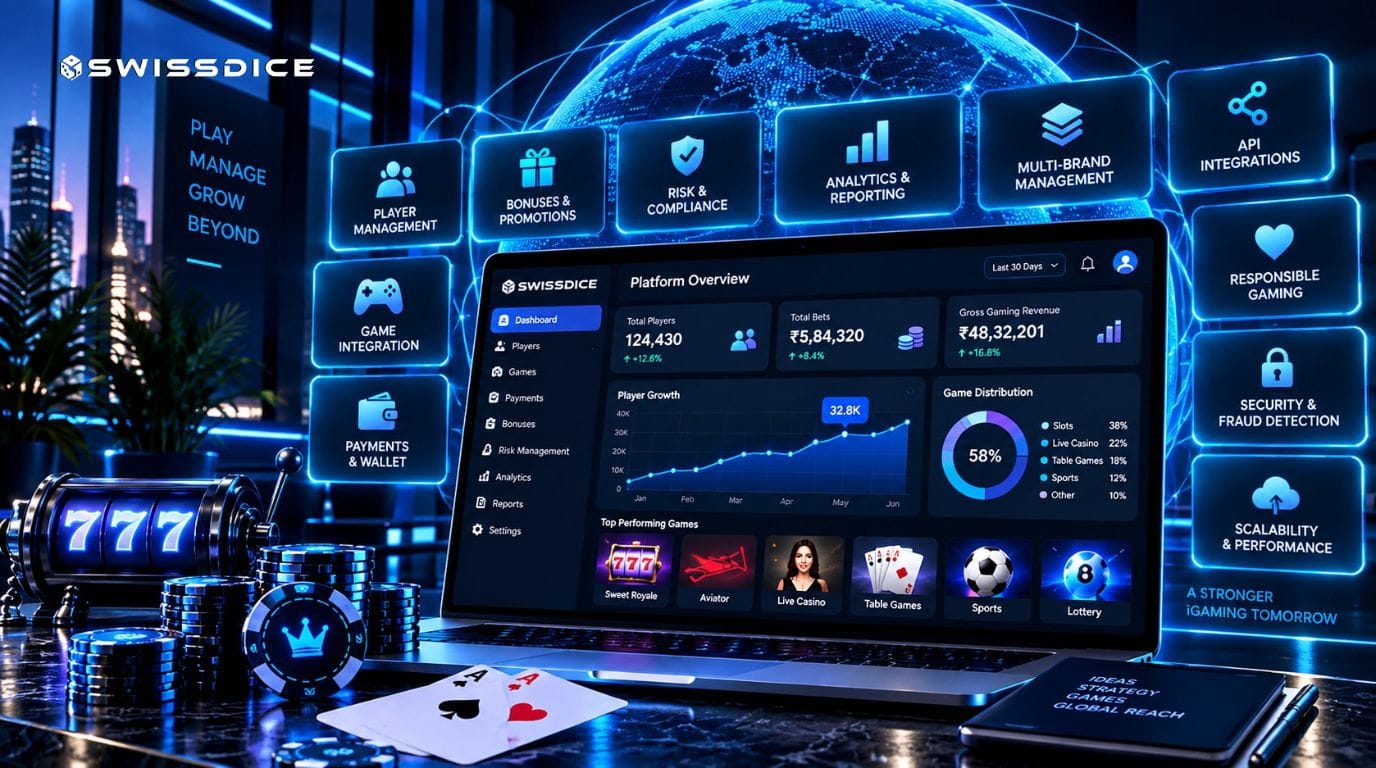
15. Game Aggregation
A casino game aggregator can provide access to games from multiple providers through a centralized integration layer.
Instead of building separate technical connections to every game studio, an operator can use an aggregation solution where appropriate.
Potential advantages include:
- Faster game integration
- Centralized game management
- Large content portfolios
- Simplified technical maintenance
- Multi-provider access
- Market-specific game configuration
The exact commercial and technical model depends on the aggregator and operator requirements.
16. Affiliate Management
Affiliate marketing remains an important acquisition channel for many iGaming businesses.
An affiliate management module can support:
- Affiliate registration
- Tracking links
- Referral tracking
- Commission models
- Revenue-share arrangements
- CPA models
- Hybrid commissions
- Affiliate reporting
- Fraud monitoring
Operators should ensure affiliate tracking and promotional practices comply with the requirements of their target jurisdictions.
17. Multi-Brand Management
Growing gaming companies may operate several brands from the same technology infrastructure.
A multi-brand architecture can allow operators to manage:
- Multiple casino brands
- Different domains
- Different themes
- Market-specific configurations
- Shared player infrastructure
- Separate promotions
- Brand-level reporting
This can reduce duplication while allowing individual brands to maintain distinct customer experiences.
18. Security and Data Protection
Security should be part of the platform architecture from the beginning.
Important security considerations include:
- Encryption
- Secure API authentication
- Role-based access
- Session security
- Network protection
- Database security
- Audit logging
- Vulnerability management
- Backup and disaster recovery
- Monitoring and alerting
Operators also need to consider applicable privacy and data-protection obligations when processing player information.
19. Scalability and High Availability
An iGaming platform must handle fluctuating traffic and transaction volumes.
Scalable architecture can use technologies such as:
- Cloud infrastructure
- Containerization
- Load balancing
- Horizontal scaling
- Database replication
- Caching
- Queue-based processing
- Monitoring systems
- Automated deployment
High availability is particularly important because interruptions can affect player experience, transactions, revenue, and operator reputation.
20. Mobile and Cross-Platform Support
Players increasingly expect gaming products to work smoothly across different devices.
A modern platform should support responsive experiences across:
- Desktop
- Mobile browsers
- Tablets
- Android applications
- iOS applications
The exact implementation depends on the operator’s product strategy.
Mobile UX should prioritize fast loading, touch-friendly controls, clear navigation, and consistent account and wallet experiences.
What Should Operators Look for in an iGaming Platform?
Selecting an iGaming platform should go beyond comparing feature lists.
Operators should evaluate the platform across several dimensions.
Technology Architecture
Is the platform modular, API-driven, scalable, and easy to integrate?
Product Coverage
Does it support the casino, sportsbook, betting, or other products required by the business?
Regulatory Support
Can the technology support the operator’s target jurisdictions and compliance workflows?
Integration Ecosystem
How easily can the operator connect payment providers, game suppliers, KYC tools, CRM systems, and other third-party services?
Customization
Can the platform adapt to the operator’s branding, workflows, business rules, and market requirements?
Scalability
Can the architecture support additional players, brands, games, and jurisdictions?
Operational Control
Does the back office provide sufficient control over players, games, payments, bonuses, content, and reporting?
How to Choose Between Turnkey, White Label and Custom iGaming Platforms
The platform model can significantly influence the required feature set.
White Label iGaming Platform
A white label casino platform typically provides a ready-made technology foundation that can be branded and launched with relatively limited customization.
It can be suitable for businesses prioritizing speed to market.
Turnkey iGaming Platform
A turnkey iGaming solution generally provides a broader technology package that can be configured for an operator’s business requirements.
It can offer more control than a basic white-label model while reducing the need to develop every component independently.
Custom iGaming Platform
A custom platform is built around the operator’s specific technology, product, operational, and integration requirements.
It generally requires more time and investment but can provide greater flexibility and ownership over the technology architecture.
Emerging iGaming Platform Features to Watch
The next generation of iGaming platforms is likely to focus increasingly on automation, personalization, data, and interoperability.
AI-Powered Personalization
AI can help analyze player behavior and support personalized recommendations, segmentation, and content experiences.
Real-Time Analytics
Operators increasingly need immediate visibility into player activity, transactions, game performance, and operational metrics.
Automated Risk Monitoring
Advanced behavioral models can complement traditional rules-based fraud and risk systems.
Modular Platform Architecture
API-first and modular architectures allow operators to add or replace individual services without rebuilding the entire platform.
Omnichannel Player Experiences
Operators may increasingly connect casino, sportsbook, mobile, and other gaming experiences through unified player accounts and wallets.
iGaming Platform Development: A Practical Architecture
A modern platform can be structured into several interconnected layers:
Frontend Layer
Website, mobile web, applications and player interfaces
↓
Core Platform Layer
PAM, wallet, bonus engine, CRM, casino management and sportsbook integration
↓
Integration Layer
Games, aggregators, payment gateways, KYC, fraud prevention and external APIs
↓
Data & Analytics Layer
Reporting, player analytics, business intelligence and operational monitoring
↓
Infrastructure & Security Layer
Cloud infrastructure, databases, caching, security, backups and monitoring
This modular architecture allows individual components to evolve without forcing the operator to replace the entire technology stack.
How SwissDice Supports iGaming Platform Development
SwissDice provides technology and development services for businesses building and operating iGaming products.
Its platform-oriented capabilities can cover areas such as:
- iGaming platform development
- Casino platform development
- Turnkey iGaming solutions
- White-label gaming solutions
- Casino game integration
- Game aggregation
- RGS infrastructure
- Payment integration
- PAM integration
- Bonus and gamification systems
- Custom software development
- Third-party API integration
- Technical support
- Security and infrastructure services
For operators, the objective is to build an iGaming technology environment that supports the current product while remaining flexible enough for future integrations, markets, brands, and gaming products.
iGaming Platform Features Checklist
Before selecting or developing a platform, operators should assess whether it provides the following:
- Player Account Management
- Casino management
- Sportsbook integration
- Payment gateway integration
- KYC and verification
- CRM
- Bonus engine
- Responsible gaming
- Risk and fraud management
- Back-office administration
- Analytics and reporting
- Multi-currency support
- Multi-language support
- API integrations
- Game aggregation
- Affiliate management
- Multi-brand support
- Security controls
- Scalable infrastructure
- Mobile support
- Regulatory configuration
Not every operator needs every feature on day one. The right platform should provide the features required for the current business model while allowing additional capabilities to be introduced as the business grows.
Frequently Asked Questions
What are the most important iGaming platform features?
The most important features typically include PAM, casino and sportsbook management, payment integration, KYC, CRM, bonus management, responsible gaming, risk management, reporting, APIs, security, and scalable infrastructure.
What is PAM in iGaming?
PAM stands for Player Account Management. It manages player registration, profiles, verification, balances, transactions, account controls, and other parts of the player lifecycle.
Why is a bonus engine important for an iGaming platform?
A bonus engine allows operators to create and manage promotions such as welcome bonuses, free spins, cashback, reload offers, and loyalty rewards while applying eligibility and promotional rules.
Does an iGaming platform need payment gateway integration?
Yes. Real-money gaming platforms generally need secure payment infrastructure for deposits and withdrawals. Operators may integrate multiple payment providers to support different markets and payment preferences.
What is an iGaming game aggregator?
A game aggregator provides a centralized integration layer through which an operator can access games from multiple gaming providers. This can simplify game integration and portfolio management.
What security features should an iGaming platform have?
Important areas include encryption, secure APIs, authentication, role-based access, audit logs, infrastructure security, transaction controls, monitoring, backups, and fraud-prevention integrations.
Can an iGaming platform support multiple brands?
Yes. A multi-brand architecture can allow multiple casino or gaming brands to operate on shared technology while maintaining separate branding, content, promotions, domains, and reporting.
How much does an iGaming platform cost?
There is no universal cost. Pricing depends on whether the operator chooses a white-label, turnkey, or custom platform, along with the required modules, integrations, jurisdictions, customization, infrastructure, and ongoing support.
Conclusion
The best iGaming platform features are not simply the ones that create the longest feature checklist. They are the capabilities that help an operator manage players, games, payments, promotions, compliance, risk, data, and technology efficiently while creating a reliable customer experience.
At a minimum, modern operators should evaluate PAM, payment integration, game management, CRM, bonuses, responsible gaming, risk management, analytics, APIs, security, scalability, and mobile support.
As an operator grows, additional capabilities such as multi-brand management, advanced personalization, game aggregation, automated risk monitoring, and real-time analytics can become increasingly valuable.
The most effective approach is to select or develop an iGaming platform around the operator’s target market, regulatory environment, product strategy, and long-term technology roadmap—not simply around the number of features listed by a vendor.