The online casino industry has evolved beyond traditional fiat-based payment systems. Today, operators can build casino platforms that accept conventional currencies such as USD, EUR, or GBP, cryptocurrencies such as Bitcoin and Ethereum, or a combination of both.
This has created an important comparison for operators and players: crypto casino vs traditional online casino.
At a basic level, a traditional online casino normally relies on fiat currencies and conventional financial rails such as cards, bank transfers, and e-wallets. A crypto casino incorporates cryptocurrency payments and, depending on its architecture, may use blockchain-based wallets, smart contracts, token-based systems, or provably fair mechanisms.
The difference, however, goes well beyond the payment method. It can affect the player journey, transaction processing, wallet architecture, compliance controls, security model, loyalty programs, market strategy, and technology stack.
For iGaming businesses, selecting between a traditional, crypto, or hybrid casino model requires a clear understanding of these differences.
In this guide, SwissDice compares crypto casinos and traditional online casinos across payments, transaction speed, privacy, security, regulation, currencies, bonuses, accessibility, technology, and operational considerations.
What Is a Traditional Online Casino?
A traditional online casino is a digital casino platform that primarily operates using fiat currencies and conventional payment infrastructure.
Players can typically deposit and withdraw using methods such as:
- Credit and debit cards
- Bank transfers
- E-wallets
- Local payment methods
- Other approved fiat payment services
The casino may offer a combination of:
- Online slots
- Table games
- Live casino
- Roulette
- Blackjack
- Baccarat
- Jackpots
- Specialty casino games
A traditional casino platform generally includes a player account system, casino game lobby, wallet, payment gateway, KYC processes, responsible gambling tools, bonuses, customer support, and an operator back office.
In regulated markets, operators must comply with the applicable licensing framework, technical standards, customer verification requirements, financial controls, and player protection obligations. For example, the UK Gambling Commission’s current licence framework includes requirements covering payments, customer funds, anti-money-laundering controls, customer identity verification, technical standards, and responsible gambling.
What Is a Crypto Casino?
A crypto casino is an online casino that supports cryptocurrency as part of its payment or gaming infrastructure.
Depending on the platform design, players may be able to use digital assets such as:
- Bitcoin
- Ethereum
- Litecoin
- Stablecoins such as USDT
- Other supported cryptocurrencies
A crypto casino does not necessarily mean that every part of the platform runs on blockchain technology.
There are several possible architectures.
Crypto Payment Casino
The casino operates primarily like a conventional online casino but adds cryptocurrency deposits and withdrawals.
Hybrid Casino
The platform supports both fiat and crypto payments.
For example:
USD / EUR → Traditional Payment Gateway
and
BTC / ETH / USDT → Crypto Wallet Infrastructure
Blockchain-Based Casino
Some platforms use blockchain infrastructure for additional parts of the gaming experience, potentially including smart contracts, on-chain transactions, token systems, or verifiable game mechanisms.
This distinction matters because accepting cryptocurrency is not the same as being fully decentralized.
Crypto Casino vs Traditional Online Casino: What Is the Difference?
The biggest differences appear in payments, transaction processing, user verification, security, currency support, compliance, and platform architecture.
1. Payment Methods
Payment infrastructure is one of the most visible differences.
Traditional Online Casino
Traditional casinos commonly use:
- Bank cards
- Bank transfers
- E-wallets
- Local payment methods
- Fiat payment processors
Funds move through conventional financial institutions and payment providers.
Crypto Casino
Crypto casinos can accept cryptocurrency through blockchain wallet infrastructure.
Depending on the implementation, the operator may support:
- Bitcoin
- Ethereum
- Stablecoins
- Other approved tokens
This can reduce dependence on conventional banking rails for the supported crypto transactions, but it does not eliminate the need for payment, compliance, and financial controls.
For an operator, the key question is therefore not simply “Does the casino accept crypto?” but rather “How is the wallet and payment architecture designed?”
2. Transaction Speed
Transaction speed is frequently promoted as an advantage of crypto casinos, but it should not be treated as universally faster.
Blockchain transactions can be initiated directly from a wallet, but actual settlement time depends on the blockchain network, confirmation requirements, wallet architecture, liquidity processes, compliance checks, and the operator’s withdrawal policy.
Traditional withdrawals can also vary significantly depending on the payment method and operator’s verification procedures.
So the practical comparison is:
Traditional casino
Payment gateway → Verification → Processing → Banking network → Player
Crypto casino
Player wallet → Blockchain transaction → Confirmation → Operator wallet/system → Player
The underlying blockchain can settle a transaction quickly, but operators may still apply internal review, risk, or compliance checks before releasing funds.
3. Privacy and KYC Requirements
Privacy is another area where crypto casinos are often differentiated from conventional casinos.
However, the idea that crypto gambling automatically means anonymous gambling is misleading.
An operator may still be required to identify customers depending on:
- Licensing jurisdiction
- Customer location
- Payment regulations
- AML requirements
- Risk profile
- Transaction patterns
The UK Gambling Commission, for example, requires licensed operators to maintain customer identity verification and includes anti-money-laundering requirements in its licence conditions.
Crypto transactions can provide a different payment experience, but the blockchain itself does not make transactions inherently anonymous. Blockchain activity can be publicly visible, and regulated operators may also use blockchain analytics and transaction monitoring.
For operators, the distinction is important:
Crypto payment ≠ automatic anonymity
Blockchain wallet ≠ exemption from KYC
Reduced payment friction ≠ reduced compliance responsibility
FATF continues to emphasize the importance of risk-based controls around virtual assets and virtual asset service providers, while its 2026 work also highlights emerging illicit-finance risks affecting increasingly digital and cross-border gambling environments.
4. Security Infrastructure
Both traditional and crypto casinos require strong security, but their risk profiles are different.
Traditional Online Casino Security
A conventional casino typically needs to secure:
- User accounts
- Payment information
- Personal data
- Wallet balances
- APIs
- Databases
- Admin systems
- Payment integrations
Crypto Casino Security
A crypto casino additionally needs to consider:
- Wallet security
- Private-key protection
- Hot and cold wallet architecture
- Blockchain transaction monitoring
- Smart contract security, where applicable
- Address screening
- Digital asset custody
- Blockchain confirmations
Crypto technology can introduce additional attack surfaces.
For example, a decentralized casino using smart contracts creates a different security model from a centralized casino using conventional backend systems. A coding flaw in a smart contract can create financial consequences that are difficult to reverse.
Therefore, blockchain should not be presented as automatically “more secure.” Security depends on the architecture, implementation, controls, audits, and operational processes.
5. Regulation and Licensing
Regulation is one of the most important differences for operators.
Traditional online casinos operate within gambling licensing frameworks established by individual jurisdictions.
Crypto casinos may have to consider two interconnected regulatory layers:
Gambling regulation + digital-asset/payment regulation
This can create additional compliance complexity.
Operators may need to consider:
- Gambling licensing
- Customer identity verification
- AML controls
- Source-of-funds checks
- Responsible gambling
- Transaction monitoring
- Digital-asset restrictions
- Tax obligations
- Advertising requirements
- Geographic restrictions
- Data protection
FATF’s 2026 update on virtual assets notes that jurisdictions continue working on implementation of AML/CFT standards for virtual assets and virtual asset service providers.
FATF has also highlighted emerging money-laundering and terrorist-financing risks involving increasingly digital, cross-border gambling services and their payment channels.
This means crypto casino development should start with a jurisdiction and compliance assessment, not just a technology roadmap.
6. Supported Currencies
Traditional casinos normally operate with fiat currencies.
Examples include:
- USD
- EUR
- GBP
- CAD
- AUD
- Other local currencies
Crypto casinos can support digital assets in addition to or instead of fiat currencies.
Examples can include:
- BTC
- ETH
- USDT
- LTC
- SOL
A hybrid casino may support both.
Why Hybrid Currency Support Matters
A hybrid wallet can allow operators to serve customers who prefer traditional payments while also supporting users who want crypto transactions.
From a product perspective, this can create a broader payment ecosystem.
However, a multi-currency wallet also introduces additional technical requirements for:
- Exchange-rate management
- Wallet reconciliation
- Transaction tracking
- Blockchain confirmation
- Accounting
- Treasury management
- Risk controls
7. Bonuses and Loyalty Programs
Traditional online casinos commonly use:
- Welcome bonuses
- Deposit bonuses
- Free spins
- Reload offers
- Loyalty points
- VIP programs
- Cashback offers
Crypto casinos can support similar promotions while also introducing crypto-native mechanics.
Potential examples include:
- Crypto cashback
- Token-based rewards
- Crypto deposit incentives
- Tiered VIP programs
- On-chain rewards
- Blockchain-based membership systems
However, token rewards or crypto incentives do not automatically make a loyalty program more valuable. Their usefulness depends on the economic model, legal framework, player experience, and how the operator manages volatility and redemption.
8. Accessibility and Geographic Restrictions
One frequently cited advantage of cryptocurrency is that blockchain networks can operate across borders without requiring the same banking infrastructure used for conventional payments.
That does not mean a crypto casino can legally accept players everywhere.
An operator still has to consider:
- Gambling laws
- Crypto laws
- Licensing conditions
- Restricted territories
- Payment restrictions
- Customer location
- Advertising regulations
Therefore:
Technical accessibility does not equal legal market access.
A cryptocurrency may be technically transferable across borders while the underlying gambling service remains restricted in a particular jurisdiction.
9. Transaction Reversibility
Traditional and blockchain payment systems handle transactions differently.
Some traditional payment methods may support:
- Chargebacks
- Reversals
- Payment disputes
- Refund processes
Confirmed blockchain transactions are generally designed to be irreversible at the protocol level.
That creates both an opportunity and a risk.
Potential Benefit
There may be fewer conventional chargeback mechanisms for a confirmed blockchain transfer.
Operational Risk
An incorrect wallet address, wrong network, or mistaken transaction can be difficult or impossible to reverse.
This means crypto payment UX needs strong safeguards such as:
- Address validation
- Network selection
- Deposit instructions
- Transaction confirmation status
- Risk screening
- Clear user warnings
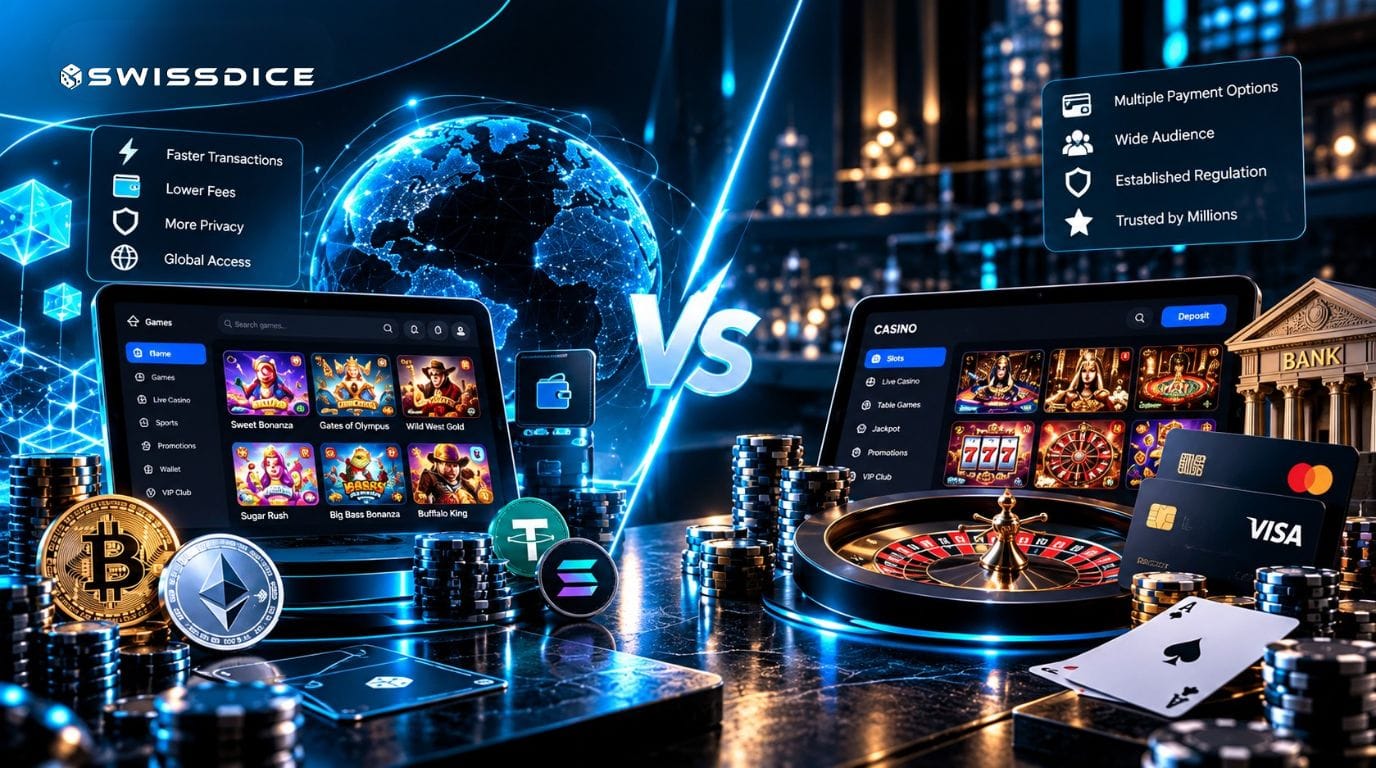
Traditional Online Casino vs Crypto Casino: Comparison Table
| Feature | Traditional Online Casino | Crypto Casino |
| Primary payment model | Fiat | Cryptocurrency |
| Common currencies | USD, EUR, GBP and local fiat | BTC, ETH, USDT and other supported assets |
| Banking dependency | Higher | Lower for crypto transactions |
| Wallet model | Casino/payment-provider wallet | Crypto or hybrid wallet |
| Transaction processing | Banks, gateways and payment providers | Blockchain and crypto infrastructure |
| KYC | Common in regulated markets | Still applicable where required |
| AML controls | Required according to applicable rules | Required according to applicable rules and potentially digital-asset requirements |
| Transaction reversibility | Varies by payment method | Confirmed blockchain transactions are generally irreversible |
| Smart contracts | Usually not required | Optional, depending on architecture |
| Blockchain | Usually not required | Used for crypto transactions; broader use depends on platform design |
| Game transparency tools | RNG testing and certification may apply | Can additionally include blockchain-based or provably fair mechanisms |
| Bonus model | Fiat bonuses, free spins, loyalty | Fiat or crypto rewards, depending on rules |
| Currency volatility | Usually lower for fiat balances | Crypto balances may have significant price volatility |
| Cross-border payments | Dependent on banking/payment infrastructure | Blockchain can facilitate cross-border transfers, subject to legal restrictions |
| Regulatory complexity | Gambling regulation | Gambling + potentially digital-asset/payment regulation |
| User experience | Familiar banking and payments | Wallet-based payments and crypto-specific flows |
Advantages of Traditional Online Casinos
Traditional online casinos remain relevant because they provide an established user experience and integrate with familiar financial systems.
Familiar Payment Experience
Players can use payment methods they already understand.
Broad Fiat Support
Operators can price and account for balances in common currencies.
Established Compliance Processes
Regulated gambling jurisdictions provide established frameworks for licensing, customer verification, payments, and responsible gambling.
Simple Player Journey
A user does not necessarily need prior knowledge of blockchain wallets or network fees.
Established Game Ecosystems
Traditional casino technology supports mature integrations with slots, live casino, table games, jackpots, game aggregators, PAM systems, CRM, and payment providers.
Limitations of Traditional Online Casinos
Traditional casino models also have operational challenges.
Banking Dependency
Operators depend more heavily on banks and payment providers.
Payment Restrictions
Some payment methods may not support every market or transaction type.
Processing Delays
Deposits and withdrawals can require third-party processing and verification.
Geographic Constraints
Banking infrastructure and local regulations can restrict market availability.
Payment Fees
Operators may need to manage payment-processing costs and settlement arrangements.
Advantages of Crypto Casinos
Crypto casino platforms can provide additional functionality for operators targeting cryptocurrency users.
Cryptocurrency Payments
Users can deposit and withdraw using supported digital assets.
Alternative Financial Rails
Crypto transactions can provide an alternative to conventional banking rails for supported use cases.
Blockchain-Based Features
Operators can introduce blockchain-related functionality where it genuinely improves the product.
Provably Fair Mechanisms
Some crypto gaming platforms use cryptographic verification mechanisms intended to allow players to independently verify certain game outcomes.
Crypto-Native Loyalty
Operators can experiment with tokenized or blockchain-based reward models where legally permitted.
Hybrid Casino Opportunities
Operators do not necessarily have to choose between fiat and crypto. A hybrid model can support both.
Limitations and Risks of Crypto Casinos
Crypto casino development also introduces additional challenges.
Cryptocurrency Price Volatility
The value of some digital assets can change significantly. Operators need to decide how balances, settlements, and accounting are handled.
Regulatory Uncertainty
Digital-asset and gambling requirements differ by jurisdiction and continue to evolve.
Wallet Security
Custodial systems create significant security responsibilities for operators.
Irreversible Transactions
Confirmed blockchain transactions can be difficult to reverse.
Blockchain Fees and Congestion
Transaction costs and confirmation times can vary across networks.
Compliance Complexity
Crypto transactions may require additional monitoring, screening, and source-of-funds controls.
The UK Gambling Commission specifically warns licensees that funds originating from crypto-assets require appropriate scrutiny and describes crypto-assets as high risk in its AML guidance.
What Is Provably Fair Gaming?
Provably fair gaming is a cryptographic approach used by some blockchain and crypto casino platforms to provide players with a mechanism for independently verifying certain game outcomes.
A common implementation uses cryptographic values such as:
- Server seed
- Client seed
- Nonce
- Hash functions
The purpose is to allow a player to verify that the outcome was generated according to the published mechanism rather than being changed after the fact.
However, provably fair does not mean that every aspect of an online casino is automatically trustworthy.
It does not replace:
- Gambling licensing
- Game certification
- Responsible gambling
- KYC/AML
- Security testing
- Financial controls
- Operator accountability
For a commercial casino, provable fairness should be considered one component of a broader trust and compliance framework.
Crypto Casino vs Traditional Online Casino: Which Model Should Operators Choose?
The answer depends on the business model rather than one model being universally suitable.
A traditional online casino may fit an operator focused on established fiat payment methods and markets where conventional online gambling infrastructure is mature.
A crypto casino may fit a business targeting customers who actively use digital assets and where the intended jurisdiction permits the relevant gambling and crypto activities.
A hybrid casino can combine both approaches.
Traditional Model
Best aligned with:
- Fiat-first audiences
- Established payment ecosystems
- Conventional casino operations
- Markets where fiat infrastructure is strong
Crypto Model
Can suit:
- Crypto-native audiences
- Digital-asset payment strategies
- Blockchain-focused products
- Operators with the appropriate regulatory framework
Hybrid Model
Can be useful when an operator wants:
- Fiat + crypto payments
- Broader wallet functionality
- Multiple payment options
- Flexibility across customer segments
The correct choice should be based on market research, licensing, payment availability, customer behavior, technology requirements, and operational risk.
How to Build a Crypto or Traditional Online Casino
Although the payment models differ, both casino types require a strong iGaming platform foundation.
1. Define the Business Model
Determine:
- Target market
- Target players
- Casino products
- Payment methods
- Revenue model
- Currency strategy
- Licensing jurisdiction
- Responsible gambling requirements
2. Choose the Payment Architecture
For traditional casinos, this may include:
Bank/Card/E-Wallet → Payment Gateway → Casino Wallet
For crypto casinos:
Blockchain Wallet → Crypto Payment Layer → Casino Wallet
For a hybrid platform:
Fiat + Crypto → Unified Wallet Layer → Casino Platform
3. Select the Casino Games
The platform can integrate:
- Slots
- Table games
- Live dealer games
- Crash games
- Plinko
- Lottery-style games where legal
- Custom casino games
4. Build the Player Account and PAM
The Player Account Management system can control:
- Registration
- Login
- KYC
- Wallet
- Bonuses
- Limits
- Transaction history
- Responsible gambling settings
5. Integrate Payments
Integrations should cover the payment methods relevant to the target market.
Crypto platforms may additionally require:
- Wallet infrastructure
- Blockchain nodes or providers
- Address screening
- Transaction monitoring
- Confirmation tracking
6. Add Security and Risk Controls
The platform should include:
- Authentication
- Encryption
- Role-based access
- Fraud detection
- Transaction monitoring
- API security
- Audit logs
- Infrastructure security
7. Implement Compliance
Compliance should be incorporated throughout the product rather than added after development.
This includes:
- KYC
- AML
- Responsible gambling
- Age verification
- Customer funds processes
- Geographic controls
- Regulatory reporting
8. Test and Launch
Testing should cover:
- Casino games
- Wallet transactions
- Payment failures
- Blockchain transactions
- KYC workflows
- Bonus logic
- Security
- Performance
- Responsible gambling controls
Why Hybrid Casino Platforms Are Important
The crypto-vs-fiat decision does not have to be binary.
A hybrid online casino platform can combine conventional and cryptocurrency payments.
For example:
Deposit Options
Fiat
USD → Card → Payment Gateway → Casino Wallet
Crypto
USDT → Blockchain Wallet → Crypto Payment Layer → Casino Wallet
Benefits of a Hybrid Architecture
A hybrid platform can provide:
- Broader payment choice
- Multiple currency options
- Greater product flexibility
- Alternative payment rails
- A unified player experience
It can also require more sophisticated accounting, wallet reconciliation, compliance, treasury, and transaction monitoring.
What Should Operators Consider Before Launching a Crypto Casino?
Before investing in development, operators should answer five important questions.
1. Where Will the Casino Operate?
Identify the jurisdictions where customers will be accepted.
2. Is Crypto Gambling Permitted?
The legality of online gambling and cryptocurrency use must be assessed separately and together.
3. Which Assets Will Be Supported?
Decide whether the platform will support:
- Bitcoin
- Ethereum
- Stablecoins
- Other digital assets
4. Will the Casino Be Custodial or Non-Custodial?
This decision significantly affects the wallet architecture and security model.
5. What Compliance Framework Is Required?
Map:
Licensing → KYC → AML → Payments → Responsible Gambling → Reporting
before development begins.
SwissDice: Crypto and Traditional Casino Software Development
SwissDice provides iGaming software development solutions for businesses building online casino and gaming platforms.
Depending on the project requirements, SwissDice can support the development and integration of:
- Crypto casino platforms
- Traditional online casino platforms
- Hybrid casino platforms
- Custom casino software
- Casino game integration
- Game aggregation
- PAM integration
- Wallet systems
- Payment gateway integration
- Crypto payment integration
- KYC/AML integrations
- Bonus and gamification systems
- Admin dashboards
- Custom reporting
- Third-party integrations
- Technical support
For businesses evaluating crypto casino vs traditional online casino, the platform architecture should be selected after considering the target market, payment strategy, compliance requirements, user expectations, and long-term product roadmap.
SwissDice can help translate those requirements into a modular iGaming technology architecture.
Final Thoughts
The difference between a crypto casino and a traditional online casino is not simply Bitcoin versus credit cards.
The two models can differ across:
- Payment infrastructure
- Wallet architecture
- Transaction processing
- Currency management
- User verification
- Security
- Compliance
- Loyalty systems
- Geographic strategy
- Technology requirements
Traditional casinos continue to benefit from familiar fiat payments and established regulatory and operational models. Crypto casinos can provide alternative payment infrastructure and blockchain-based functionality, but they also introduce wallet security, asset volatility, transaction irreversibility, and additional compliance considerations.
For many operators, the most practical solution may be a hybrid casino platform that supports both fiat and cryptocurrency payments.
The right model depends on the jurisdiction, customer base, licensing framework, payment strategy, technical architecture, and business objectives.
For operators planning their next iGaming product, SwissDice can provide the technology foundation required to build a traditional, crypto, or hybrid casino platform.
Frequently Asked Questions
What is the difference between a crypto casino and a traditional online casino?
The main difference is the financial infrastructure. Traditional online casinos primarily use fiat currencies and conventional payment methods, while crypto casinos support cryptocurrency transactions. Crypto platforms may also incorporate blockchain-based features depending on their architecture.
Is a crypto casino the same as a blockchain casino?
No. A casino can accept cryptocurrency without using blockchain technology for the actual game logic. A blockchain casino may use smart contracts or on-chain mechanisms beyond payments.
Are crypto casinos anonymous?
Not necessarily. A crypto wallet does not automatically remove KYC or AML obligations. Requirements depend on the applicable jurisdiction, licence, operator model, and risk controls.
Are crypto casino transactions faster?
They can be, but there is no universal guarantee. Blockchain confirmation time, network congestion, operator processing, compliance reviews, and withdrawal policies can all affect the final transaction time.
Are crypto casino transactions reversible?
Confirmed blockchain transactions are generally irreversible at the protocol level. Operators therefore need strong safeguards around wallet addresses, supported networks, and transaction processing.
Are crypto casinos legal?
Legality varies by jurisdiction. Operators must assess both gambling laws and applicable cryptocurrency or digital-asset regulations before accepting customers.
What cryptocurrencies can an online casino accept?
Depending on the platform and regulatory strategy, a casino may support assets such as Bitcoin, Ethereum, Litecoin, Solana, and stablecoins such as USDT. The final list should be based on the target market, payment infrastructure, compliance requirements, and business model.
What is a hybrid crypto casino?
A hybrid crypto casino supports both traditional fiat payments and cryptocurrency transactions through a unified casino platform.
What is provably fair gaming?
Provably fair gaming uses cryptographic mechanisms that can allow players to verify certain game outcomes. It is a transparency mechanism and does not replace licensing, game certification, security, KYC/AML, or responsible gambling controls.
Can SwissDice develop a crypto casino platform?
Yes. SwissDice can develop crypto, traditional, and hybrid online casino platforms with casino games, payment integrations, wallet infrastructure, KYC/AML integrations, bonuses, administration tools, and other required iGaming components.