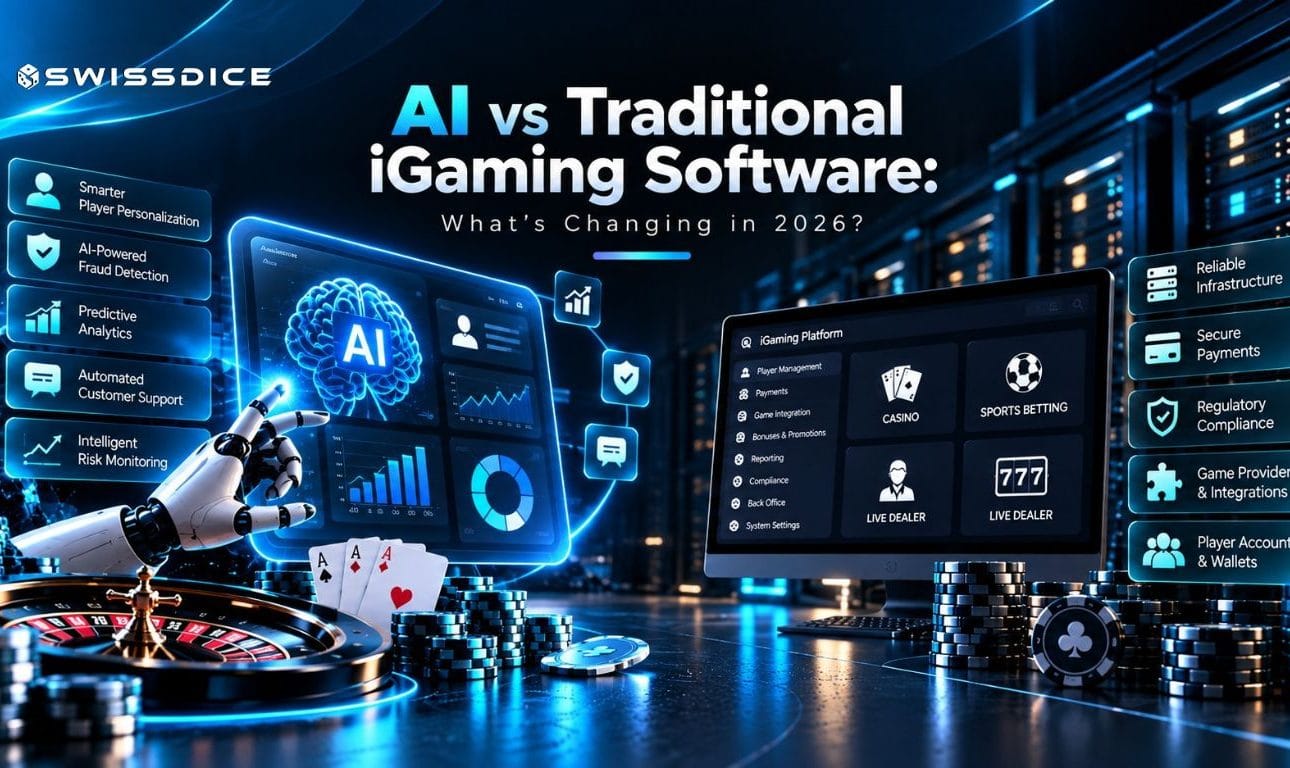
The iGaming software industry is moving from rule-based systems toward increasingly data-driven and AI-assisted platforms. In 2026, operators are using artificial intelligence for areas such as personalization, fraud detection, customer support, game recommendations, risk monitoring, and operational analytics.
Traditional iGaming software is still the foundation of most online casino and betting businesses. Player accounts, payment processing, game integrations, wallets, bonuses, reporting, compliance workflows, and back-office systems continue to depend on predictable business rules and reliable infrastructure.
The difference is not simply AI vs traditional iGaming software. The more practical shift is toward combining established iGaming infrastructure with AI capabilities where automation and data analysis can create measurable operational value.
For businesses planning an AI iGaming platform, understanding where AI adds value—and where conventional software remains essential—is critical to choosing the right technology architecture.
What Is Traditional iGaming Software?
Traditional iGaming software refers to the established technology infrastructure used to operate online casinos, sportsbooks, poker platforms, betting exchanges, and other real-money gaming products.
These systems typically rely on predefined rules, workflows, APIs, databases, and business logic.
Core components can include:
- Player Account Management (PAM)
- Casino and sportsbook modules
- Game aggregation
- Payment gateways
- Wallet management
- Bonus and promotional systems
- CRM
- KYC workflows
- Reporting and analytics
- Back-office administration
- Affiliate management
- Responsible gaming controls
- Third-party integrations
For example, a conventional bonus engine may apply a bonus according to predefined conditions:
If deposit ≥ required amount → issue bonus according to configured rules.
This approach is predictable, auditable, and relatively straightforward to test.
What Is AI-Powered iGaming Software?
AI-powered iGaming software uses artificial intelligence and machine-learning techniques to analyze data, identify patterns, generate predictions, automate decisions, or provide intelligent assistance.
Instead of relying exclusively on fixed rules, AI systems can learn from historical and real-time data.
Potential applications include:
- Player personalization
- Recommendation engines
- Fraud detection
- Risk analysis
- Churn prediction
- Customer-service automation
- Intelligent CRM
- Game recommendations
- Marketing optimization
- Anomaly detection
- Player behavior analysis
- Operational forecasting
For example, a traditional CRM system might segment players based on predefined rules.
An AI-powered CRM can analyze multiple behavioral signals and identify patterns that may not be obvious through manual segmentation.
AI vs Traditional iGaming Software: Key Differences
| Area | Traditional iGaming Software | AI-Powered iGaming Software |
| Decision-making | Rule-based | Data-driven and model-assisted |
| Personalization | Predefined segments | Dynamic recommendations |
| Fraud detection | Rules and thresholds | Pattern and anomaly detection |
| CRM | Campaign-based | Predictive and behavioral |
| Customer support | Scripted workflows | AI-assisted conversations |
| Analytics | Historical reporting | Predictive and real-time insights |
| Risk monitoring | Configured rules | Rules + behavioral models |
| Automation | Workflow automation | Intelligent automation |
| Data usage | Primarily reporting | Analysis, prediction and optimization |
| Adaptability | Changes require configuration | Models can adapt when properly trained |
This does not mean AI automatically replaces conventional software. In most practical architectures, AI operates as an additional intelligence layer on top of established systems.
Why AI Is Becoming Important in iGaming in 2026
Modern iGaming platforms generate significant amounts of operational and behavioral data.
Examples include:
- Login activity
- Game sessions
- Bets
- Deposits
- Withdrawals
- Promotions
- Customer-support interactions
- Payment behavior
- Device information
- Geographic signals
- Session patterns
Traditional analytics can summarize this information.
AI can potentially use the same data to identify patterns and generate predictions.
This makes AI particularly relevant to areas where operators need to process large datasets and respond quickly.
1. AI-Powered Player Personalization
Personalization is one of the most visible applications of AI in iGaming.
A traditional platform might recommend games using simple rules such as:
Players who played Game A also receive Game B.
An AI recommendation system can consider a broader set of signals, such as:
- Previous game activity
- Session behavior
- Game preferences
- Frequency of play
- Recent interactions
- Content engagement
- Promotion history
The system can then generate personalized recommendations.
Example
Instead of showing the same casino lobby to every player, an AI-enabled platform could dynamically prioritize relevant game categories based on observed user behavior.
Personalization should still operate within applicable responsible-gaming, privacy, and regulatory requirements.
2. AI for Fraud Detection
Fraud prevention is another area where AI can complement traditional iGaming controls.
Traditional systems commonly use rules such as:
- Multiple accounts from the same device
- Unusual transaction frequency
- Deposit limits
- IP-related checks
- Failed payment thresholds
These rules remain useful because they are transparent and easy to configure.
AI can add another layer by identifying combinations of behaviors that may indicate suspicious activity.
For example:
Account A + Account B + Account C → similar device behavior + unusual transaction timing + coordinated activity
Individually, each signal might appear normal. Combined analysis may indicate an anomaly worth investigating.
3. Predictive Player Analytics
Traditional analytics generally answers questions such as:
- How many active players did we have?
- What was the average session duration?
- Which games generated the most activity?
- How much revenue was generated?
AI-based analytics can go further by estimating future behavior.
Potential use cases include:
- Churn prediction
- Player engagement forecasting
- Deposit behavior analysis
- Campaign response prediction
- Game-demand forecasting
- Customer-support demand forecasting
For operators, the value comes from moving from:
What happened?
to:
What could happen next?
Predictions should be treated as probabilistic signals rather than guaranteed outcomes.
4. AI in Customer Support
Traditional iGaming customer support usually depends on:
- FAQs
- Knowledge bases
- Ticket systems
- Live agents
- Predefined responses
AI can provide an additional support layer.
AI assistants can potentially help users with common questions related to:
- Account navigation
- Payment status
- Game information
- Bonus terms
- Verification procedures
- Platform features
More complex or sensitive issues can be escalated to human agents.
A useful architecture is therefore:
AI Assistant → Automated Resolution → Human Escalation
rather than attempting to eliminate human support completely.
5. AI-Powered CRM
Traditional CRM systems typically depend on manually configured customer segments.
For example:
- New users
- Active users
- Inactive users
- High-value users
- Promotion users
AI-powered CRM can analyze multiple behavioral variables and dynamically identify user segments.
Potential applications include:
- Predictive segmentation
- Campaign personalization
- Churn-risk identification
- Offer optimization
- Customer journey analysis
- Engagement forecasting
However, personalization should not become a mechanism for encouraging harmful gambling behavior. Operators need appropriate responsible-gaming controls and compliance oversight.
6. AI for Game Recommendations
The size of modern casino game libraries makes discovery increasingly important.
An operator may integrate hundreds or thousands of games through aggregation platforms.
A traditional lobby might organize games according to:
- Popularity
- Release date
- Provider
- Game type
- Manual promotion
An AI recommendation engine can use behavioral data to dynamically organize content.
Potential recommendation factors include:
- Previous game preferences
- Game categories
- Session patterns
- Similar-user behavior
- Recent engagement
- Content interactions
This can make the casino lobby more responsive to individual users.
7. AI and iGaming Risk Management
Risk management can combine conventional controls with AI-based monitoring.
Traditional systems may use predetermined thresholds:
If transaction > X → trigger review.
AI can analyze multiple variables simultaneously and detect unusual combinations.
Potential signals include:
- Sudden changes in betting behavior
- Unusual transaction patterns
- Rapid account activity
- Abnormal login behavior
- Account relationships
- Unusual device patterns
The strongest approach is often a hybrid risk engine:
Rules + Machine Learning + Human Review
Rules provide deterministic controls, while AI can identify patterns that fixed rules may miss.
8. AI for Game Development
AI is also influencing how iGaming content is developed.
Development teams can use AI-assisted tools for:
- Code assistance
- Test generation
- Documentation
- Data analysis
- Game concept exploration
- Localization workflows
- QA support
- Content generation
However, production games still require professional development, mathematical validation, security testing, responsible-game design, and appropriate certification.
AI can accelerate parts of the development lifecycle, but it does not remove the need for engineering and testing expertise.
9. AI and iGaming Analytics
A traditional analytics dashboard may show:
Revenue → €X
Active players → X
Conversion rate → X%
AI-enabled analytics can help investigate why these metrics changed.
For example:
Revenue declined primarily because activity decreased within a particular player segment and game category.
This type of analysis can help teams move from reporting toward diagnosis.
For larger operators, AI can potentially support:
- Revenue forecasting
- Player segmentation
- Game performance analysis
- Campaign analysis
- Payment monitoring
- Operational forecasting
- Anomaly detection
Traditional Software Still Matters
The growing use of AI does not make traditional iGaming infrastructure obsolete.
In fact, many AI applications depend on reliable conventional systems.
A platform still needs:
- Secure authentication
- Wallet infrastructure
- Payment processing
- Transaction management
- Game APIs
- Databases
- Account management
- Compliance workflows
- Reporting
- Back-office controls
AI needs accurate data and dependable infrastructure to function effectively.
Therefore, replacing the entire platform with AI is usually less practical than adding AI capabilities to a robust iGaming technology stack.
AI vs Traditional iGaming Software: Architecture
A modern platform can be structured into several layers.
Core iGaming Layer
Handles:
- PAM
- Wallets
- Payments
- Games
- Bonuses
- CRM
- Transactions
Data Layer
Collects and processes:
- Player activity
- Transactions
- Game events
- Operational data
- Customer interactions
AI Layer
Provides:
- Recommendations
- Predictive analytics
- Fraud signals
- Churn prediction
- Intelligent segmentation
- Automated assistance
Risk & Compliance Layer
Provides:
- KYC
- AML workflows
- Responsible gaming
- Risk rules
- Monitoring
- Audit trails
Administration Layer
Provides:
- Reporting
- Configuration
- User management
- Campaign management
- Market and game controls
This architecture allows AI to complement rather than replace the platform’s core infrastructure.

Benefits of AI iGaming Platforms
An AI-enabled iGaming platform can potentially provide several operational benefits.
Better Personalization
Players can receive more relevant content and recommendations.
Faster Data Analysis
AI can process large datasets more efficiently than manual analysis.
Earlier Risk Detection
Behavioral models can identify unusual activity that may require investigation.
Operational Automation
AI can automate repetitive support and analytical tasks.
Predictive Insights
Operators can use models to estimate future trends and player behavior.
More Dynamic CRM
Customer segments can be updated based on changing behavioral signals.
Challenges of Using AI in iGaming
AI adoption also introduces new challenges.
Data Quality
Poor-quality or incomplete data can produce unreliable model outputs.
Explainability
Operators may need to understand why an AI system generated a particular recommendation or alert.
Privacy
Player data must be handled according to applicable privacy and data-protection requirements.
Model Drift
Player behavior and market conditions change. Models can become less accurate if they are not monitored and updated.
Bias
Training data can contain patterns that produce unintended biases.
Security
AI systems introduce additional attack surfaces and require appropriate security controls.
Regulatory Requirements
The use of AI in regulated environments needs to align with applicable legal and compliance requirements.
For these reasons, AI implementation should include model governance, monitoring, testing, access controls, data governance, and human oversight.
How to Integrate AI Into an Existing iGaming Platform
Operators do not necessarily need to rebuild their entire platform.
A phased approach can be more practical.
Step 1: Identify the Business Problem
Start with a specific use case:
- Fraud detection
- Customer support
- Personalization
- Churn analysis
- Analytics
Step 2: Audit Available Data
Review:
- Data quality
- Data availability
- Data structure
- Historical records
- Real-time data
Step 3: Build the AI Integration Layer
Connect AI services with existing platform APIs and data infrastructure.
Step 4: Test the Model
Evaluate:
- Accuracy
- False positives
- False negatives
- Latency
- Stability
Step 5: Add Human Oversight
High-impact decisions should have appropriate review and escalation processes.
Step 6: Monitor Performance
Track model performance continuously and retrain or recalibrate where necessary.
AI vs Traditional iGaming Software: Cost Considerations
AI can introduce additional costs beyond conventional platform development.
Potential expenses include:
- Data infrastructure
- AI model development
- Cloud computing
- API usage
- Model monitoring
- Data engineering
- Security
- Integration
- Testing
- Maintenance
Traditional software may have more predictable infrastructure costs, while AI systems can introduce variable usage costs depending on architecture and workload.
The right choice depends on the business problem rather than simply choosing the newest technology.
What Will Change in iGaming Software in 2026?
Several areas are likely to continue evolving as AI becomes more integrated into iGaming technology.
From Static to Dynamic Experiences
Interfaces and recommendations can increasingly respond to individual user behavior.
From Reporting to Prediction
Analytics systems are moving beyond historical dashboards toward forecasting and anomaly detection.
From Rule-Only to Hybrid Risk Systems
Traditional rules can be combined with machine-learning signals.
From Manual to AI-Assisted Operations
Support, analytics, monitoring, and content workflows can increasingly include AI assistance.
From Standalone Tools to AI-Enabled Platforms
Rather than operating AI as a separate product, operators can integrate AI directly into their existing platform architecture.
AI iGaming Software vs Traditional Software: Which Approach Should Operators Use?
There is no single architecture that fits every iGaming business.
A startup launching a focused product may prioritize a reliable core platform and add selected AI functionality later.
An established operator with significant historical data may have more opportunities to deploy AI across personalization, CRM, fraud monitoring, and analytics.
The decision should consider:
- Business objectives
- Available data
- Platform architecture
- Regulatory requirements
- Development resources
- Integration complexity
- Expected ROI
- Security requirements
- Operational maturity
In many cases, a hybrid iGaming architecture provides a practical path: conventional software handles deterministic transactions and core gaming operations, while AI adds intelligence to areas where prediction, classification, recommendation, or automation can provide value.
How SwissDice Supports AI-Ready iGaming Development
SwissDice works with businesses developing iGaming technology, casino platforms, gaming products, integrations, and supporting infrastructure.
An AI-ready iGaming architecture can be designed around existing business requirements while leaving room for future AI capabilities.
Potential components include:
- iGaming platform development
- Casino software development
- Game API integration
- Payment integration
- PAM and wallet integration
- CRM and bonus systems
- Risk-management functionality
- Analytics infrastructure
- Custom software development
- Third-party integrations
- Back-office development
- Technical support
For businesses exploring AI, the focus should be on identifying specific operational or product problems where intelligent automation can produce measurable value, rather than adding AI simply because it is a current technology trend.
The Future of AI in iGaming Software
AI is likely to become increasingly embedded in iGaming platforms, but traditional software will remain essential.
The future is more likely to look like:
Core Platform + Data Infrastructure + AI Intelligence + Risk & Compliance
rather than:
Traditional Software → Completely Replaced by AI
The core platform will continue managing transactions, accounts, payments, games, and business rules. AI will increasingly support personalization, prediction, detection, automation, and analytics.
For operators, the key question is therefore not whether AI will replace traditional iGaming software. It is where AI can be integrated safely and effectively into an existing iGaming technology ecosystem.
Conclusion
The comparison between AI vs traditional iGaming software is becoming less about choosing one technology over another and more about creating the right combination.
Traditional iGaming software provides the dependable foundation required for player management, payments, games, transactions, compliance, and administration. AI adds another layer that can help analyze complex data, personalize experiences, identify anomalies, automate support, and generate predictive insights.
In 2026, businesses planning an AI iGaming platform should prioritize a scalable architecture, high-quality data, strong security, responsible-use controls, and clearly defined AI use cases.
For operators and gaming businesses, the strongest long-term approach is likely to be an AI-enabled iGaming ecosystem built on reliable traditional infrastructure—with AI introduced where it solves a real business problem and produces measurable value.
1. What is the difference between AI and traditional iGaming software?
Traditional iGaming software primarily uses predefined rules, workflows, APIs, and business logic to manage gaming operations. AI-powered iGaming software adds machine learning and intelligent automation for areas such as personalization, fraud detection, predictive analytics, recommendations, and customer support.
2. How is AI changing iGaming software in 2026?
AI is increasingly being integrated into player personalization, risk monitoring, fraud detection, CRM, customer support, game recommendations, analytics, and operational forecasting. The main shift is toward combining AI capabilities with established iGaming infrastructure.
3. Can AI replace traditional iGaming software?
AI is unlikely to replace the core functions of traditional iGaming software. Platforms still require reliable systems for payments, wallets, player accounts, games, transactions, compliance, and back-office management. AI generally works as an additional intelligence layer.
4. What are the benefits of AI-powered iGaming software?
AI can support personalized player experiences, automated customer support, predictive analytics, anomaly detection, fraud monitoring, dynamic segmentation, and more data-driven decision-making.
5. How is AI used for fraud detection in iGaming?
AI can analyze multiple behavioral and transactional signals to identify unusual patterns. It can complement traditional rules by detecting anomalies that may not be captured through fixed thresholds alone.
6. Can AI personalize an online casino experience?
Yes. AI recommendation systems can analyze factors such as game preferences, previous activity, session behavior, and content interactions to help personalize game recommendations and casino-lobby experiences.
7. Is traditional iGaming software still important in 2026?
Yes. Core platform components such as PAM, wallets, payment processing, game integrations, transaction management, compliance workflows, and reporting remain fundamental to iGaming operations.
8. What is an AI-ready iGaming platform?
An AI-ready iGaming platform has a reliable core infrastructure, structured data, APIs, analytics capabilities, and integration points that allow AI models and services to be added for use cases such as personalization, risk monitoring, prediction, and automation.
9. How much does AI iGaming software development cost?
The cost varies according to platform complexity, AI use cases, integrations, data infrastructure, security requirements, development scope, and regulatory requirements. A simple AI feature requires significantly different resources from a complete AI-enabled iGaming platform.
10. How can SwissDice help with AI iGaming software development?
SwissDice can support businesses with iGaming platform development, custom software development, game and payment integrations, PAM and wallet functionality, analytics infrastructure, risk-management features, and other components required to build an AI-ready iGaming ecosystem.