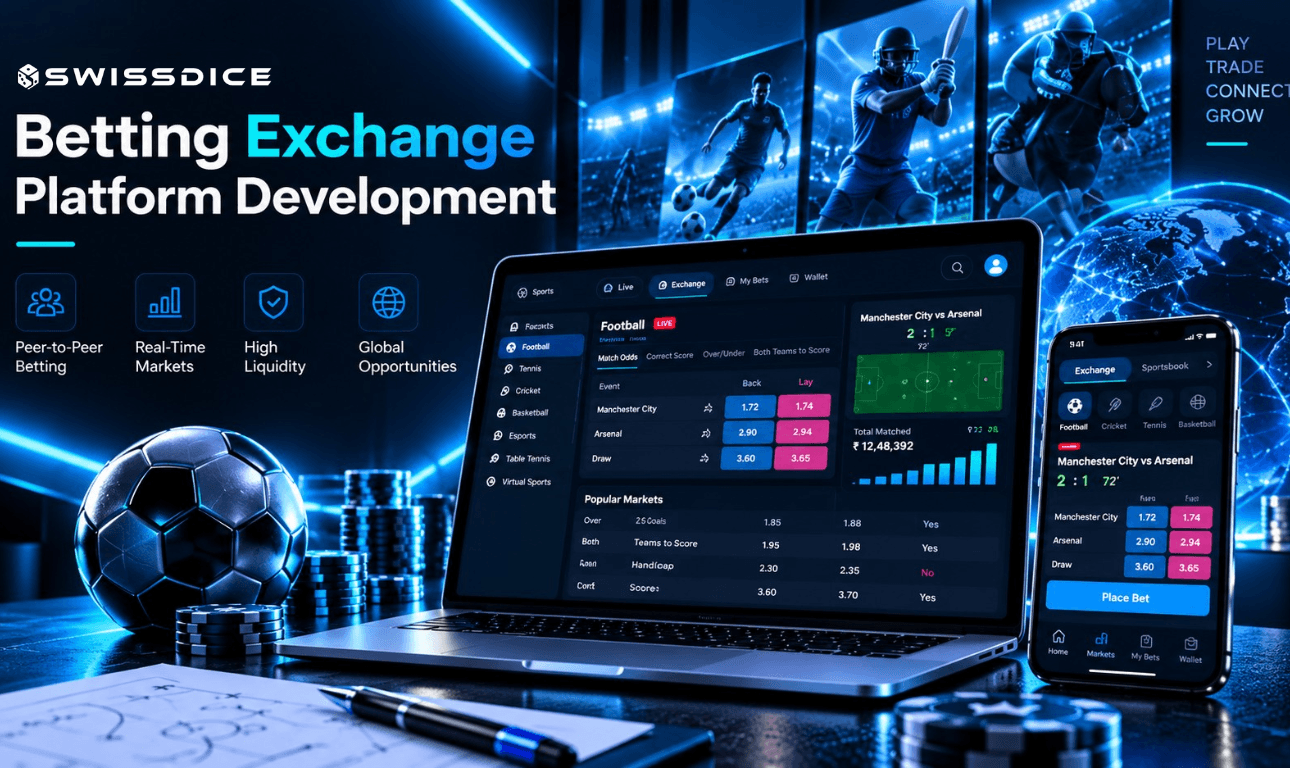
Betting exchange platform development is the process of building a digital betting marketplace where users can bet against each other rather than placing every wager directly against a traditional bookmaker. The platform facilitates the marketplace, matches compatible bets, manages odds and liquidity, processes transactions, settles markets, and provides operators with tools for risk, compliance, reporting, and administration.
Unlike conventional sportsbook software, a betting exchange platform requires a matching engine capable of processing back and lay bets in real time. It also needs market and odds management, liquidity controls, wallet integration, settlement logic, live betting infrastructure, data feeds, fraud prevention, and scalable backend architecture.
For operators, sportsbooks, gaming startups, and technology businesses, developing a betting exchange can create a differentiated betting product. However, the complexity is substantially higher than building a basic sportsbook because the platform must manage both sides of a marketplace and maintain accurate synchronization between users, markets, odds, balances, and settlements.
This guide covers how betting exchange platforms work, their business models, key features, technology architecture, development process, costs, security, compliance, and how to choose a betting exchange software development company.
What Is a Betting Exchange Platform?
A betting exchange platform is a peer-to-peer betting marketplace that enables users to offer and accept bets against other participants.
The two fundamental positions are:
- Back — betting that an outcome will happen.
- Lay — betting that an outcome will not happen.
For example, imagine a football match between Team A and Team B.
A user may:
Back Team A at 2.50
Another user may:
Lay Team A at 2.50
When the platform matches compatible orders, the exchange facilitates the transaction between the two users.
The platform itself may generate revenue through commissions, transaction fees, premium services, or other permitted commercial models rather than relying exclusively on a traditional sportsbook margin.
The exact business and regulatory model varies by jurisdiction.
How Does a Betting Exchange Work?
A betting exchange operates similarly to a marketplace, but the traded product is a betting position associated with a defined event and outcome.
The basic workflow is:
Event → Market → Odds → Back/Lay Orders → Matching → Bet Confirmation → Settlement
1. Event Creation
The platform receives or creates an event, such as:
- Football match
- Tennis match
- Horse race
- Cricket match
- Esports competition
2. Market Creation
Different markets are created around the event.
For a football match, examples could include:
- Match winner
- Both teams to score
- Over/under goals
- Correct score
- First goalscorer
3. Users Submit Orders
Users select an outcome and submit either a back or lay position.
4. Matching Engine Finds Compatible Orders
The platform searches the order book for compatible orders.
When the relevant conditions are met, the system matches the orders.
5. Funds Are Reserved
The platform verifies available balances and reserves the required funds according to the applicable betting rules.
6. Event Takes Place
The platform receives event updates through appropriate data feeds.
7. Market Is Suspended or Closed
When the relevant event occurs or the market reaches its settlement condition, betting may be suspended or closed.
8. Market Is Settled
The platform determines the winning outcome and settles matched positions.
9. Balances Are Updated
The wallet records are updated and users can view the applicable transaction and settlement history.
Betting Exchange vs Traditional Sportsbook
A betting exchange and traditional sportsbook serve similar consumer needs but use different marketplace mechanics.
| Feature | Betting Exchange | Traditional Sportsbook |
| Counterparty | Usually another user | Operator/bookmaker |
| Core mechanism | Back/lay matching | Operator-set odds |
| Liquidity | User-driven | Operator-managed |
| Matching engine | Essential | Not normally central |
| Order book | Core feature | Usually absent |
| Commission | Common model | Margin built into odds |
| Risk exposure | Marketplace + liquidity management | Primarily operator exposure |
| Odds | Driven by available orders/market | Primarily bookmaker-managed |
| Live betting | Possible | Common |
| Market depth | Important | Less central |
This distinction is important when selecting a technology architecture.
A sportsbook platform can focus heavily on odds feeds, trading, risk, and bet acceptance. A betting exchange must additionally solve the marketplace and order-matching problem.
Key Features of a Betting Exchange Platform
A successful betting exchange needs features for both users and operators.
Back and Lay Betting
Back and lay functionality is the foundation of the exchange.
Users should be able to:
- Select an outcome
- Choose back or lay
- Enter odds
- Enter stake
- View potential liability
- Submit an order
- Cancel an unmatched order
- Track matched bets
The interface should clearly distinguish between the two positions.
Real-Time Odds
Odds and available liquidity need to update quickly.
The platform should communicate changes in:
- Available odds
- Available stake
- Matched volume
- Market status
- Order status
Real-time synchronization becomes particularly important during live events.
Order Book
The order book displays available back and lay positions.
A simplified example might look like:
| Position | Odds | Available |
| Back | 2.10 | $500 |
| Back | 2.08 | $350 |
| Lay | 2.12 | $450 |
| Lay | 2.14 | $600 |
Actual interfaces can display multiple price levels and liquidity amounts.
Matching Engine
The betting exchange matching engine is the core technical component.
It must:
- Receive orders
- Validate orders
- Check balances
- Compare compatible positions
- Match orders
- Partially match orders when applicable
- Update remaining liquidity
- Confirm transactions
- Maintain order state
- Handle cancellations
- Maintain consistency under high concurrency
The engine should be designed for low latency and deterministic processing.
Partial Matching
An order does not necessarily have to be matched completely.
For example:
A user submits a $1,000 order.
Only $600 may be available at the desired odds.
The system can match $600 and leave the remaining $400 open, subject to the platform’s rules.
Bet Slip
The bet slip should provide a clear summary of:
- Event
- Market
- Selection
- Bet type
- Odds
- Stake
- Potential return
- Liability
- Commission
- Order status
Live Betting
A modern exchange may support in-play betting for eligible events.
Live betting requires:
- Low-latency data feeds
- Rapid market updates
- Market suspension
- Event-state management
- Odds updates
- Connection handling
- Settlement controls
The platform must be designed carefully because even small delays can create material differences between displayed and actual market conditions.
Market Suspension
Markets should be capable of being suspended when required.
Examples include:
- Goal scored
- Red card
- Penalty
- Match interruption
- Race start
- Material event
- Data-feed issue
Suspension rules depend on the market and sport.
Bet History
Users should be able to view:
- Open bets
- Matched bets
- Unmatched orders
- Settled bets
- Cancelled orders
- Win/loss history
- Transaction history
Wallet Management
The exchange requires reliable wallet functionality.
It can support:
- Deposits
- Withdrawals
- Available balance
- Exposure
- Reserved funds
- Winnings
- Transaction history
- Currency conversion where applicable
The wallet should be integrated with the broader player account and payment architecture.
Advanced Features for Betting Exchange Software
Beyond the core exchange mechanics, operators can add features that improve usability and operational efficiency.
Cash Out
Cash-out functionality allows eligible positions to be closed before market settlement.
The system calculates the applicable cash-out value using current market conditions and platform rules.
Automated Trading
Some exchange models may support automated betting or trading through APIs.
Potential functionality includes:
- Automated order placement
- Order monitoring
- Market-data APIs
- Trading strategies
- API authentication
- Rate limits
Automated betting features should be reviewed against the applicable legal and platform requirements.
Multi-Sport Support
A scalable exchange can support multiple sports, such as:
- Football
- Cricket
- Tennis
- Basketball
- Horse racing
- Esports
- Motor racing
Each sport requires its own event, market, settlement, and data-feed logic.
Multi-Market Support
A single event can contain many markets.
For example, a football match can include:
- Match winner
- Over/under
- Both teams to score
- Correct score
- Handicap
- Corners
- Cards
Multi-Currency Support
International platforms may support multiple currencies where permitted.
The wallet architecture should maintain accurate balances and transaction records for each supported currency.
Notifications
Users can receive notifications for:
- Bet matched
- Bet partially matched
- Order cancelled
- Market suspended
- Market reopened
- Event started
- Bet settled
- Cash-out availability
Leaderboards and Promotions
Operators can introduce:
- Trading competitions
- Loyalty programs
- Promotional campaigns
- User rankings
- Cashback mechanisms
Promotional mechanics should comply with the target jurisdiction’s advertising and gambling requirements.
Betting Exchange Platform Technology Architecture
A robust architecture separates critical responsibilities rather than putting all functionality into a single application.
A typical architecture may include:
Frontend → API Gateway → Exchange Services → Matching Engine → Wallet/PAM → Database
Alongside these services:
Data Feeds → Market Management → Risk Engine → Settlement → Reporting
Frontend Layer
The frontend can be built using technologies such as:
- React
- Next.js
- Vue
- Angular
- TypeScript
- HTML5/CSS
The interface should support real-time updates without requiring users to repeatedly refresh the page.
API Gateway
An API gateway can manage communication between clients and backend services.
It can provide:
- Authentication
- Authorization
- Rate limiting
- Request validation
- Routing
- Monitoring
Matching Engine
The matching engine is the heart of the exchange.
It should be designed to process large numbers of concurrent orders while maintaining transaction consistency.
Important considerations include:
- Low latency
- Concurrency
- Order priority
- Partial matching
- Atomic operations
- Failure recovery
- Auditability
Market Management Service
This service can manage:
- Events
- Markets
- Selections
- Market status
- Rules
- Suspension
- Settlement conditions
Odds and Data Feed Integration
Sports data providers can supply:
- Fixtures
- Scores
- Statistics
- Match status
- Events
- Results
The platform may require multiple data sources depending on the markets and jurisdictions it supports.
Risk Management Engine
The risk engine can monitor:
- User exposure
- Market exposure
- Liability
- Betting limits
- Suspicious activity
- Abnormal patterns
For an exchange, risk management is not limited to traditional bookmaker liability because liquidity and counterparty availability are also important.
Wallet and PAM
The player account management system can handle:
- Registration
- Authentication
- Player profiles
- Limits
- Account status
- Wallet
- Transaction history
Database Layer
Depending on the architecture, the platform may use relational databases, NoSQL technologies, caching systems, event streams, and analytics databases.
The database design must support both transactional consistency and high-volume reporting.
Real-Time Layer
Technologies such as WebSockets can be used for real-time:
- Odds
- Order-book changes
- Bet matching
- Market status
- Live events
- Notifications
Betting Exchange Matching Engine: Why It Matters
The matching engine deserves special attention because it differentiates an exchange from a conventional sportsbook.
A simplified matching process is:
- Receive a back or lay order.
- Validate the user and market.
- Check available funds or liability.
- Check market status.
- Compare the order against available opposing orders.
- Match compatible positions.
- Calculate matched amounts.
- Update remaining orders.
- Reserve or release applicable funds.
- Record the transaction.
- Notify connected clients.
The engine must prevent issues such as:
- Duplicate matching
- Double settlement
- Negative balances
- Stale orders
- Race conditions
- Incorrect exposure
- Inconsistent order books
This is why a betting exchange requires specialized engineering rather than simply adding a “back/lay” interface to a sportsbook.
Liquidity Management in a Betting Exchange
Liquidity is one of the most important business and technology considerations for an exchange.
If there are not enough opposing orders, users may struggle to get their desired bets matched.
Operators can address liquidity through strategies such as:
- Market-maker participation
- Liquidity partnerships
- Cross-market liquidity
- Incentive programs
- Strategic event selection
- Automated liquidity mechanisms where permitted
The available approach depends on the platform’s business model and regulatory environment.
Technology should provide visibility into:
- Market depth
- Matched volume
- Unmatched volume
- Available liquidity
- Exposure
- Price levels
Betting Exchange Business Model
The business model determines how the operator monetizes the platform.
Commission-Based Model
One common model is charging a commission on applicable winnings or matched activity.
For example, the platform could apply a configurable percentage according to its commercial rules.
The actual commission structure depends on the business model and market.
Transaction Fees
The platform may apply transaction-related fees where permitted.
Premium Features
Potential premium services can include:
- Advanced analytics
- Trading tools
- API access
- Enhanced reporting
- Professional accounts
These features must be evaluated against applicable gambling regulations and consumer-protection requirements.
B2B Exchange Technology
Instead of operating the exchange directly, a technology provider can license or provide exchange infrastructure to operators.
The provider can monetize through:
- Platform licensing
- Setup fees
- Integration fees
- Recurring technology fees
- Support contracts
- Custom development
The appropriate model depends on the commercial relationship and licensing structure.
Betting Exchange Revenue Model vs Sportsbook Revenue Model
A betting exchange can have a fundamentally different revenue structure from a sportsbook.
A sportsbook generally builds an operator margin into its odds.
An exchange can instead facilitate transactions between users and charge a commission or another permitted fee.
This can make the platform more marketplace-oriented, but it also creates a dependency on:
- Liquidity
- Market participation
- Matching efficiency
- Market depth
- User acquisition
- Data quality
Therefore, technology alone cannot solve an exchange’s liquidity challenge. Product design and marketplace strategy are equally important. 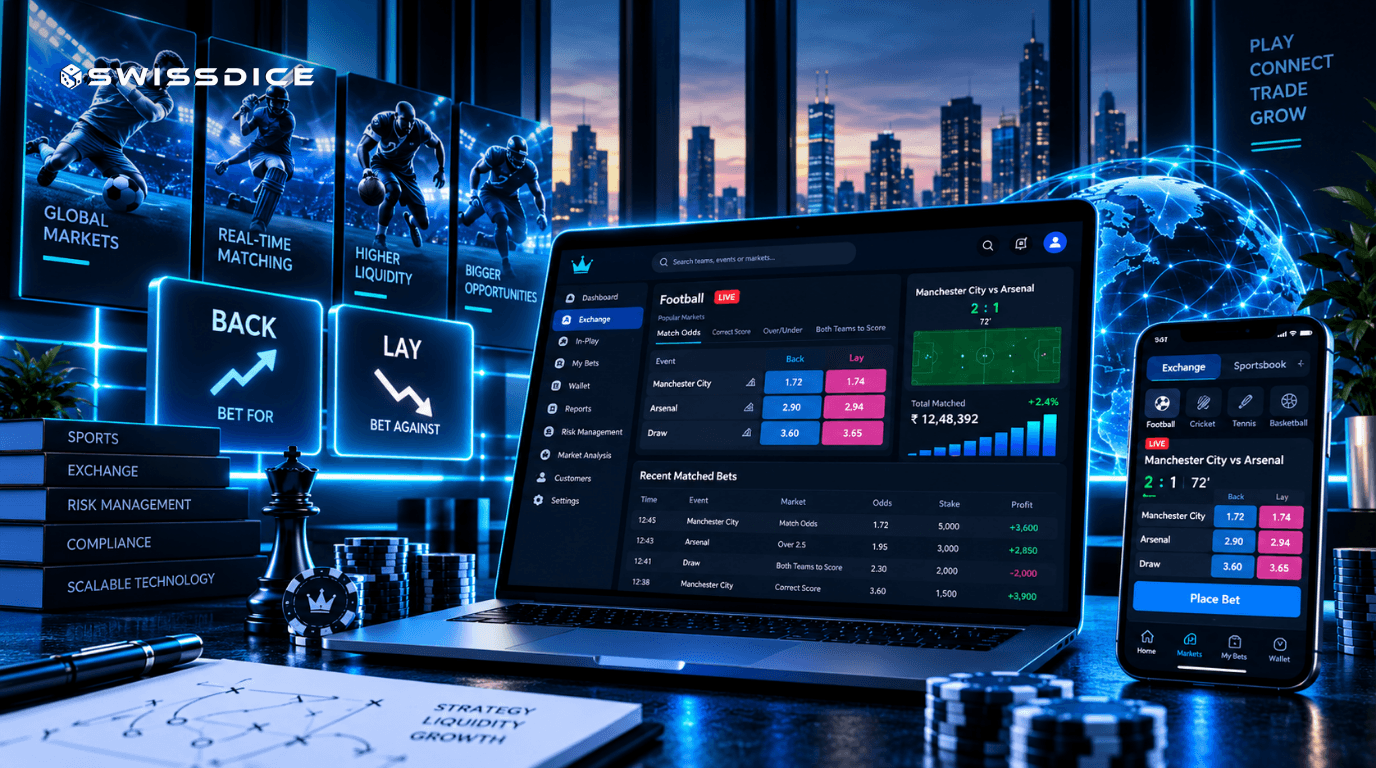
Security Requirements for Betting Exchange Development
Security is critical because betting exchanges process user accounts, financial transactions, sensitive data, and high-frequency betting activity.
Important areas include:
Authentication and Authorization
Use strong authentication mechanisms and role-based permissions.
Transaction Security
Every financial transaction should have:
- Unique transaction IDs
- Reliable status tracking
- Audit records
- Reconciliation
- Failure handling
API Security
APIs should be protected using appropriate:
- Authentication
- Authorization
- Input validation
- Rate limiting
- Encryption
- Monitoring
Data Protection
Sensitive information should be protected through appropriate encryption, access controls, secure storage, and retention policies.
Fraud Detection
The platform may need controls for:
- Account takeover
- Multiple-account abuse
- Payment fraud
- Bonus abuse
- Suspicious betting behavior
- Automated attacks
- Collusion indicators
DDoS and Infrastructure Protection
Because exchanges rely heavily on real-time availability, infrastructure should include suitable resilience and traffic protection.
Compliance and Responsible Gambling
A betting exchange cannot be treated as a purely technical product.
Legal and regulatory requirements vary by jurisdiction, and operators should obtain qualified legal advice before launching.
Depending on the market, compliance considerations may include:
- Gambling licensing
- KYC
- AML controls
- Age verification
- Player verification
- Responsible gambling
- Self-exclusion
- Deposit or wagering limits
- Transaction monitoring
- Data protection
- Advertising restrictions
- Technical standards
- Sports integrity requirements
- Reporting obligations
The platform architecture should make these controls configurable rather than hard-coded for only one market.
Responsible Gambling Features
A responsible betting exchange can provide tools such as:
- Deposit limits
- Wagering limits
- Loss limits
- Session limits
- Reality checks
- Self-exclusion
- Cooling-off periods
- Player activity statements
The exact requirements depend on the applicable jurisdiction.
How to Develop a Betting Exchange Platform
A structured development process reduces technical and commercial risk.
Step 1: Define the Business Model
Before writing code, determine:
- Target market
- Customer type
- Sports
- Betting markets
- B2C or B2B model
- Revenue model
- Liquidity strategy
- Deployment model
- Licensing requirements
Step 2: Define Exchange Mechanics
Document:
- Back betting
- Lay betting
- Odds format
- Matching rules
- Partial matching
- Order cancellation
- Market suspension
- Settlement
- Commission
Step 3: Design the Architecture
Create the technical architecture for:
- Frontend
- API
- Matching engine
- Market management
- Wallet
- PAM
- Data feeds
- Risk engine
- Settlement
- Reporting
- Administration
Step 4: Build the Matching Engine
Develop and test the exchange’s order-matching infrastructure.
This is one of the most technically sensitive stages.
Step 5: Integrate Data Feeds
Connect appropriate sports/event data providers and map their event structures into the platform.
Step 6: Build Wallet and Payment Integrations
Integrate the platform with payment gateways and wallet services appropriate to the target market.
Step 7: Develop the User Interface
Create the exchange interface, including:
- Sports navigation
- Event pages
- Market lists
- Order book
- Bet slip
- Open bets
- Account
- Wallet
- History
Step 8: Build the Admin Panel
Administrators need tools for:
- Event management
- Market management
- User management
- Risk controls
- Liquidity monitoring
- Settlement
- Reports
- Payments
- Compliance
- Audit logs
Step 9: Test the Platform
Testing should include:
- Functional testing
- API testing
- Matching-engine testing
- Load testing
- Stress testing
- Security testing
- Wallet testing
- Settlement testing
- Data-feed testing
- Mobile testing
- Failure-recovery testing
Step 10: Compliance and Certification
The platform should undergo applicable technical and regulatory assessments before launch.
Step 11: Deployment
The final system can be deployed using appropriate cloud or dedicated infrastructure.
A production environment should include monitoring, backups, logging, scaling, and disaster-recovery processes.
Betting Exchange Platform Development Cost
The betting exchange platform development cost varies substantially according to the scope of the product.
A basic exchange interface connected to existing services is very different from a proprietary exchange with its own matching engine, data infrastructure, wallet, risk engine, mobile applications, and multi-market support.
| Component | Relative Cost Impact |
| UI/UX design | Medium |
| Betting exchange frontend | Medium |
| Matching engine | Very High |
| Market management | High |
| Sports data integration | High |
| Wallet/PAM | High |
| Risk management | High |
| Live betting | High |
| Admin panel | Medium |
| Reporting & analytics | Medium |
| Mobile applications | High |
| Security infrastructure | High |
| Compliance implementation | Market-dependent |
| DevOps & cloud infrastructure | Medium–High |
| Ongoing maintenance | Recurring |
Development Timeline
A basic exchange MVP can potentially be developed within a few months.
A full-scale commercial betting exchange with proprietary matching technology, multiple sports, live betting, advanced risk management, payment integrations, mobile applications, compliance requirements, and extensive testing can take significantly longer.
A realistic estimate should be prepared only after the product scope and target markets are defined.
White Label vs Custom Betting Exchange Development
Businesses can generally consider three approaches:
White Label Betting Exchange
A pre-built exchange can provide faster market entry.
Advantages:
- Faster deployment
- Lower initial development effort
- Existing infrastructure
- Pre-built features
- Standard integrations
Potential limitations include:
- Lower customization
- Vendor dependency
- Limited control over architecture
- Less differentiation
Custom Betting Exchange Development
A custom solution provides greater control over:
- Matching engine
- User experience
- Business rules
- Risk architecture
- Integrations
- Reporting
- Branding
- Scalability
It generally requires greater investment and a longer development cycle.
Hybrid Approach
A hybrid model can combine pre-built infrastructure with custom development.
For example:
Existing exchange infrastructure + custom frontend + proprietary integrations + custom reporting
This can be useful for businesses that want faster deployment without completely sacrificing customization.
How to Choose a Betting Exchange Software Development Company
Choosing the right technology partner requires more than comparing development prices.
Exchange Development Experience
Check whether the provider has experience with:
- Betting exchanges
- Sportsbook systems
- Real-money gaming
- Matching engines
- Wallet systems
- Live betting
Technical Expertise
Evaluate expertise in:
- Real-time architecture
- Distributed systems
- APIs
- Databases
- Cloud infrastructure
- Security
- DevOps
Data Feed Experience
Sports and event data integrations can be complex. Ask which data providers and data formats the development team has worked with.
Financial Transaction Experience
The provider should understand:
- Wallet architecture
- Transaction processing
- Reconciliation
- Settlement
- Payment integrations
Compliance Awareness
A provider should understand that regulatory requirements differ between markets and should be able to implement configurable compliance controls.
Post-Launch Support
Look for support covering:
- Bug fixes
- Infrastructure
- Security
- Monitoring
- Performance optimization
- Third-party integrations
- New market features
Why SwissDice for Betting Exchange Platform Development?
SwissDice provides betting exchange platform development services for businesses building or expanding real-money betting products.
Its development capabilities can cover the exchange lifecycle, including product planning, UI/UX, backend engineering, real-time infrastructure, betting logic, API integrations, wallet connectivity, reporting, testing, deployment, and ongoing technical support.
Depending on project requirements, SwissDice can support:
- Custom betting exchange development
- Betting exchange software
- Back and lay betting
- Matching-engine development
- Real-time odds integration
- Sports data-feed integration
- Live betting infrastructure
- Wallet and PAM integration
- Payment gateway integration
- Risk-management functionality
- Admin dashboard development
- Reporting and analytics
- Mobile-responsive betting interfaces
- API and third-party integrations
For operators that already have an iGaming platform, the exchange can be integrated into the existing ecosystem.
For businesses launching a new betting product, exchange technology can also be combined with sportsbook software, casino products, payment infrastructure, game aggregation, and other iGaming services.
Future of Betting Exchange Platform Development
Betting exchanges are likely to continue evolving alongside broader changes in sports betting technology.
Several areas deserve attention.
Real-Time and Micro Betting
Faster event data and real-time processing can support increasingly granular markets where permitted.
AI-Assisted Risk Management
AI and machine learning can potentially assist with:
- Anomaly detection
- Fraud detection
- Player segmentation
- Risk monitoring
- Market analysis
These systems should complement rather than replace appropriate human oversight and regulatory controls.
Automated Trading APIs
Advanced users may increasingly expect programmatic access to market data and order functionality where permitted.
Mobile-First Betting
Mobile interfaces will remain an important channel for exchange users.
Cross-Product Integration
Operators may combine exchange functionality with:
- Sportsbook
- Casino
- Prediction markets
- Loyalty
- Payments
- Affiliate systems
This can create a broader player ecosystem.
Frequently Asked Questions
What is betting exchange platform development?
Betting exchange platform development is the process of building a peer-to-peer betting marketplace where users can place back and lay bets, match orders, manage positions, and settle bets through a centralized technology platform.
How much does it cost to develop a betting exchange platform?
The cost depends on the matching engine, sports and markets supported, data feeds, wallet and payment integrations, live betting, risk management, mobile applications, compliance requirements, security, and deployment architecture.
How long does it take to develop a betting exchange?
An MVP can potentially take a few months, while a full-scale commercial platform can require considerably longer. The actual timeline depends on functionality, integrations, testing, and regulatory requirements.
What is a matching engine in a betting exchange?
A matching engine is the backend system that compares compatible back and lay orders and executes matches according to the platform’s matching rules.
What is liquidity in a betting exchange?
Liquidity refers to the amount of available betting interest that can be matched at particular odds. Strong liquidity generally makes it easier for users to match their desired positions.
Can a betting exchange support live betting?
Yes. A betting exchange can support in-play betting when appropriate live data feeds, market suspension rules, real-time communication, and settlement systems are implemented.
What is the difference between back and lay betting?
A back bet takes a position that an outcome will happen, while a lay bet takes a position against that outcome.
Can a betting exchange support multiple sports?
Yes. The platform can be designed to support multiple sports and market types, provided the necessary data, market rules, and settlement logic are implemented.
Can I integrate a betting exchange with an existing sportsbook?
Yes. Exchange functionality can be integrated with an existing sportsbook or broader iGaming platform, subject to the architecture and APIs available.
Can betting exchange software support cryptocurrency?
It can be technically designed to integrate with crypto-enabled wallets and payment infrastructure where cryptocurrency betting is legally permitted. The implementation must account for applicable licensing, AML/KYC, transaction-monitoring, and payment requirements.
Is a betting exchange legal?
Legality depends on the jurisdiction, licensing framework, operator structure, sports betting regulations, and applicable consumer-protection requirements. Businesses should obtain qualified legal and regulatory advice before launching.
Conclusion
Betting exchange platform development involves building much more than a conventional sportsbook interface. The platform must operate as a real-time marketplace capable of handling back and lay orders, matching compatible positions, managing liquidity, processing financial transactions, updating live markets, and settling outcomes accurately.
The most technically important components include the matching engine, market management system, real-time communication layer, data-feed integrations, wallet/PAM, risk engine, settlement system, and administrative infrastructure.
From a business perspective, liquidity, user acquisition, market coverage, regulatory compliance, and the revenue model are just as important as the technology.
For businesses entering the market, the right development approach may be custom betting exchange development, white-label exchange software, or a hybrid model. The decision should be based on the desired level of customization, budget, launch timeline, target jurisdictions, and long-term product strategy.
A strong development partner should therefore bring together exchange-specific engineering, real-money gaming experience, integration capabilities, security practices, testing expertise, and an understanding of jurisdiction-specific compliance.
For operators looking to build a differentiated betting product, a well-engineered betting exchange can become an important component of a broader iGaming ecosystem.