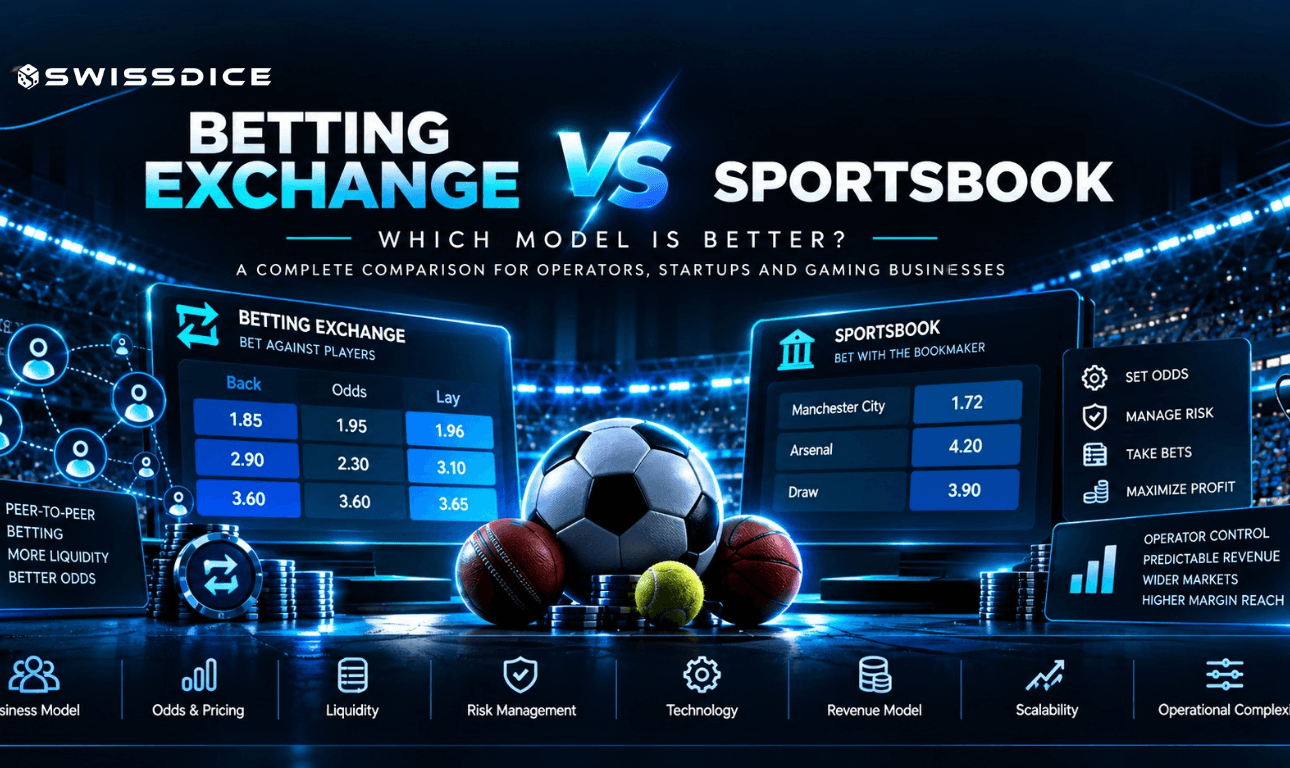
Choosing between a betting exchange and sportsbook is an important decision for any business entering the online betting market.
Both models let users bet on sports. However, they work in very different ways.
A sportsbook takes bets directly from customers. It sets the odds, manages betting risk, and pays winning bets.
A betting exchange works more like a marketplace. Users can bet against other users. The platform matches back and lay bets and manages the transaction.
So, which model is better?
There is no single answer. The right choice depends on your target audience, business model, budget, liquidity strategy, technology requirements, and target market.
This guide explains the main differences between a betting exchange vs sportsbook, including features, odds, liquidity, technology, revenue models, development costs, and business requirements.
What Is a Sportsbook?
A sportsbook is an online betting platform where users place wagers on sporting events according to odds offered by the operator or its technology/trading providers.
Common sportsbook markets include:
- Match winner
- Moneyline
- Handicap
- Over/under
- Correct score
- Both teams to score
- Player performance
- First goalscorer
- Live betting markets
The operator manages the relationship with the customer and takes responsibility for pricing, risk, settlement, and applicable regulatory controls.
A modern online sportsbook platform can also include:
- Player Account Management
- Wallet
- Payment gateway integration
- Sports data feeds
- Odds feeds
- Risk management
- Live betting
- Bet builder
- Cash out
- Bonuses
- CRM
- Affiliate management
- Reporting and analytics
- Fraud prevention
- Responsible-gambling tools
What Is a Betting Exchange?
A betting exchange is a peer-to-peer betting marketplace.
Instead of the operator acting as the direct counterparty to every wager, users can take opposing positions against other users.
The two primary betting positions are:
Back Betting
A back bet means taking a position that an outcome will happen.
For example:
Back Team A at 2.50
If Team A wins, the user receives the applicable return based on the stake and odds.
Lay Betting
A lay bet means taking a position against an outcome.
For example:
Lay Team A at 2.50
The user is effectively taking the opposing side of a back position.
The platform’s betting exchange matching engine attempts to match compatible orders.
This makes liquidity one of the most important factors in exchange-based betting.
Betting Exchange vs Sportsbook: How They Work
The fundamental difference is the relationship between the operator and the bettor.
How a Sportsbook Works
The basic sportsbook workflow is:
Event → Odds → Bet Placement → Risk Validation → Bet Acceptance → Event → Settlement
The operator or sportsbook technology determines the available odds and accepts eligible wagers.
The operator manages its exposure based on the amount and type of bets being placed.
How a Betting Exchange Works
The exchange workflow is:
Event → Market → Back/Lay Orders → Matching → Bet Confirmation → Event → Settlement
Users submit orders.
The matching engine searches for compatible opposing positions.
When compatible orders are found, they are matched according to the exchange’s rules.
This creates a fundamental difference in technology architecture.
A sportsbook primarily needs strong odds, trading, risk, wallet, and settlement infrastructure.
An exchange additionally requires a sophisticated order-matching and liquidity system.
Betting Exchange vs Sportsbook: Key Differences
| Factor | Betting Exchange | Sportsbook |
| Core model | Peer-to-peer marketplace | Operator-managed betting |
| Counterparty | Usually another bettor | Sportsbook/operator |
| Betting types | Back and lay | Primarily standard wagers |
| Matching engine | Essential | Generally not required |
| Liquidity | Critical | Important but operator-controlled |
| Odds | Influenced by market orders | Set/managed by operator or provider |
| Risk | Marketplace and liquidity risk | Operator betting exposure |
| Revenue | Often commission-based | Typically embedded margin |
| User experience | Trading/marketplace focused | Traditional betting focused |
| Technical complexity | High | Medium to high |
| Market depth | Critical | Less central |
| Operational model | Marketplace | Bookmaker |
Back vs Lay Betting: The Biggest Difference
One of the easiest ways to understand the difference between the two models is to look at how users place bets.
A sportsbook generally allows users to select a betting outcome and stake an amount.
For example:
Team A to win @ 2.50
The sportsbook accepts the bet according to its rules.
An exchange provides two sides of the market.
For example:
Back Team A @ 2.50
and
Lay Team A @ 2.50
The exchange attempts to match these opposing positions.
This creates a marketplace in which users can potentially participate on both sides of an outcome.
Odds: Betting Exchange vs Sportsbook
Odds work differently between the two models.
Sportsbook Odds
Sportsbook odds generally incorporate the operator’s pricing strategy and margin.
The operator may use:
- Trading teams
- Automated pricing
- Sports data
- Odds feeds
- Risk models
- Market intelligence
The sportsbook then adjusts prices according to market conditions and exposure.
Betting Exchange Odds
Exchange prices are influenced by the orders available in the marketplace.
The displayed odds can depend on:
- Back orders
- Lay orders
- Market liquidity
- Trading activity
- Available stake
- Event conditions
As a result, the exchange operates more like a live marketplace than a fixed-price betting shop.
What Is Liquidity in a Betting Exchange?
Liquidity means the amount of betting interest available in a market.
It is extremely important for an exchange.
Imagine a player wants to back a team with a $1,000 stake.
If only $300 is available at the desired odds, the entire bet may not be matched at that price.
This can create a poor user experience.
How Can an Exchange Build Liquidity?
An operator can use strategies such as:
- Liquidity providers
- Market makers
- Partnerships
- Popular sporting events
- Competitive pricing
- User incentives
- Strong customer acquisition
Liquidity should be considered before launching the exchange.
A technically excellent exchange can still struggle if there are not enough users or liquidity providers.
Risk Management: Exchange vs Sportsbook
Both models need strong risk management.
However, the type of risk is different.
Sportsbook Risk
The sportsbook takes direct exposure to customer bets.
It may monitor:
- Bet size
- Player exposure
- Market liability
- Odds movement
- Betting patterns
- Suspicious activity
The operator can adjust odds or betting limits according to its rules and risk strategy.
Betting Exchange Risk
An exchange also needs to manage:
- User exposure
- Market exposure
- Available liquidity
- Unmatched bets
- Order volume
- Suspicious activity
- Potential market manipulation
The platform must also make sure users have enough funds to support their positions.
Revenue Model: Betting Exchange vs Sportsbook
The revenue model is another major difference.
Sportsbook Revenue Model
A sportsbook generally earns revenue through the margin incorporated into its betting prices.
For example, the theoretical margin can be distributed across available outcomes.
Actual sportsbook profitability depends on:
- Pricing
- Betting volume
- Risk management
- Customer acquisition
- Player behavior
- Bonuses
- Market selection
Betting Exchange Revenue Model
An exchange may charge a commission on eligible matched activity or winnings.
For example, the platform could apply a configurable commission according to its commercial model.
Other possible revenue streams can include:
- Subscription services
- Premium tools
- API access
- B2B platform licensing
- Technology fees
The actual model depends on the operator’s business structure and applicable regulations.
Betting Exchange vs Sportsbook: Technology Requirements
The technology stack is similar in some areas but diverges significantly around exchange functionality.
Sportsbook Technology Stack
A modern sportsbook may include:
- Frontend
- API gateway
- Sports data feeds
- Odds management
- Trading engine
- Risk engine
- Wallet
- PAM
- Payment gateway
- Settlement engine
- CRM
- Reporting
- Admin panel
- Security infrastructure
Betting Exchange Technology Stack
An exchange requires many of the same components but adds marketplace-specific technology:
- Order management
- Matching engine
- Order book
- Back/lay logic
- Liquidity management
- Market depth
- Real-time price updates
- Exchange settlement
- Exposure management
This additional layer generally makes exchange development more technically complex.
Matching Engine vs Sportsbook Trading Engine
The matching engine is one of the defining components of an exchange.
Its job is to process orders and find compatible opposing positions.
A simplified process looks like this:
Order Received → Validation → Balance Check → Market Check → Match → Update Order Book → Settlement Record
The system needs to support:
- Back orders
- Lay orders
- Partial matching
- Order cancellation
- Price priority
- Time priority
- Market suspension
- Concurrent orders
- Real-time updates
A sportsbook trading engine has a different primary responsibility.
It focuses on:
- Pricing
- Odds movements
- Market creation
- Risk
- Exposure
- Trading decisions
Therefore, while both platforms require sophisticated backend systems, their core engines solve different problems.
Live Betting: Which Model Is Better?
Both models can support live betting.
However, exchange-based live betting can be technically demanding because prices, liquidity, orders, and market states can change rapidly.
A live betting exchange requires:
- Low-latency data feeds
- Real-time order matching
- Market suspension
- Event-state synchronization
- Rapid price updates
- Reliable settlement
- Connection recovery
A sportsbook also needs fast data and market suspension, but it does not have to match opposing customer orders in the same way.
For operators prioritizing live betting at scale, infrastructure performance is therefore a critical consideration in either model.
Betting Exchange vs Sportsbook Features
Both platforms can provide many overlapping features.
Common Sportsbook Features
- Prematch betting
- Live betting
- Multiple sports
- Multiple markets
- Bet slip
- Cash out
- Bonuses
- Player wallet
- Payment integration
- KYC
- Risk management
- Reporting
- CRM
- Affiliate management
Betting Exchange Features
In addition to many sportsbook capabilities, an exchange may provide:
- Back betting
- Lay betting
- Order book
- Matching engine
- Market depth
- Partial matching
- Unmatched orders
- Order cancellation
- Exchange commission
- Liquidity monitoring
- Trading APIs
Which Model Is Easier to Launch?
For many businesses, a sportsbook can be simpler to launch because the operator does not need to establish a peer-to-peer marketplace before bets can be accepted.
An exchange has an additional challenge:
You need enough market liquidity for users to obtain useful matches.
This means a new exchange may need a deliberate liquidity strategy from day one.
A sportsbook can also use third-party odds and sports data providers to accelerate market coverage.
An exchange can similarly integrate external feeds, but the platform still needs its own order book and matching infrastructure.
Betting Exchange vs Sportsbook Development Cost
The development cost depends heavily on the required scope.
Generally, a fully custom betting exchange can require a larger technology investment than a conventional sportsbook because of the additional marketplace infrastructure.
Sportsbook Cost Drivers
- Frontend
- Odds integration
- Sports data
- Trading/risk engine
- PAM
- Wallet
- Payments
- Live betting
- Admin panel
- CRM
- Reporting
- Mobile applications
- Compliance
- Security
Betting Exchange Cost Drivers
All of the above may apply, plus:
- Matching engine
- Order book
- Back/lay logic
- Liquidity management
- Market-depth interface
- Order management
- Partial matching
- Exchange-specific settlement
- Trading APIs
The final betting exchange development cost depends on the number of sports, markets, integrations, target jurisdictions, technology architecture, and level of customization.
Development Timeline: Exchange vs Sportsbook
A simple sportsbook MVP may generally reach development faster than a highly customized betting exchange.
However, there is no universal development timeline.
A project estimate should account for:
- Product scope
- Number of sports
- Number of markets
- Prematch/live betting
- Third-party integrations
- Matching-engine requirements
- Payment systems
- Mobile apps
- Compliance
- Certification
- Testing
- Infrastructure
A basic MVP and an enterprise-ready platform should not be treated as equivalent development projects.
Compliance and Regulatory Considerations
Both sportsbooks and betting exchanges operate in regulated environments in many jurisdictions.
However, the exact requirements depend on the market and operating structure.
Potential compliance areas include:
- Gambling licensing
- KYC
- Age verification
- AML
- Responsible gambling
- Self-exclusion
- Deposit and wagering limits
- Transaction monitoring
- Data protection
- Advertising requirements
- Sports integrity
- Technical testing
- Reporting
For exchanges, the regulatory framework may also need to address the specific characteristics of peer-to-peer or marketplace-style betting.
Businesses should obtain qualified legal and regulatory advice before selecting a market or launching a betting product.
Responsible Gambling in Both Models
Responsible gambling should be part of the product architecture rather than an afterthought.
Possible tools include:
- Deposit limits
- Loss limits
- Wagering limits
- Session limits
- Reality checks
- Self-exclusion
- Cooling-off periods
- Player activity statements
The precise controls and implementation requirements depend on the target jurisdiction.
Both sportsbook and exchange products should provide clear information about wagers, balances, outcomes, and account activity.
Which Model Offers Better User Experience?
This depends on the type of bettor being targeted.
Sportsbook User Experience
Sportsbooks are generally easier for casual bettors to understand.
The user selects:
Event → Market → Selection → Odds → Stake → Place Bet
This familiar flow can reduce the learning curve.
Betting Exchange User Experience
An exchange introduces additional concepts:
- Back
- Lay
- Odds
- Available liquidity
- Market depth
- Matched amount
- Unmatched amount
- Liability
This can be attractive to experienced bettors and trading-oriented users, but it may require better onboarding for newcomers.
Which Model Is Better for Startups?
For a startup, the decision should be based on resources and strategy rather than simply development cost.
Choose a Sportsbook When:
- You want a familiar betting experience.
- You want greater control over pricing.
- You have a clear odds/risk strategy.
- Your target audience includes casual bettors.
- You want to launch with a conventional sportsbook proposition.
- You prefer not to depend heavily on peer-to-peer liquidity.
Choose a Betting Exchange When:
- You want a peer-to-peer marketplace.
- Back/lay betting is central to your proposition.
- You have a strategy for generating liquidity.
- You want marketplace-driven pricing.
- Your audience includes experienced bettors or traders.
- You are prepared to invest in matching technology.
Can You Combine a Betting Exchange and Sportsbook?
Yes.
A business can build a hybrid betting ecosystem that combines sportsbook and exchange functionality.
For example:
Sportsbook + Betting Exchange + Casino + Wallet + PAM
This approach can allow users to choose between traditional sportsbook markets and exchange-style markets from the same account.
However, the architecture becomes more complex because the platform needs to manage different betting engines, rules, risk models, and settlement workflows.
A modular architecture can make this easier to scale.
How to Choose Between a Betting Exchange and Sportsbook
Before making a decision, evaluate these questions.
1. What Is Your Target Audience?
Are you targeting:
- Casual sports bettors?
- Professional bettors?
- Trading-oriented users?
- High-frequency users?
- A broad consumer market?
2. How Will You Generate Liquidity?
This is especially important for an exchange.
Consider:
- Market makers
- Liquidity providers
- Partnerships
- User acquisition
- Event selection
3. What Is Your Revenue Model?
Decide whether your primary revenue will come from:
- Sportsbook margin
- Exchange commission
- Platform licensing
- Subscription
- B2B services
4. What Markets Will You Offer?
Determine:
- Sports
- Prematch
- Live
- Market types
- Local events
- International events
5. What Is Your Technology Budget?
An exchange can require significant investment in matching, liquidity, real-time processing, and monitoring.
6. Which Jurisdictions Will You Target?
Regulatory requirements should influence the product architecture from the beginning.
Why SwissDice for Betting Exchange Platform Development?
SwissDice provides betting exchange platform development capabilities for businesses looking to build, customize, or integrate exchange-based betting products.
A project can be structured around the business’s existing iGaming ecosystem or developed as part of a broader betting platform.
Potential development capabilities include:
- Custom betting exchange development
- Back and lay betting
- Matching-engine development
- Order-book functionality
- Real-time odds integration
- Sports data-feed integration
- Live betting
- Wallet and PAM integration
- Payment gateway integration
- Risk-management functionality
- Bet settlement
- Admin dashboard
- Reporting and analytics
- API integration
- Mobile-responsive interfaces
- Technical support and maintenance
For operators that already have sportsbook infrastructure, exchange functionality can potentially be integrated into the existing ecosystem.
For startups, SwissDice can also support broader iGaming platform development, payment integration, casino technology, prediction market solutions, and other gaming infrastructure.
Future of Betting Exchange and Sportsbook Platforms
The distinction between exchanges and sportsbooks may become less rigid as operators increasingly build modular betting ecosystems.
Several developments are worth watching.
AI-Assisted Risk Management
AI and machine learning can assist with:
- Fraud detection
- Anomaly detection
- Customer segmentation
- Risk monitoring
- Predictive analytics
Human oversight remains important for high-impact decisions.
Real-Time Betting
Faster event data and lower-latency infrastructure are enabling increasingly responsive live-betting experiences.
Automated Trading
Exchange users may increasingly expect API access and automated trading functionality where legally and commercially appropriate.
Sportsbook and Exchange Convergence
Operators may combine conventional sportsbook markets with exchange-style products, prediction markets, and other event-based experiences.
Mobile-First Betting
Mobile applications and responsive web experiences will remain important channels for sports betting users.
Frequently Asked Questions
What is the difference between a betting exchange and a sportsbook?
A sportsbook accepts bets directly from customers and manages its own odds and risk. A betting exchange connects users who want to take opposing positions through back and lay bets.
Is a betting exchange better than a sportsbook?
Neither model is always better. A sportsbook may suit businesses that want greater control over pricing and risk. An exchange may suit businesses that want a peer-to-peer marketplace.
Is a betting exchange more profitable?
Not necessarily. Profit depends on betting volume, liquidity, commission or margin, customer acquisition, operating costs, risk management, and regulation.
Why is liquidity important in a betting exchange?
Liquidity determines how much betting interest is available for matching. Low liquidity can make it difficult for users to place or match larger bets.
What is back and lay betting?
A back bet supports an outcome happening. A lay bet takes the opposite position.
Does a sportsbook need a matching engine?
A traditional sportsbook does not normally require a customer-to-customer matching engine. It primarily needs odds, trading, risk, bet acceptance, and settlement systems.
Is betting exchange software expensive?
It can be. A custom exchange requires specialized technology such as a matching engine, order book, liquidity management, real-time processing, and exchange-specific settlement.
Can a sportsbook and betting exchange use the same wallet?
Yes. A hybrid platform can use a shared wallet and player account system, provided the architecture supports the different transaction and settlement requirements.
Can both platforms offer live betting?
Yes. Both can support live betting when the necessary data feeds, real-time infrastructure, market controls, and settlement systems are available.
Can a betting exchange support multiple sports?
Yes. An exchange can support football, cricket, tennis, basketball, horse racing, esports, and other sports, subject to the required data and market rules.
Can a business offer both sportsbook and exchange betting?
Yes. A hybrid platform can provide traditional sportsbook markets and exchange-based markets under one ecosystem.
Is a betting exchange legal?
The legality of a betting exchange depends on the jurisdiction, licensing framework, operator structure, and applicable gambling laws. Businesses should obtain qualified legal and regulatory advice before launching.
Conclusion
The choice between betting exchange vs sportsbook ultimately comes down to the business model you want to build.
A sportsbook gives the operator greater control over odds, pricing, risk, and the overall betting experience. It is generally easier for customers to understand and can be a strong choice for businesses targeting a broad sports-betting audience.
A betting exchange creates a peer-to-peer marketplace where users can back and lay outcomes. This can provide a distinctive trading-style experience and a different revenue model, but it requires sophisticated matching technology and, most importantly, enough liquidity to make the marketplace useful.
For businesses that want the flexibility of both models, a hybrid sportsbook and betting exchange platform can combine conventional betting with marketplace-based wagering.
The best decision should therefore consider target users, liquidity, revenue model, risk exposure, technology requirements, development budget, scalability, and jurisdiction-specific compliance rather than choosing one model simply because it appears more popular.
For operators planning a new betting product, starting with a clear product strategy and technical architecture is the most important step. Once those requirements are established, the appropriate sportsbook, betting exchange, or hybrid model becomes much easier to determine.