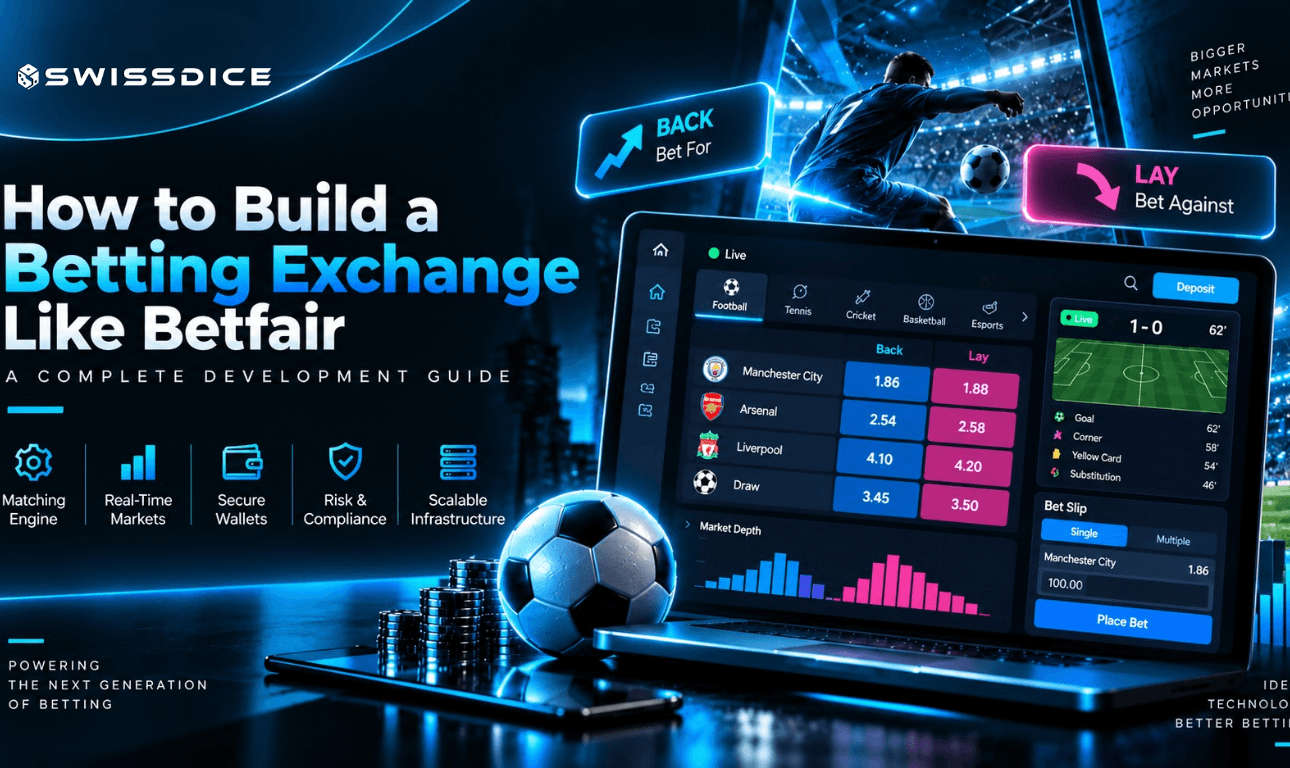
A betting exchange like Betfair works differently from a traditional sportsbook. Instead of having the operator act as the direct counterparty to every wager, a betting exchange creates a marketplace where users can take opposing positions on an event.
One user can back an outcome, while another can lay the same outcome. The exchange’s technology identifies compatible orders, matches them, manages the associated funds and liabilities, and settles the market after the event.
This model creates a more dynamic betting environment, but it also makes the underlying technology more complex. A reliable betting exchange platform needs a matching engine, real-time market data, liquidity management, wallet infrastructure, risk controls, user management, payment integrations, compliance workflows, and an administrative back office.
For businesses planning to enter the sports betting market, the important question is not simply how to copy the Betfair interface. It is how to build the technology infrastructure that makes an exchange work reliably at scale.
This guide explains how to build a betting exchange like Betfair, including how it works, essential features, development steps, technology requirements, business models, costs, timelines, and how to select a development partner.
What Is a Betting Exchange?
A betting exchange is a peer-to-peer betting marketplace where users can place bets against other users.
In a conventional sportsbook, the operator generally publishes odds and accepts bets from customers. In an exchange, users can submit both sides of a market.
Back Betting
A back bet means a user is betting for an outcome.
For example:
A bettor believes Team A will win and places a back bet on Team A.
Lay Betting
A lay bet means a user is betting against an outcome.
For example:
A bettor believes Team A will not win and places a lay bet against Team A.
When compatible back and lay orders are available, the exchange’s matching engine can match them.
This peer-to-peer structure is one of the defining characteristics of an exchange. Betfair’s own educational material similarly describes its Exchange as a marketplace where customers can bet against one another rather than simply betting against a bookmaker.
Why Build a Betting Exchange Like Betfair?
The exchange model can provide several opportunities for businesses entering online betting.
Peer-to-Peer Betting
Users can take opposing positions instead of relying entirely on operator-set prices.
Multiple Betting Strategies
An exchange can support both conventional back betting and lay betting, creating opportunities for users interested in trading markets.
Commission-Based Revenue
Instead of relying solely on sportsbook margins, an exchange can generate revenue through commissions applied according to its commercial model.
Trading-Oriented Experience
Advanced users can monitor prices, liquidity, market depth, and open positions.
Multiple Sports and Markets
The platform can support different sports and market types through a centralized market-management architecture.
However, an exchange also requires sufficient liquidity. Simply creating hundreds of markets does not guarantee a useful marketplace. Users need available opposing orders to match their bets.
Essential Features of Betting Exchange Software
A successful betting exchange software solution requires more than a betting slip.
The platform should support the complete lifecycle of an order, from registration and funding through matching and settlement.
1. User Registration and Login
The registration system should support:
- Email registration
- Mobile verification
- Password management
- Two-factor authentication
- Identity verification
- Account limits
- Responsible gambling controls
- Session management
- Device monitoring
The registration flow should also connect with the platform’s KYC process where required.
2. Back and Lay Betting
Back and lay betting is the foundation of an exchange.
Users should be able to:
- Select an event
- Choose a market
- Select a back or lay position
- Enter stake
- Select odds
- Review potential return or liability
- Submit an order
- Cancel eligible unmatched orders
The interface should clearly distinguish between potential winnings and liability.
3. Real-Time Odds
Odds can change continuously as orders enter and leave the marketplace.
The platform should provide real-time updates for:
- Back prices
- Lay prices
- Available liquidity
- Matched volume
- Market movement
- Suspended markets
- In-play markets
Real-time communication technologies such as WebSockets can be used to distribute updates efficiently.
4. Matching Engine
The betting exchange matching engine is the core technical component.
It receives orders and determines whether compatible positions exist.
A robust matching engine should handle:
- Order validation
- Price matching
- Partial matching
- Full matching
- Order priority
- Order cancellation
- Market suspension
- Concurrent requests
- Exposure calculations
- Transaction consistency
For high-volume exchanges, the matching engine needs to be designed for predictable performance rather than simply high throughput.
5. Partial Matching
A user may request a stake larger than the available opposing liquidity.
For example:
A user wants to place a £1,000 order, but only £400 is currently available.
The system can match the available amount and maintain the remaining amount as an unmatched order, depending on the platform’s rules.
This makes partial matching an important exchange feature.
6. Market Depth
Market depth allows users to understand available prices and liquidity.
A market screen can show:
- Available back prices
- Available lay prices
- Amount available
- Price levels
- Matched volume
- Price movement
This is particularly useful for users who actively trade betting markets.
7. In-Play Betting
In-play betting exchange software allows customers to place or manage bets after an event has started, subject to applicable rules and regulations.
In-play functionality requires:
- Low-latency data
- Live event updates
- Market suspension
- Event detection
- Odds updates
- Automated market controls
- Reliable settlement data
For example, if a goal is scored during a football match, the relevant market may need to be suspended immediately before being recalculated and reopened.
8. Cash Out and Trading
Where supported by the platform’s rules, users may be able to close positions before an event finishes.
Trading functionality can include:
- Cash out
- Back-to-lay
- Lay-to-back
- Profit/loss tracking
- Exposure monitoring
- Position management
- Price charts
These tools turn the exchange into more than a simple betting interface.
9. Wallet Management
A betting exchange requires a reliable financial ledger.
The wallet system should distinguish between:
- Available balance
- Locked funds
- Bet stake
- Lay liability
- Winnings
- Pending withdrawals
- Bonuses, where applicable
- Fees or commission
Every financial movement should have an auditable transaction record.
10. Payment Integration
Depending on the target market, the platform may integrate:
- Cards
- Bank transfers
- E-wallets
- Local payment methods
- Other permitted payment services
The payment architecture should support secure deposits and withdrawals while connecting transaction events with the internal wallet ledger.
11. KYC and AML
A real-money betting platform needs appropriate identity and financial controls.
Potential capabilities include:
- Identity verification
- Age verification
- Address verification
- Source-of-funds checks
- Transaction monitoring
- Suspicious activity detection
- Sanctions screening
- Self-exclusion
- Responsible gambling controls
Requirements vary by jurisdiction, licence, product, and customer location.
12. Risk Management
Risk management is another major component of exchange software.
The system can monitor:
- User exposure
- Market exposure
- Betting patterns
- Unusual transactions
- Account behavior
- Multiple accounts
- Collusion indicators
- Deposit and withdrawal patterns
Automated rules can generate alerts for suspicious activity while allowing authorized staff to investigate cases.
13. Admin Dashboard
The operator needs centralized control over the platform.
An admin panel may include:
- User management
- Market management
- Event management
- Betting management
- Liquidity monitoring
- Risk controls
- KYC review
- Payment monitoring
- Settlement management
- Reports
- Responsible gambling controls
- Audit logs
14. Reporting and Analytics
Analytics help operators understand how the exchange is performing.
Reports can include:
- Active users
- Bets placed
- Bets matched
- Unmatched bets
- Trading volume
- Commission
- Deposits
- Withdrawals
- Market performance
- User activity
- Revenue
- Risk exposure
How to Build a Betting Exchange Like Betfair
Developing an exchange requires more planning than building a standard betting website.
Here is a practical development roadmap.
Step 1: Define Your Business Model
Start by defining:
- Target customers
- Target countries
- Sports
- Betting markets
- Revenue model
- Commission structure
- Liquidity strategy
- Mobile requirements
- Payment methods
- Licensing requirements
These decisions influence the platform architecture from the beginning.
Step 2: Select Your Target Sports
You do not necessarily need to launch every sport on day one.
Potential categories include:
- Football
- Cricket
- Tennis
- Horse racing
- Basketball
- Baseball
- Ice hockey
- Esports
Start with sports that align with your target audience and available data and liquidity resources.
Step 3: Research the Target Market
Market research should examine:
- User demand
- Existing exchanges
- Sports popularity
- Local betting regulations
- Competitors
- Payment preferences
- Customer acquisition costs
- Available data providers
- Liquidity requirements
This research helps determine which markets are commercially and technically practical.
Step 4: Determine Licensing and Compliance Requirements
Licensing should be considered before development rather than after the software is complete.
The requirements can vary depending on:
- Operator location
- Customer location
- Licence jurisdiction
- Sports offered
- Betting products
- Payment methods
- Advertising strategy
A qualified gambling lawyer or regulatory consultant should confirm the requirements for the intended market.
Step 5: Design the Platform Architecture
The technical architecture should cover:
Frontend → API → Betting Engine → Matching Engine → Wallet → Settlement
alongside:
Data Providers → Market Management → Risk Management → Analytics
The architecture should also be designed for scalability and fault isolation.
Step 6: Design UX/UI
The exchange interface should make complex market information easy to understand.
Important screens include:
- Homepage
- Sports lobby
- Event page
- Market page
- Back/lay betting panel
- Bet slip
- Open bets
- Matched bets
- Unmatched bets
- Wallet
- Transaction history
- Account settings
Mobile responsiveness is essential because many users access betting products through smartphones.
Step 7: Develop the Matching Engine
The development team builds the order processing infrastructure.
The engine should handle:
- Incoming orders
- Fund validation
- Market validation
- Price comparison
- Matching
- Partial matching
- Balance updates
- Order status
- Market updates
- Audit records
This component should be independently load-tested.
Step 8: Integrate Sports Data
Connect the exchange with suitable sports data providers for:
- Fixtures
- Scores
- Event status
- Results
- Statistics
- Market information
The exact provider requirements depend on the sports, territories, market types, and in-play functionality.
Step 9: Integrate Payments and KYC
Connect the platform to appropriate payment and identity providers.
The integrations should work with the internal wallet, account, compliance, and transaction systems.
Step 10: Build Risk and Fraud Controls
Introduce automated monitoring before launch.
The platform should be able to identify unusual activity and give authorized operators tools for investigation.
Step 11: Test the Platform
Testing should cover more than normal user journeys.
Important scenarios include:
- High concurrent traffic
- Large order volumes
- Simultaneous orders
- Partial matching
- Market suspension
- Network failure
- Payment failure
- Data-feed interruption
- Duplicate requests
- Wallet consistency
- Settlement errors
Security and penetration testing should also be included in the launch process.
Step 12: Launch and Monitor
After deployment, monitor:
- System performance
- Matching latency
- Failed transactions
- Market errors
- Payment activity
- User behavior
- Risk alerts
- Data-feed health
An exchange is not a one-time software project. Continuous monitoring, maintenance, security updates, and feature development are part of operating the platform.
Technology Stack for Betting Exchange Development
There is no universal technology stack for every exchange. The selection should be based on performance, scalability, team expertise, integration requirements, and operational needs.
A possible architecture could use:
Frontend
- React
- Next.js
- TypeScript
- HTML5
- CSS
Backend
- Java
- Go
- Node.js
- .NET
Database
- PostgreSQL
- MySQL
- MongoDB for selected use cases
Caching
- Redis
Messaging
- Apache Kafka
- RabbitMQ
Real-Time Communication
- WebSockets
Infrastructure
- AWS
- Microsoft Azure
- Google Cloud
DevOps
- Docker
- Kubernetes
- CI/CD
- Infrastructure as Code
The matching engine and wallet ledger should receive particular architectural attention because both require strong consistency and reliable transaction handling.
Betting Exchange Liquidity: The Biggest Business Challenge
Technology alone does not make an exchange successful.
Liquidity is critical.
If a user wants to back a particular outcome but cannot find sufficient opposing lay orders, the bet may remain unmatched.
This means a new exchange needs a strategy for generating liquidity.
Possible approaches include:
- Launching high-demand markets
- Building an active user base
- Working with liquidity partners
- Market-maker relationships
- Supporting popular sports first
- Optimizing market discovery
- Expanding markets based on user demand
A strong liquidity strategy should be planned alongside software development.
Betting Exchange Revenue Model
A betting exchange can generate revenue in several ways.
Commission
The operator can charge commission according to the platform’s commercial rules, often based on qualifying winnings.
Subscription or Premium Features
Advanced users could potentially receive premium trading tools or analytics through subscription models, where legally and commercially appropriate.
B2B Licensing
Businesses can license exchange technology to operate their own betting products.
White-Label Exchange
A white-label solution can provide a pre-built technical foundation that is branded and configured for another operator.
API Services
An exchange may expose selected functionality through APIs for approved business partners.
The appropriate revenue model depends on the market, customer base, licensing structure, and operating strategy.
Custom vs White-Label Betting Exchange Software
Businesses generally have two major development routes.
Custom Betting Exchange Development
With custom development, the platform is designed specifically around the operator’s requirements.
Advantages
- Greater control
- Custom user experience
- Custom business rules
- Flexible integrations
- Greater architectural ownership
- Easier differentiation
Suitable for
Businesses planning a long-term betting technology product with specialized requirements.
White-Label Betting Exchange
A white-label solution uses an existing technology foundation that can be configured and branded.
Advantages
- Faster deployment
- Lower initial development complexity
- Pre-built functionality
- Existing integrations
- Easier market entry
Suitable for
Operators that prioritize speed to market and do not need to customize every component.
Which Model Should You Choose?
There is no universal answer.
The decision should consider:
- Budget
- Launch timeline
- Required customization
- Technical team
- Target jurisdiction
- Integrations
- Long-term ownership
- Scalability
How to Choose a Betting Exchange Software Development Company
Choosing the right development partner can significantly affect the quality and maintainability of the platform.
Look for a company with experience in:
iGaming and Betting Technology
A general software company may not understand exchange-specific requirements such as order matching, liability, liquidity, market suspension, and settlement.
Matching Engine Development
Ask how the provider approaches:
- Order matching
- Concurrency
- Partial matching
- Price priority
- Transaction consistency
- Performance testing
Third-Party Integrations
The provider should be able to work with:
- Sports data providers
- Payment gateways
- KYC providers
- AML systems
- Analytics
- Communication services
Scalable Architecture
The platform should be designed to accommodate increasing:
- Users
- Events
- Markets
- Orders
- Transactions
- Real-time updates
Security
Ask about:
- Authentication
- Encryption
- API security
- Infrastructure security
- Audit logging
- Vulnerability testing
- Penetration testing
Post-Launch Support
A betting exchange requires ongoing:
- Bug fixing
- Infrastructure monitoring
- Security updates
- API maintenance
- Performance optimization
- Feature development
Betting Exchange Development Process at SwissDice
At SwissDice, betting exchange development can be structured around the business requirements, target market, and technical scope.
01. Requirement Analysis
We define:
- Business model
- Target market
- Sports
- Betting types
- User roles
- Integrations
- Compliance requirements
02. Product Planning
The team prepares the product architecture, technical roadmap, feature priorities, and development milestones.
03. UI/UX Design
User journeys, market screens, betting interfaces, dashboards, and responsive experiences are designed before full development.
04. Backend and Matching Engine Development
The core betting infrastructure is developed, including order management, matching, wallet, market management, and settlement components.
05. API and Third-Party Integrations
The platform is connected with relevant:
- Sports data APIs
- Payment gateways
- KYC/AML services
- Notification systems
- Analytics tools
06. Risk and Compliance Integration
Risk management, responsible gambling, user verification, and transaction monitoring workflows are integrated according to the project requirements.
07. QA and Performance Testing
The platform undergoes functional, integration, security, and performance testing.
08. Deployment
The application is deployed to the selected infrastructure with monitoring, security, backups, and operational controls.
09. Post-Launch Support
SwissDice can continue supporting technical maintenance, integrations, performance improvements, and future feature development.
How Much Does It Cost to Build a Betting Exchange Like Betfair?
The cost of betting exchange software development depends heavily on the project’s scope.
Major cost factors include:
- Custom vs white-label development
- Number of sports
- Number of betting markets
- Matching engine complexity
- In-play betting
- Mobile applications
- Payment integrations
- KYC/AML integrations
- Risk management
- Trading tools
- Data providers
- Admin panel
- Multi-language support
- Multi-currency support
- Security requirements
- Licensing and compliance
- Cloud infrastructure
A basic MVP and a multi-jurisdiction enterprise exchange are two very different projects.
For this reason, a development company should estimate the project after defining the functional scope rather than quoting a generic fixed price.
How Long Does It Take to Build a Betting Exchange?
Development time depends on the platform’s complexity.
A typical roadmap can include:
| Stage | Indicative Timeline |
| Business analysis | 2–4 weeks |
| UX/UI design | 3–6 weeks |
| Backend development | 8–16 weeks |
| Matching engine | 8–16+ weeks |
| Frontend development | 6–12 weeks |
| Integrations | 3–8 weeks |
| QA and security testing | 4–8 weeks |
| Deployment | 2–4 weeks |
These stages can overlap, so the total project duration should not be calculated by simply adding every range together.
A custom enterprise exchange with extensive in-play functionality, multiple sports, mobile applications, complex risk management, and multi-jurisdiction compliance can require considerably more development time.
Why Choose SwissDice for Betting Exchange Development?
SwissDice develops iGaming and betting technology for businesses looking to launch customized digital gaming products.
Our betting technology capabilities can include:
- Betting exchange platform development
- Custom betting software
- Sports betting platform development
- Betting exchange API integration
- Sports data integration
- Matching engine development
- Payment gateway integration
- KYC/AML integration
- Risk management
- Admin dashboard development
- Real-time betting infrastructure
- Mobile betting solutions
- Third-party integrations
- Custom reporting
- Technical support
The development approach can be adapted to custom, turnkey, API-driven, or other deployment requirements depending on the project.
The objective is to build an exchange around the operator’s actual business model rather than simply reproducing another platform’s interface.
Final Thoughts
Building a betting exchange like Betfair requires a combination of marketplace technology, real-time betting infrastructure, financial transaction management, risk controls, and regulatory planning.
The visible betting interface is only one part of the product. Behind it are the matching engine, wallet ledger, market engine, sports data feeds, settlement system, liquidity infrastructure, compliance workflows, and operational dashboards.
For businesses considering an exchange, the recommended starting point is to define the target market, sports, licensing requirements, liquidity strategy, revenue model, and required features before selecting the technology architecture.
Once these foundations are established, a development partner such as SwissDice can help transform the requirements into a scalable betting exchange platform.
FAQs About Betting Exchange Development
What is a betting exchange?
A betting exchange is a peer-to-peer marketplace where users can place opposing bets. One user can back an outcome while another can lay it, with the platform matching compatible orders.
How is a betting exchange different from a sportsbook?
A sportsbook generally offers operator-set odds, while a betting exchange allows users to participate on opposing sides of a market. An exchange therefore requires an order-matching and liquidity-management system.
Can I build a betting exchange like Betfair?
Yes. A custom betting exchange can be developed with features such as back and lay betting, matching, market management, real-time odds, in-play betting, wallets, payments, risk management, and settlement.
What is the most important technology in a betting exchange?
The matching engine is one of the most important components because it processes and matches compatible orders. However, it must work together with the wallet, market, risk, data, and settlement systems.
How much does betting exchange software development cost?
There is no universal price. Cost depends on the number of sports and markets, matching-engine requirements, integrations, mobile apps, compliance, security, and customization.
How long does it take to develop a betting exchange?
An MVP can take several months, while a highly customized enterprise platform can require significantly longer. The timeline depends on scope, integrations, testing requirements, and regulatory requirements.
Can a betting exchange support live betting?
Yes, where permitted. Live betting requires real-time sports data, low-latency communication, market suspension mechanisms, automated event handling, and reliable settlement processes.
What is betting exchange liquidity?
Liquidity represents the amount of money available for users to match against each other at different prices. Higher available liquidity generally makes it easier for users to get their orders matched.
Can SwissDice develop a custom betting exchange?
Yes. SwissDice can develop custom betting exchange technology based on the required sports, markets, business model, integrations, deployment model, and target jurisdiction.
Is white-label betting exchange software available?
A white-label approach can provide a pre-built technical foundation that can be branded and configured for an operator. The suitability of this model depends on the required level of customization and control.