Building an iGaming platform involves much more than creating a casino website and connecting a few games. Operators need an interconnected technology ecosystem capable of managing players, games, payments, wallets, bonuses, compliance workflows, reporting, security, third-party services and day-to-day casino operations.
A successful iGaming platform development project therefore starts with business and regulatory planning before software development begins. The platform architecture should be designed around the operator’s target markets, gaming products, expected transaction volumes, integrations, operational model and long-term growth plans.
This guide explains the major stages, technologies and decisions operators should understand when planning an iGaming platform in 2026.
What Is iGaming Platform Development?
iGaming platform development is the process of designing and building the technology infrastructure used to operate online casino, betting or other real-money gaming products.
The platform acts as the central system connecting the player-facing website or application with player accounts, games, payments, wallets, promotions, regulatory tools and operator administration.
Depending on the business model, an iGaming platform may support online casino games, live dealer games, sportsbook products, crash games, instant games, lotteries, virtual games, crypto payments or several gaming verticals through one ecosystem.
The development process can include frontend and backend development, platform architecture, database design, player account management, wallet systems, game APIs, payment integrations, compliance tools, back-office applications, testing, deployment and ongoing technical support.
What Does an iGaming Platform Actually Include?
A modern iGaming platform is made up of multiple systems working together.
At its centre is usually a Player Account Management system (PAM). The PAM stores and manages information associated with player accounts and interacts with authentication, wallets, payments, bonuses, compliance services and reporting systems.
Around the PAM, operators generally require a gaming content layer, wallet and transaction infrastructure, payment integrations, KYC and AML services, promotion tools, CRM functionality, affiliate systems, reporting dashboards and an administrative back office.
The exact architecture depends on the jurisdiction, product and business model. A casino platform designed for one regulated market may have significantly different onboarding, payment, reporting and responsible-gaming requirements from a platform intended for another jurisdiction.
That is why technology decisions should follow market and regulatory planning rather than the other way around.
Define the Business Model Before Development Starts
One of the biggest mistakes in platform development is beginning with features before defining how the business will operate.
Operators should first determine what they plan to offer, who their players will be, which jurisdictions they intend to target and how the platform will generate revenue.
A casino-only operator will have different infrastructure requirements from a multi-product operator offering casino, sportsbook and lottery services. Similarly, a single-brand operation may require a different account and reporting architecture from a business planning to manage multiple brands.
Important decisions include the gaming verticals being launched, target countries, currencies, languages, expected player volumes, payment methods, promotional strategy, affiliate model, game suppliers and future expansion plans.
These requirements eventually determine the architecture and integrations required by the platform.
Choose the Right iGaming Development Model
Operators do not necessarily need to build every component from the ground up.
There are several approaches to launching an iGaming business.
A custom iGaming platform provides greater flexibility over architecture, features, user experience and integrations. It can be appropriate when an operator has unique technical requirements or expects significant long-term customization.
A turnkey iGaming platform combines core platform technology with many of the integrations and operational tools required to launch a gaming business.
A white label iGaming platform typically provides a more packaged operating environment where substantial parts of the technology ecosystem are already established.
There is no universally best model.
The correct choice depends on factors such as available capital, internal technology resources, desired level of control, target market, launch strategy and future customization requirements.
Operators should therefore evaluate the total operating model rather than comparing solutions only by initial development cost.
Design a Scalable iGaming Platform Architecture
Platform architecture determines how reliably the system can operate as player activity, transaction volumes and integrations grow.
A typical architecture separates major responsibilities across services such as authentication, player management, wallets, payments, games, bonuses, compliance and reporting.
Modern development teams may use modular or service-oriented architectures so components can be updated or scaled without rebuilding the entire platform.
For example, payment processing may experience very different traffic patterns from reporting or casino game discovery. Separating these workloads can make infrastructure easier to scale and maintain.
The architecture should also account for API management, databases, caching, logging, monitoring, backups, redundancy and disaster recovery.
Scalability should not be treated as something to add after launch. If an operator expects international growth or high-volume campaigns, scaling requirements should be included during architecture planning.
Build the Player Account Management System
The Player Account Management system is one of the most important components of an iGaming platform.
It creates the operational connection between the player and the casino ecosystem.
A PAM may manage registration, authentication, player profiles, account status, verification information, preferences, responsible-gaming settings, wallet balances, transactions and account history.
It also needs to communicate with other services.
For example, when a player makes a deposit, the payment system updates the relevant transaction information. When the player launches a game, the gaming infrastructure must associate the activity with the correct account and wallet. When a bonus is activated, promotional rules need to interact with player and transaction data.
For this reason, PAM design can affect almost every operational area of the platform.
Develop Wallet and Transaction Management
Money movement requires particularly careful architecture.
An iGaming wallet needs to manage deposits, withdrawals, wagers, winnings, refunds, bonuses and other balance movements accurately.
Some platforms use a single wallet across casino products, while others may require separate or multi-wallet structures depending on the product and business rules.
Every balance-changing event should create a traceable transaction record.
Operators also need to consider multi-currency support, exchange-rate handling, payment reconciliation, bonus balances, transaction statuses and withdrawal workflows.
For crypto-enabled platforms, additional considerations may include blockchain confirmations, wallet infrastructure, custody arrangements and transaction monitoring where applicable.
A reliable wallet is not simply a displayed player balance. It is a financial ledger that needs consistency, accuracy and auditability.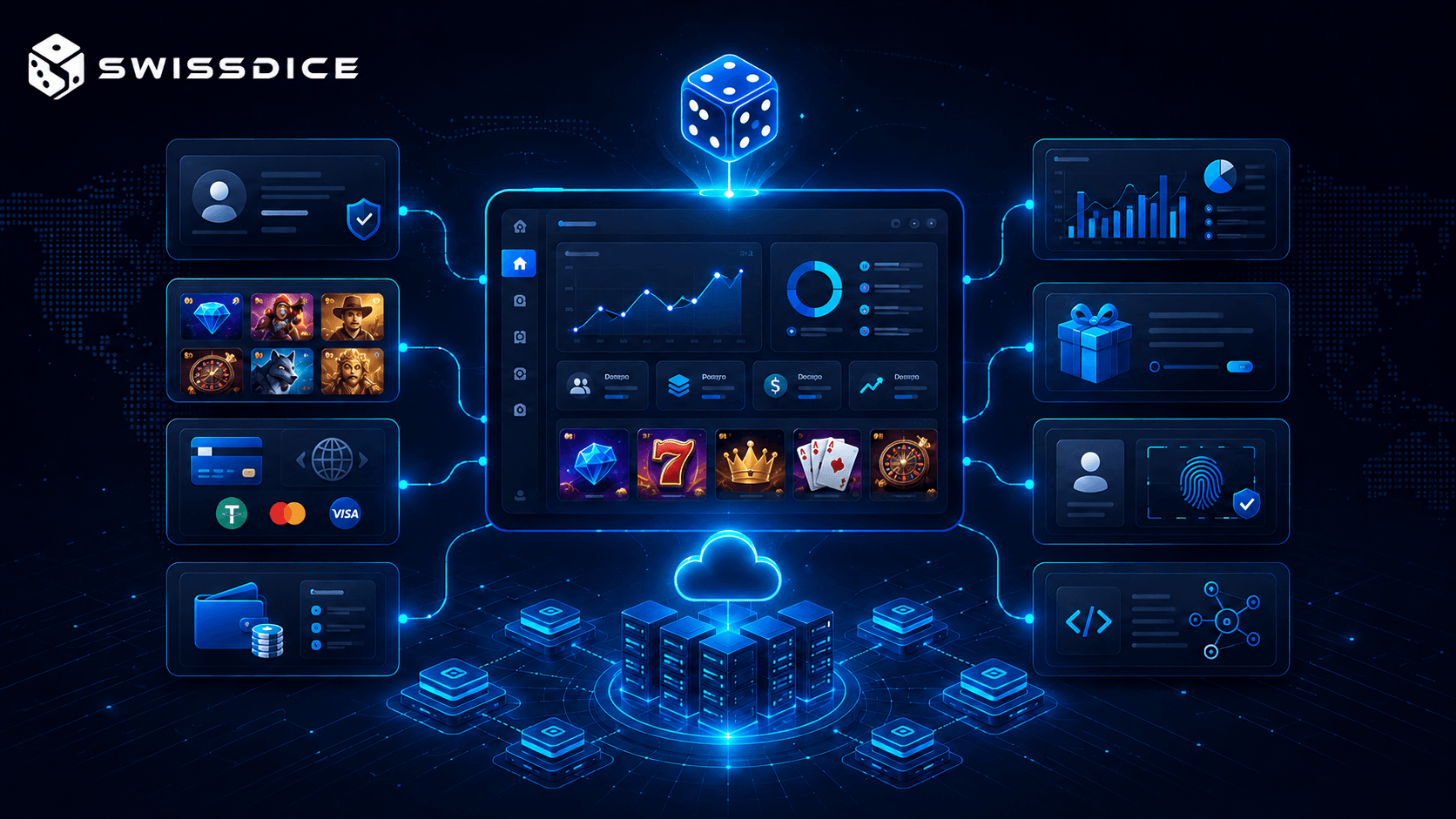
Integrate Casino Games Through APIs
Casino operators typically do not develop every game available on their platform.
Instead, games can be integrated from external providers through direct APIs or a casino game aggregator.
Direct integrations allow an operator to connect individually with game studios. However, managing numerous providers separately can increase technical and operational overhead.
A casino game aggregation layer can provide access to multiple providers through a unified technical connection.
Depending on supplier availability and commercial agreements, a platform may support slots, table games, live casino, crash games, instant-win games, virtual products and specialty games.
The technical integration must handle game launching, player sessions, wagers, wins, transaction callbacks, error handling and reporting correctly.
Operators should also consider how games will be organized inside the casino lobby through categories, search, filters, recommendations and promotional placement.
Integrate Payment Gateways and Alternative Payment Methods
Payment experience has a direct impact on casino operations.
An iGaming platform may need to connect with card processors, bank payment systems, digital wallets, local payment methods and, where appropriate, cryptocurrency infrastructure.
Payment availability varies significantly between markets.
This makes geographic planning particularly important. Operators should determine which payment methods are commonly used and permitted in their intended jurisdictions before choosing integrations.
The technical system should support deposit processing, withdrawals, transaction statuses, failed payments, reconciliation, payment limits and reporting.
Payment integrations also interact closely with fraud detection, KYC and AML systems.
As a result, payment architecture should be planned as part of the broader player and compliance ecosystem rather than as an isolated checkout feature.
Plan KYC, AML and Player Verification
Compliance workflows need to be integrated into the platform architecture from the beginning.
Depending on jurisdiction and operator requirements, the platform may need to connect with services for identity verification, age verification, sanctions screening, transaction monitoring, source-of-funds processes, document verification or risk scoring.
The system should be capable of applying appropriate actions based on verification status.
For example, certain functionality may need to be restricted until required verification has been completed.
These requirements vary considerably by market, so operators should work with qualified legal and compliance professionals when defining their regulatory obligations.
Technology can support compliance processes, but the platform itself does not determine whether an operator is legally permitted to operate in a particular jurisdiction.
Build Responsible Gaming Controls into the Product
Responsible gaming should be part of product architecture rather than treated as a separate page added before launch.
Depending on applicable regulation, platform functionality may include deposit or financial limits, session controls, reality checks, self-exclusion, account restrictions and player-risk monitoring.
Regulatory requirements continue to evolve. For example, the UK Gambling Commission’s Remote Gambling and Software Technical Standards include requirements concerning customer accounts, financial limits, game design, random outcomes and security. Its current schedule also contains financial-limit changes due to take effect on 30 September 2026.
This illustrates why regulatory requirements need to be reviewed throughout the platform lifecycle—not only when the initial product is developed.
Develop a Flexible Bonus and Promotion Engine
Bonuses remain an important acquisition and retention mechanism for many casino businesses.
However, a useful bonus engine needs more than a field for adding promotional funds.
Operators may need configurable rules for welcome promotions, deposit bonuses, reload campaigns, cashback, free spins, loyalty programs, VIP rewards or tournaments.
The engine should be able to define eligibility rules, activation periods, wagering conditions, player segments, game restrictions and campaign limits.
More advanced platforms can connect promotion logic with CRM and player segmentation systems so campaigns can be targeted rather than applied uniformly to the entire player base.
This creates a more flexible foundation for lifecycle marketing.
Create an Operator Back Office
Players interact with the casino frontend.
Operations teams interact with the back office.
A well-designed back-office system gives authorized employees access to the information and controls required to run the platform.
Teams may need to review players, transactions, games, payments, withdrawals, bonuses, affiliates, reports and platform settings.
Role-based permissions are particularly important because not every employee should have access to every operational function.
Back-office workflows should also generate appropriate audit records for important administrative actions.
The objective is to provide operational visibility without compromising security or control.
Connect CRM, Analytics and Reporting
An iGaming platform generates significant operational data.
Without structured reporting, however, that data provides limited value.
Analytics infrastructure can help operators understand registrations, deposits, withdrawals, player activity, game performance, bonuses, revenue and retention.
Different teams require different views.
Finance teams may focus on payments and reconciliation. Marketing teams may evaluate campaigns and player cohorts. Gaming teams may monitor provider or game performance. Compliance teams may need risk and account information.
A good platform therefore separates raw transactional data from reporting and analytical workflows while maintaining reliable definitions across systems.
As the business grows, structured data architecture becomes increasingly important for automation, business intelligence and decision-making.
Design APIs and Third-Party Integrations
Very few modern gaming platforms operate entirely within one software environment.
A platform may need integrations with game providers, payment processors, identity verification systems, CRM services, affiliate software, fraud systems, analytics tools, customer-support platforms and regulatory services.
An API-first approach can make these integrations easier to manage.
Well-designed APIs should include secure authentication, consistent data structures, version management, error handling, rate limiting, monitoring and documentation.
Operators should also think about vendor dependency.
If replacing a payment processor or verification provider requires major platform redevelopment, the architecture can eventually limit business flexibility.
Designing clear integration boundaries helps reduce that dependency.
Prioritize Platform Security
An iGaming platform processes accounts, financial transactions and commercially sensitive operational information.
Security therefore needs to exist across the entire technology stack.
Important areas include authentication, access control, encryption, infrastructure protection, API security, logging, monitoring, vulnerability management, backups and incident response.
Security requirements may also come directly from regulators.
For example, the UK Gambling Commission’s remote gambling security requirements reference relevant parts of ISO/IEC 27001:2022 for applicable licence holders.
Security should consequently be reviewed during architecture, development, testing and ongoing operations rather than being treated as a one-time pre-launch activity.
Build for Multiple Markets
International expansion creates additional complexity.
The same platform may eventually need to support different currencies, languages, payment methods, domains, game catalogues, regulatory settings, promotional rules and responsible-gaming controls.
This makes configuration important.
Where possible, market differences should be controlled through configurable rules rather than separate versions of the entire platform.
Licensing structures can also change over time. Curaçao, for example, now operates its licensing framework through the Curaçao Gaming Authority under the National Ordinance on Games of Chance, including online gaming licences and a framework for gaming-related suppliers.
Operators planning international expansion should therefore map regulatory and technical requirements jurisdiction by jurisdiction rather than assume one deployment automatically fits every market.
Develop a Mobile-First Player Experience
A technically powerful backend does not guarantee a good player experience.
The frontend needs to make registration, verification, deposits, game discovery, gameplay and withdrawals straightforward across common devices and screen sizes.
Performance is particularly important.
Large casino catalogues can involve thousands of images, game metadata records and third-party connections. Poor frontend architecture can therefore create slow lobby loading even when the backend is performing correctly.
Mobile-first development should consider navigation, search, filtering, page weight, image delivery, game launching, payment flows and account management.
UX decisions should also account for accessibility and applicable responsible-gaming requirements.
Test the Entire Platform Before Launch
Testing an iGaming platform requires more than checking whether individual pages load.
Development teams need to test interactions between systems.
A deposit, for example, can involve the frontend, PAM, payment service, wallet, transaction ledger, fraud controls, reporting system and notification services.
Testing should therefore cover functional behaviour, integrations, payments, game transactions, wallet accuracy, APIs, performance, security, device compatibility, browsers and failure scenarios.
Load testing becomes especially important when large player volumes are expected.
Teams should also test what happens when an external provider becomes unavailable.
A resilient platform should fail safely and recover predictably rather than allowing third-party problems to create incorrect balances or inconsistent transactions.
Prepare for the Platform Launch
Technical deployment is only one part of launch readiness.
Before going live, operators should confirm that production infrastructure, domains, payment systems, game providers, monitoring, support processes, reporting, operational permissions and required regulatory workflows are ready.
The production environment should also have appropriate monitoring and alerting.
Technical teams need visibility into API failures, unusual transaction behaviour, infrastructure capacity and service availability.
Having incident procedures before launch reduces confusion when real production issues occur.
A controlled launch with monitoring can also help teams identify operational problems before marketing traffic increases significantly.
Scale the Platform After Launch
Launching is not the end of iGaming platform development.
Once real players begin using the system, operators gain information that development environments cannot fully reproduce.
Teams can monitor which games receive the most traffic, where registration users leave the funnel, which payment methods fail most often and which technical services experience the greatest load.
That information should feed back into product development.
Scaling may involve additional computing capacity, database optimization, caching, queue systems, CDN infrastructure, service separation or changes to third-party integrations.
Product scaling is equally important.
New markets may require additional languages, payment systems, games, compliance integrations or localized promotional tools.
The most effective architecture is therefore one that can evolve without requiring the core platform to be rebuilt every time the business expands.
How Long Does iGaming Platform Development Take?
There is no universal development timeline.
The schedule depends on the development model, number of gaming products, existing technology, customization level, number of integrations, regulatory requirements and testing scope.
A heavily customized multi-product ecosystem generally requires substantially more engineering and integration work than a platform assembled from established components.
Operators should therefore avoid estimating a launch date based solely on frontend development.
Architecture, third-party onboarding, commercial agreements, payment integrations, testing, certification and regulatory processes can all affect the overall timeline.
A useful project plan separates dependencies controlled by the development team from dependencies controlled by external providers or regulators.
How Much Does It Cost to Build an iGaming Platform?
There is also no credible single price for developing an iGaming platform.
Cost depends on what is being built.
A project requiring custom PAM infrastructure, wallets, back-office systems, payment connections, multiple gaming verticals and extensive integrations will have different development requirements from a standardized platform configuration.
Operators should evaluate costs across the complete lifecycle, including development, infrastructure, game integrations, payment integrations, third-party services, security, maintenance, compliance support and future product development.
The lowest initial development price does not necessarily produce the lowest long-term operating cost.
Architecture that is difficult to maintain or extend can become expensive as the business grows.
Custom, Turnkey or White Label: Which Approach Is Better?
The choice depends on the operator’s objectives.
Custom development typically provides the greatest architectural and product flexibility but requires more planning, engineering and ongoing technology management.
Turnkey platforms can reduce the amount of technology that an operator needs to assemble independently while still allowing meaningful brand and operational configuration.
White label solutions can simplify launch requirements further when the business model and target jurisdiction are suitable.
The decision should be based on desired control, differentiation, internal capabilities, time to market, regulatory strategy and long-term growth—not simply which model appears fastest.
iGaming Platform Development Checklist for Operators
Before starting development, operators should be able to answer the following questions:
- Which countries or regulated markets will the platform target?
- Which gaming verticals will be offered?
- Will the project use custom, turnkey or white label technology?
- What player information must the PAM manage?
- How will wallet balances and transactions be recorded?
- Which casino game providers or aggregators are required?
- Which payment methods are needed for each market?
- Which KYC, AML and fraud services must be integrated?
- What responsible-gaming controls are required?
- What bonus, CRM and gamification functionality is needed?
- How will affiliates be managed?
- What functionality should be available through the back office?
- Which reports are required by operations, finance and compliance teams?
- Which currencies and languages must the system support?
- Which third-party APIs need to be integrated?
- What traffic and transaction volumes should the architecture support?
- What security, monitoring and recovery controls are required?
- What testing and certification processes apply?
- What resources will manage the platform after launch?
- How should the architecture support additional products and markets later?
Answering these questions early creates a much stronger foundation for technical planning.
Choosing an iGaming Platform Development Partner
An experienced iGaming software development partner should understand more than frontend design.
Operators should evaluate whether a potential technology provider understands PAM architecture, transaction systems, payment integrations, game APIs, back-office workflows, security, scalability and the operational realities of running gaming technology.
Technical discovery should happen before development begins.
A capable development partner should be able to translate business requirements into system architecture, identify integration dependencies and explain technical trade-offs rather than simply provide a feature list.
Operators should also ask how future integrations and market expansion will be handled.
A platform that works for the initial launch but cannot adapt efficiently can restrict growth later.
Building an iGaming Platform for Long-Term Growth
Successful iGaming platform development is ultimately about building an operational technology ecosystem rather than a collection of isolated features.
Player accounts need to communicate with wallets. Wallets need to interact correctly with games and payments. Compliance services need access to relevant player and transaction information. Promotions need to work with player activity. Back-office teams need visibility across all of these systems.
Planning these relationships before development helps reduce technical complexity later.
For businesses developing new gaming technology or modernizing an existing platform, SwissDice provides iGaming technology services across platform development, game integrations, payment integrations, custom casino development and supporting technical systems.
The objective should not simply be to launch an online gaming platform.
It should be to build infrastructure that can operate reliably, integrate efficiently and scale as the business grows.
Frequently Asked Questions About iGaming Platform Development
What is an iGaming platform?
An iGaming platform is the technology infrastructure used to operate online gaming products. It can connect player accounts, wallets, games, payments, bonuses, compliance services, reporting and administrative tools through one ecosystem.
What is iGaming platform development?
iGaming platform development is the process of planning, designing, building, integrating, testing and deploying the technology required to operate an online gaming business.
What are the main components of an iGaming platform?
Common components include Player Account Management, wallet and transaction systems, casino game integrations, payment gateways, KYC and AML tools, bonus management, CRM, affiliate systems, reporting and an operator back office.
What is PAM in iGaming?
PAM stands for Player Account Management. It manages player accounts and associated information and connects player activity with services such as authentication, wallets, transactions, verification and responsible-gaming tools.
How are casino games integrated into an iGaming platform?
Games are generally integrated through provider APIs or a casino game aggregator. These integrations enable the platform to manage game sessions, wagers, wins and transaction communication between the gaming provider and player account infrastructure.
Can an iGaming platform support multiple currencies?
Yes. A properly designed platform can support multiple currencies, although payment availability, accounting processes and regulatory requirements should be evaluated for each target market.
Can cryptocurrency be integrated into an iGaming platform?
Crypto payments can be integrated where the operator’s business model, licensing conditions and applicable regulations permit them. Operators need to consider wallet infrastructure, transaction monitoring, AML controls and other jurisdiction-specific requirements.
Is a custom iGaming platform better than a white label platform?
Neither model is universally better. Custom platforms generally provide greater flexibility and control, while white label solutions can reduce the amount of infrastructure an operator needs to develop independently. The correct choice depends on the business model, target market, resources and growth strategy.
How long does it take to develop an iGaming platform?
Development time varies according to architecture, customization, gaming products, integrations, regulatory requirements, testing and third-party dependencies. A project should therefore be estimated after technical discovery rather than using a generic timeline.
What should operators plan before developing an iGaming platform?
Operators should define their target markets, licensing strategy, gaming products, payment methods, player account requirements, game integrations, compliance processes, promotional tools, reporting needs, expected traffic and long-term expansion strategy before development begins.
How do you make an iGaming platform scalable?
Scalability starts with architecture. Modular services, appropriate database design, caching, workload separation, monitoring, cloud infrastructure and well-designed APIs can help a platform accommodate increasing player and transaction volumes.
What should I look for in an iGaming platform development company?
Look for experience across platform architecture, PAM systems, wallet and transaction logic, game integrations, payment systems, APIs, security, back-office development and scalable infrastructure. The provider should also understand how technical requirements change across different regulated markets.
Final Takeaway
An iGaming platform is the technological foundation of an online gaming operation.
Operators planning a platform in 2026 should start with business requirements and target-market obligations, then define architecture, PAM, wallet infrastructure, gaming content, payments, compliance systems, promotions, reporting, security and operational tools.
Building these components around a scalable integration strategy creates a platform that is easier to operate today and easier to expand tomorrow.
Planning an iGaming platform?
Talk to SwissDice about platform architecture, custom development, casino game integration, payment integrations and scalable iGaming technology.