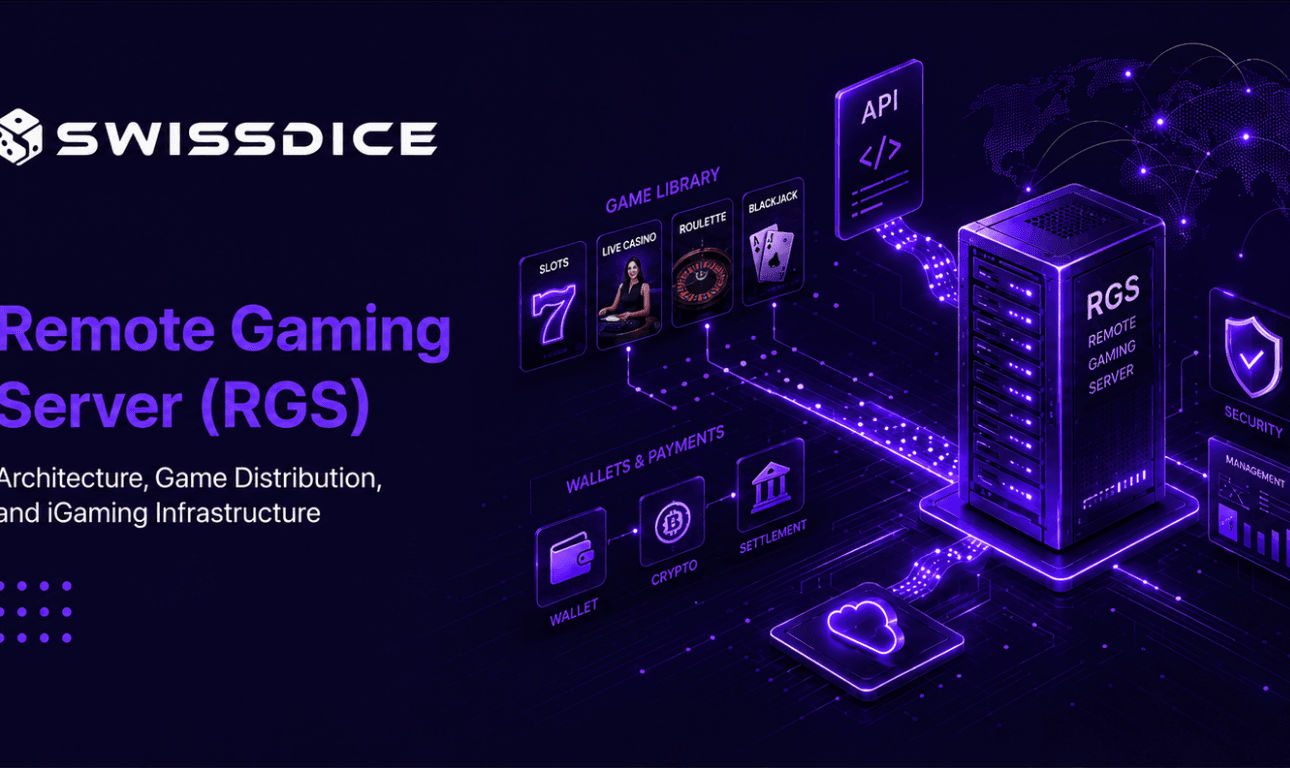
A practical guide for casino operators, game studios, aggregators and iGaming technology teams.
Behind almost every digital casino game is infrastructure that players never see.
When a player opens a slot, places a bet, starts a crash round or triggers an instant-win game, the visible game client is only one part of the system. The game must communicate with backend technology responsible for game sessions, outcome logic, wallet transactions, configuration, reporting and operator integrations.
That backend layer is commonly built around a Remote Gaming Server, or RGS.
A Remote Gaming Server can become particularly important for game studios and operators that want to develop proprietary games, manage multiple titles through one backend environment and distribute those games to casino platforms or aggregation networks.
SwissDice provides Remote Gaming Server Solutions designed to support casino game development, game management, platform integration and scalable content distribution.
This guide explains what an RGS is, how it works, what components it requires, how it connects with casino platforms and what businesses should evaluate before selecting or developing an RGS.
What Is a Remote Gaming Server?
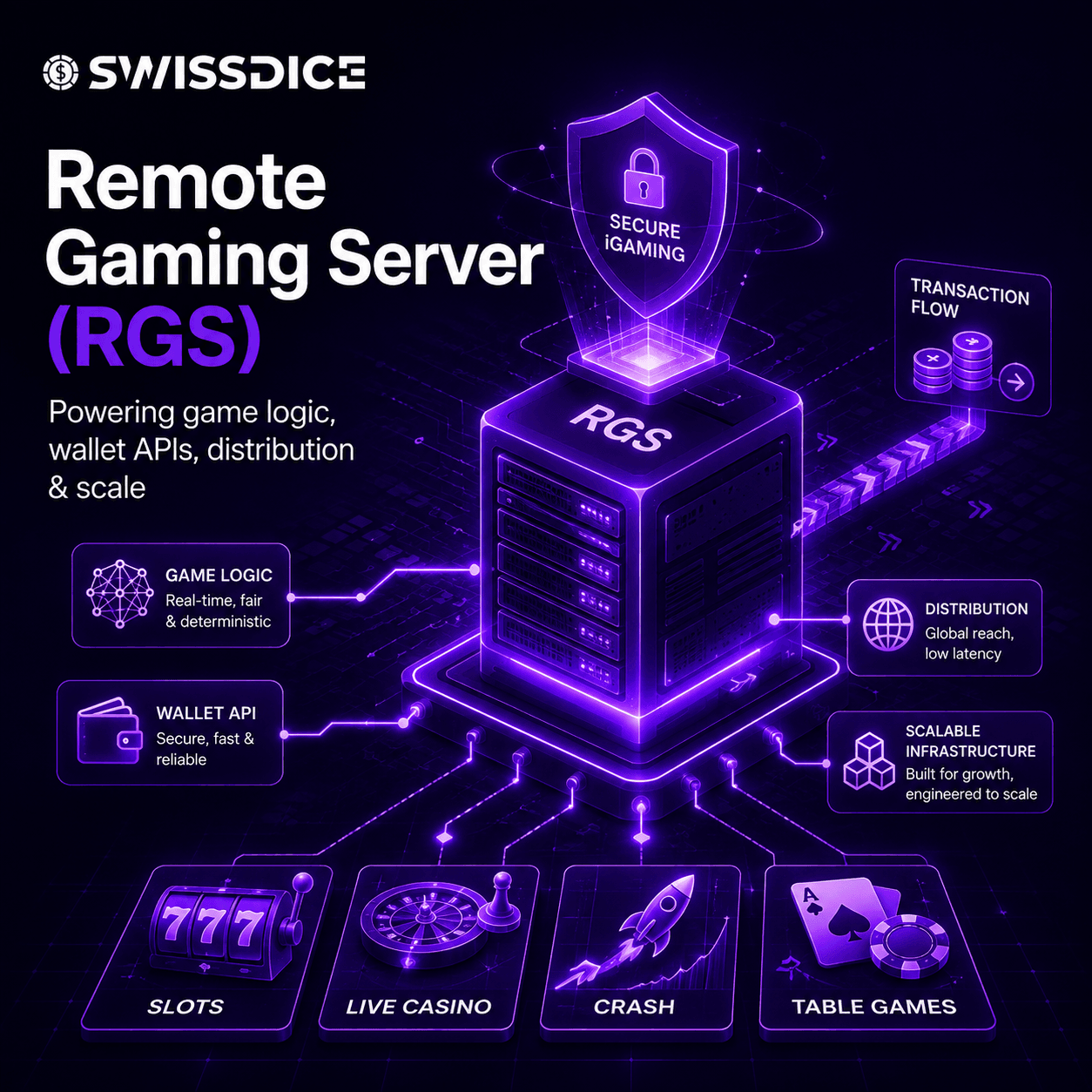
A Remote Gaming Server (RGS) is backend infrastructure used to host, manage and deliver casino games while handling functions such as game logic, game sessions, Random Number Generation, configuration, reporting and communication with casino platforms.
Gaming Laboratories International defines a Remote Game Server as interactive gaming hardware and software that is separate from the main gaming platform and may manage game features, configurations, RNGs and reporting. GLI also notes that a gaming platform can integrate with one or more RGS environments.
In simple terms:
The casino platform manages the player and wider casino operation; the RGS manages the game environment and communication required to run the game.
Depending on the architecture, an RGS can support:
- Slots
- Crash games
- Plinko
- Instant-win games
- Table games
- Casino originals
- Multiplayer games
- RNG-based games
- Other digital casino formats
An RGS is therefore much more than a server where game files are stored.
It can become the operational engine connecting games, mathematics, RNG, wallets, sessions, operators and distribution channels.
What Does an RGS Do?
A Remote Gaming Server can perform several core functions:
- Hosts casino games and backend game services.
- Executes or coordinates game logic.
- Manages game sessions and rounds.
- Works with RNG functionality for applicable games.
- Communicates bets and wins with operator wallets.
- Stores or communicates relevant game records.
- Manages game configurations.
- Connects games with casino platforms.
- Supports reporting and transaction reconciliation.
- Helps game studios distribute multiple titles through a common integration layer.
The exact responsibilities depend on the RGS architecture and the systems surrounding it.
Why Remote Gaming Servers Matter in iGaming
Game studios used to face a difficult technical challenge: developing the actual game was only one part of bringing a title to market.
They also needed infrastructure capable of:
- Launching games
- Managing sessions
- Processing game rounds
- Communicating with wallets
- Handling transaction failures
- Supporting currencies
- Supporting languages
- Managing configuration
- Generating reports
- Integrating with multiple operators
Building these functions separately for every game creates unnecessary complexity.
A well-designed RGS platform moves common backend responsibilities into reusable infrastructure.
That means a studio can build multiple games on top of one shared game-delivery architecture rather than rebuilding wallet communication, session handling and operator connectivity for every title.
How Does a Remote Gaming Server Work?
A simplified online casino game flow may look like this:
Player → Casino Platform → Game Launch → RGS → Game Client
During actual gameplay, additional communication occurs between the game, RGS and operator wallet.
Consider a basic slot round.
Player Launches the Game
The player selects a game from the casino lobby.
The operator platform sends information needed to initialize the session.
This can include:
- Player/session token
- Game ID
- Currency
- Language
- Operator
- Brand
- Jurisdiction or configuration profile
RGS Validates the Game Session
The RGS verifies that the launch request is valid.
It may determine:
- Which operator is requesting the game
- Which game configuration applies
- Supported currency
- Player session validity
- Market availability
- Bet configuration
A valid game session is then created or retrieved.
Game Client Loads
The player sees the game interface.
This client may contain:
- Reels
- Symbols
- Controls
- Animation
- Sound
- Paytable
- Betting UI
But sensitive game outcome logic should normally remain within controlled server-side infrastructure.
Player Places a Bet
The player initiates a game round.
The game sends the request to the RGS.
Depending on architecture, the RGS communicates with the casino wallet to validate and debit the required wager.
Game Outcome Is Determined
For an RNG-based game, the backend applies the game’s approved mathematical logic and random input to determine the outcome.
Current UK Gambling Commission RTS 7 requires random outcomes for applicable remote games to be “acceptably random.” Its guidance requires, among other things, that RNG output correspond to expected probabilities and remain unpredictable.
The RGS then provides the result required by the game client.
Result Is Displayed
The player-facing game animates the server result.
For example:
RGS result: Reel outcome A-B-C-D-E
Game client: Displays the reel animation corresponding to that result.
This separation allows important outcome logic to remain controlled by backend infrastructure.
Winnings Are Settled
If the round produces a win, the RGS communicates the settlement to the appropriate wallet or platform service.
The system may process:
- Bet amount
- Win amount
- Transaction ID
- Round ID
- Game ID
- Player/session identifier
- Currency
Round Data Is Recorded
Relevant information may be retained for:
- Game history
- Transaction reconciliation
- Customer support
- Reporting
- Audit requirements
- Technical troubleshooting
This transaction history becomes particularly important when a round is interrupted or a wallet request fails.
Remote Gaming Server Architecture Explained
A production RGS generally consists of multiple services rather than one physical server.
A simplified architecture can include:
1. Game Session Service
Controls player game sessions.
Responsibilities may include:
- Launch tokens
- Session expiration
- Player state
- Game state
- Operator configuration
2. Game Engine
Runs relevant game logic.
Depending on the game architecture, it can process:
- Game states
- Player actions
- Round logic
- Bonus mechanics
- Payout rules
- Win calculations
3. RNG Service
Provides random values required by relevant game models.
The UK Gambling Commission currently requires applicable RNG outputs and resulting games to demonstrate randomness to a high degree of confidence through accepted statistical analysis. It also specifies unpredictability and appropriate distribution as important qualities.
GLI-19 v3.0 separately includes dedicated sections covering game outcomes using RNGs, game fairness and payout percentages for interactive gaming systems.
4. Wallet Integration Layer
Connects game activity with the operator’s wallet system.
Typical operations can include:
- Balance
- Bet/debit
- Win/credit
- Cancel
- Rollback
- Transaction lookup
Wallet architecture is one of the most important parts of an RGS integration because failures can directly affect player balances.
5. Transaction Service
Maintains authoritative records of relevant gaming transactions.
Important identifiers can include:
- Transaction ID
- Round ID
- Session ID
- Player ID/token
- Game ID
- Operator
- Bet
- Win
- Currency
- Timestamp
- Transaction state
A strong design also considers idempotency, so retrying a network request does not accidentally debit or credit a player twice.
6. Game Configuration Service
Allows permitted configuration to vary between operators or markets.
Configuration could include:
- Game availability
- Currency
- Bet limits
- Language
- Visual configuration
- Maintenance state
- Approved mathematical configuration where permitted
Configuration changes affecting rules, probabilities or payouts can have regulatory implications.
For example, the UK Gambling Commission’s RTS 7 states that game rules, payout parameters and outcome probabilities cannot simply be changed while a game remains available for gambling outside permitted game rules; relevant alterations normally require appropriate player notice and controlled implementation.
7. Operator Integration API
Provides the contract between the RGS and casino platform.
Typical interfaces can include:
- Game launch
- Authentication
- Balance
- Bet
- Win
- Rollback
- Round history
- Game metadata
Clean API documentation can significantly reduce operator integration complexity.
8. Reporting & Monitoring
Technical teams need visibility into what the RGS is doing.
Monitoring can cover:
- API latency
- Failed wallet requests
- Game errors
- Session failures
- Transaction mismatches
- Service availability
- Database performance
- Infrastructure health
Operational reporting may additionally cover game and transaction activity.
What Role Does RNG Play in an RGS?
RGS and RNG are closely related terms, but they are not interchangeable.
RGS = the broader game-serving infrastructure.
RNG = a mechanism used to generate random values for applicable games.
GLI-19 defines RNG technology in the context of interactive gaming and treats Remote Game Servers separately as infrastructure capable of supporting features such as RNG, game configuration and reporting.
An RNG-based slot might work conceptually like this:
Random values → probability mapping → game outcome → payout logic → displayed result
The game mathematics defines what outcomes are possible and their theoretical probabilities.
The RNG provides the random inputs used by the implementation.
Those are related but distinct responsibilities.
Real Regulatory Data: What Current Standards Tell Us About RGS Design
RGS architecture should never be designed solely around development convenience.
The intended market matters.
GLI-19 v3.0
Gaming Laboratories International currently lists GLI-19 Interactive Gaming Systems v3.0 among its published technical standards.
The standard includes dedicated technical sections covering areas such as:
- Gaming sessions
- Game information
- RNG-driven outcomes
- Game fairness
- Payout percentages and odds
- Bonus features
- Alternative game modes
- Skill games
- Peer-to-peer gaming
- Persistence games
This demonstrates why an RGS intended for regulated distribution needs architecture that considers far more than simply hosting executable game files.
UK Gambling Commission RTS
The UK Gambling Commission’s current Remote Gambling and Software Technical Standards are issued under sections 89 and 97 of the Gambling Act 2005. The Commission updated its RTS introduction on 20 March 2026, and its public guidance notes further RTS changes effective 30 June 2026.
The framework covers 17 numbered RTS areas, including customer account information, transactions, game rules, result determination, RNG, progressive jackpots, interrupted gambling, financial limits, responsible product design and third-party software.
For RGS architects, this is an important real-world example: the regulatory surface extends across outcomes, transactions, interruptions, security and product behavior.
Security Requirements
The UK Gambling Commission’s current security requirements use relevant controls from ISO/IEC 27001:2022.
The Commission specifically identifies as critical systems those that handle sensitive customer data, generate or process random numbers, store game results or current gamble state, connect directly to those systems, or transmit sensitive customer information.
Those categories overlap closely with the responsibilities of many RGS environments.
This makes security architecture an essential RGS requirement rather than an optional infrastructure enhancement.
What Happens If a Game Round Is Interrupted?
This is one of the practical reasons RGS architecture matters.
Imagine:
- A player places a €10 bet.
- The operator wallet confirms the debit.
- The RGS determines the outcome.
- The player’s internet connection drops before the animation completes.
The game cannot simply forget the round.
The backend needs a reliable source of truth.
Good RGS architecture should therefore consider:
- Round IDs
- Transaction states
- Result persistence
- Retry logic
- Idempotent wallet operations
- Rollbacks
- Reconciliation
- Recovery after reconnect
The animation is not the game result.
The authoritative backend state is what allows the round to be reconstructed correctly.
RGS and Wallet Integration
Wallet connectivity is often one of the most technically sensitive RGS components.
Common APIs include:
Balance
Returns the player’s available balance.
Debit / Bet
Deducts the confirmed wager.
Credit / Win
Credits a valid game payout.
Rollback
Reverses an eligible transaction after an interrupted or failed workflow.
Transaction Status
Confirms whether a previous operation succeeded.
A robust integration should also address situations such as:
- Timeouts
- Network retries
- Duplicate callbacks
- Partial failures
- Currency precision
- Invalid sessions
- Insufficient funds
- Delayed responses
Ignoring these edge cases is one of the fastest ways to create balance discrepancies.
RGS and Casino Game Aggregators
An RGS and a game aggregator perform different functions.
RGS
Runs and manages games.
Game Aggregator
Provides operators with access to content from multiple game suppliers through a consolidated integration.
A game studio might therefore follow this distribution model:
Studio Games → Studio RGS → Aggregator → Casino Operators → Players
Alternatively:
Studio Games → Studio RGS → Direct Operator Integration
Reelsoft, for example, describes its commercial architecture as combining an RGS with a game aggregation solution for game creation and distribution.
This illustrates how the two technologies complement one another rather than replacing each other.
Who Needs a Remote Gaming Server?
An RGS is particularly relevant for businesses that own or intend to own gaming content.
Casino Game Studios
A studio developing several titles can use common RGS infrastructure rather than rebuilding backend integration technology for every game.
Casino Operators With Proprietary Games
Operators developing branded casino originals can use an RGS to manage and integrate their own gaming portfolio.
iGaming Platform Providers
Platform businesses can use RGS technology to add proprietary content capabilities to a broader casino ecosystem.
Game Aggregators
Aggregators may integrate with external RGS environments to distribute game content from different studios.
Independent Game Developers
Development teams moving from prototypes to commercial casino distribution eventually need infrastructure around:
- Game sessions
- Wallets
- Transactions
- Reporting
- Deployment
- Operator integration
An RGS can provide that shared foundation.
What Games Can Run Through an RGS?
An RGS can support slots, crash games, Plinko, instant-win titles, table games, multiplayer games, and other custom casino formats. The exact game types depend on the RGS architecture, APIs, game engine, and operator integration requirements.
Common game categories include:
Slots
RGS infrastructure can handle mathematical logic, game rounds, transactions and configuration for slot portfolios.
Crash Games
Real-time multiplayer crash environments may require synchronized rounds, event streaming, wallet operations and game history.
Plinko
Backend systems can manage bet requests, mathematical outcome generation and transaction settlement.
Instant-Win Games
Games such as Mines, Dice, Limbo, Towers or Wheel-style products can share common RGS APIs and infrastructure.
Table Games
Digital blackjack, roulette, baccarat and other suitable formats can also use server-side game infrastructure.
Multiplayer Games
Shared game sessions require additional architecture for concurrency, event distribution and synchronized game states.
Benefits of Using a Remote Gaming Server
1. Shared Infrastructure Across Multiple Games
Common functionality can be reused rather than developed independently for every title.
2. Centralized Game Management
Games can be managed through one backend environment.
Operators or studios may gain centralized control over:
- Game versions
- Game status
- Currency support
- Languages
- Configuration
- Operator connections
3. Easier Operator Integration
Rather than each game implementing a different integration contract, games can operate behind standardized RGS APIs.
4. Faster Portfolio Expansion
Once core infrastructure is established, developers can focus more heavily on:
- Mechanics
- Mathematics
- Art
- Gameplay
- New titles
rather than recreating foundational backend services.
5. Better Transaction Control
Centralized transaction handling can improve reconciliation and operational visibility.
6. Multi-Operator Distribution
A well-designed RGS can connect a game portfolio to multiple compatible operator or aggregation environments.
7. Scalability
Shared cloud-native infrastructure can be designed to scale services according to game activity.
However, “scalable” should be measurable, not simply a marketing word.
Operators should ask RGS providers about:
- Peak concurrent sessions
- Transaction throughput
- API latency
- availability targets
- autoscaling behavior
- failure recovery
- database limits
- load-test results
RGS Security: What Should Be Protected?
Because an RGS can handle game outcomes, transactions and session data, security needs to operate at multiple levels.
API Security
Controls can include:
- Authentication
- Authorization
- Request signing
- Rate limiting
- Input validation
- Replay protection
Transaction Security
Systems should reduce risks such as:
- Duplicate debits
- Duplicate wins
- manipulated values
- corrupted game states
Infrastructure Security
Relevant controls can include:
- Network segmentation
- Secrets management
- logging
- monitoring
- patch management
- backups
Administrative Security
Back-office access should use appropriate:
- Roles
- permissions
- authentication
- audit logs
The UKGC’s current standards explicitly classify systems handling RNG, game results, sensitive information and communication with core systems as security-critical areas.
Cloud RGS vs Dedicated Infrastructure
An RGS can be deployed using different infrastructure models.
Cloud-Based RGS
Potential advantages include:
- Elastic capacity
- Infrastructure automation
- Multi-region architecture
- Managed services
- Faster provisioning
Dedicated / Private Infrastructure
May be relevant where businesses require:
- Greater infrastructure control
- Specialized regulatory architecture
- Private network environments
- Custom hosting policies
The appropriate deployment model depends on:
- Target jurisdiction
- Scale
- architecture
- security
- operational resources
- certification requirements
Some commercial RGS technologies explicitly support either private infrastructure or public-cloud deployments. SlotEngine, for example, states that its RGS can be deployed privately or on cloud infrastructure and is designed for vertical and horizontal scaling.
Multi-Tenant RGS Architecture
Studios distributing games to multiple operators often need multi-tenant functionality.
Instead of deploying an entirely separate RGS for every casino, the platform may logically separate operator environments.
Tenant-level configuration can include:
- Operator ID
- Brand
- Supported games
- Currency
- Language
- API credentials
- wallet endpoints
- market configuration
Strong tenant isolation is essential so one operator cannot access another operator’s data or configuration.
RGS APIs: What Should Developers Expect?
A clear API contract is one of the strongest indicators of RGS maturity.
Typical API areas include:
| API | Function |
| Game Launch | Creates or validates a game session |
| Authenticate | Confirms session/player token |
| Balance | Retrieves player balance |
| Bet | Records and debits wager |
| Win | Credits payout |
| Rollback | Reverses qualifying transaction |
| Round | Retrieves round information |
| Game List | Supplies game metadata |
| Health | Reports service availability |
Developers should also look for:
- Versioned APIs
- Sandbox environment
- Webhook documentation
- Error codes
- retry rules
- idempotency guidance
- example requests
- test credentials
Good documentation can reduce integration time as much as good code.
Remote Gaming Server vs Building Each Game Independently
Consider a studio planning ten games.
Without an RGS architecture, each title might independently require:
- Session logic
- Wallet API
- Reporting
- transaction handling
- operator integration
- currency handling
That creates duplicated engineering.
With an RGS:
10 Game Clients
↓
Shared Game / Transaction Infrastructure
↓
One Standardized Operator Integration Layer
The actual architecture may be considerably more sophisticated, but the principle is important:
move reusable infrastructure out of individual games.
Remote Gaming Server vs Game Aggregator
| Capability | RGS | Game Aggregator |
| Runs proprietary games | Yes | Usually no |
| Game-session management | Yes | Limited/indirect |
| Game outcome infrastructure | Yes | No |
| RNG integration | Yes | No |
| Wallet transactions | Yes | Routes/integrates |
| Multi-game management | Yes | Yes |
| Connects multiple game studios | No/optional | Yes |
| Distributes games to operators | Yes | Yes |
| Operator-facing content catalogue | Possible | Core function |
A studio that wants to create and operate its own games should think about an RGS.
An operator that wants to access games from hundreds of suppliers is usually thinking about aggregation.
Some businesses need both.
What Should Operators and Studios Look for in an RGS?
Before selecting a Remote Gaming Server solution, ask the following questions.
Game Architecture
What types of games can the RGS support?
API Design
Are wallet and operator APIs documented and versioned?
RNG
How is random outcome functionality implemented and tested?
Mathematics
Can different mathematical profiles be managed appropriately?
Transactions
How are retries, rollbacks and duplicate requests handled?
Scale
What load testing has been completed?
Availability
What uptime or recovery objectives are contractually defined?
Multi-Tenancy
Can multiple operators be securely supported?
Reporting
What game and transaction information is available?
Certification
Which parts of the infrastructure have been independently tested?
Markets
Which regulatory environments has the system been prepared for?
Deployment
Cloud, private infrastructure or both?
Ownership
Who owns the game code, backend code and integration layer?
Documentation
What technical documentation and sandbox tools are available?
Common RGS Development Mistakes
Building Wallet Logic Too Late
Wallet architecture needs to be defined before games are close to launch.
Treating Game Animation as the Source of Truth
The backend transaction and game state should determine what actually happened.
Ignoring Idempotency
Network retries should not generate duplicate wagers or payouts.
Hard-Coding Currencies
International distribution becomes much harder when currency logic is embedded directly in individual games.
Hard-Coding Languages
Localization should be configurable.
Coupling Every Game to One Operator
An RGS intended for distribution should expose standardized integration rather than embedding operator-specific logic throughout game code.
Treating Certification as a Final-Step Checkbox
The intended jurisdiction can influence architecture, game logic, records, RNG requirements and technical documentation.
Market planning should therefore begin before development.
How SwissDice Remote Gaming Server Solutions Fit Into the Game Development Lifecycle
SwissDice provides Remote Gaming Server Solutions for iGaming businesses building and managing proprietary casino content.
Rather than treating RGS technology as an isolated server product, the architecture can be planned alongside the full game-development and distribution lifecycle.
Game Development
Develop:
- Slots
- Crash games
- Plinko
- Instant-win games
- Custom casino originals
Game Mathematics & Logic
Define:
- RTP
- Probability
- Volatility
- Paytables
- Game outcomes
- Bonus logic
RGS Backend Infrastructure
Support:
- Game sessions
- Game rounds
- Configuration
- Transactions
- APIs
- Reporting
Wallet Integration
Connect game transactions with compatible casino-wallet environments.
Operator API Integration
Create the technical interface between proprietary games and casino platforms.
Casino Aggregator Integration
Prepare games for broader distribution through compatible aggregation infrastructure.
QA & Testing
Test:
- Gameplay
- mathematics
- transactions
- APIs
- performance
- browser/device behavior
- failure scenarios
Ongoing Technical Support
Continue supporting:
- New games
- integrations
- infrastructure improvements
- platform compatibility
- currencies
- localization
- technical maintenance
For studios building a portfolio rather than one isolated game, the RGS can become the common technical foundation connecting those activities.
A Practical RGS Development Roadmap
01. Product & Distribution Planning
Define:
- Game types
- Target operators
- Target markets
- Distribution model
- Expected scale
02. Architecture Design
Plan:
- Services
- APIs
- transaction model
- database
- sessions
- RNG
- infrastructure
03. Wallet & Operator API Design
Define standardized:
- Launch
- authentication
- balance
- bet
- win
- rollback
- reporting
04. Game Integration Framework
Create a repeatable method for connecting new games to the RGS.
05. Back Office & Monitoring
Develop relevant:
- game management
- operator configuration
- monitoring
- logs
- reports
06. Testing & Security
Validate:
- game flows
- transaction integrity
- failure recovery
- performance
- access controls
- APIs
07. Market & Certification Preparation
Map technical requirements to intended jurisdictions and independent testing requirements.
08. Operator / Aggregator Integration
Connect the RGS to selected distribution partners.
09. Production Deployment
Deploy controlled production infrastructure.
10. Portfolio Expansion
Add games without rebuilding the common platform layer.
The Future of Remote Gaming Server Architecture
RGS infrastructure is evolving alongside the broader iGaming technology ecosystem.
Several technical directions are particularly relevant.
Modular Services
Studios increasingly benefit from separating game delivery, transactions, mathematics and reporting into independently maintainable components.
API-First Distribution
Standardized APIs make it easier to connect game portfolios with multiple external casino platforms.
Cloud-Native Infrastructure
Containers, orchestration and automated scaling can help RGS platforms manage varying loads.
Real-Time Observability
Game studios increasingly need visibility into API failures, game activity, transaction integrity and infrastructure performance.
Casino Originals
Crash, Plinko, Mines and other instant formats have increased interest in reusable backend architectures that allow studios to iterate on new game concepts quickly.
Game Development Platforms
Some modern RGS providers are expanding beyond backend hosting into complete ecosystems combining game-development tools and distribution. Stake Engine, for example, describes its RGS as a developer platform for creating and integrating casino titles, while Reelsoft combines its Vision RGS with game-distribution infrastructure.
The RGS is increasingly becoming a game-development and distribution platform, not merely hosting infrastructure.
Frequently Asked Questions About Remote Gaming Servers
What does RGS stand for in iGaming?
RGS stands for Remote Gaming Server or, in some industry usage, Remote Game Server. It is backend technology used to host, manage and deliver online casino games while coordinating game logic, sessions, transactions, configuration and platform integration.
What is a Remote Gaming Server?
A Remote Gaming Server is backend infrastructure connecting casino games with operator technology. It can manage game sessions, game logic, RNG functionality, bets, wins, configuration, reporting and communication with wallets and casino platforms.
Is an RGS the same as an online casino platform?
No. An RGS mainly manages gaming content and related backend processes. A casino platform typically manages the broader business environment including player accounts, payments, bonuses, CRM, KYC and back-office operations.
Is an RGS the same as a casino game aggregator?
No. An RGS operates and serves games. A game aggregator connects operators with content supplied by multiple game providers. A studio may distribute games from its RGS through an aggregator.
Does an RGS contain the RNG?
It can. GLI’s definition of a Remote Game Server specifically identifies random-number generators among the functions an RGS may drive. Actual architecture varies between implementations.
What casino games can run on an RGS?
Depending on the architecture, an RGS can support slots, crash games, Plinko, instant-win games, table games, multiplayer games and custom casino originals.
How does an RGS connect to a casino wallet?
RGS and operator systems normally communicate through APIs for operations such as authentication, balance, bet/debit, win/credit, rollback and transaction verification.
Why is rollback functionality important?
Network or system failures can interrupt casino transactions. Rollback and transaction-state mechanisms help ensure interrupted operations can be reconciled without creating incorrect player balances.
Can one RGS support multiple operators?
Yes, if it is designed as multi-tenant or otherwise capable of managing separate operator configurations, authentication credentials, wallet endpoints and game availability securely.
Can one RGS host multiple casino games?
Yes. Supporting a portfolio of games through common backend infrastructure is one of the main reasons studios use RGS technology.
Does an RGS require certification?
Requirements depend on the target jurisdiction, operator licence, game type and technical architecture. Some regulated markets require independent testing of relevant gaming software, RNGs and systems.
What is GLI-19?
GLI-19 is Gaming Laboratories International’s technical standard for Interactive Gaming Systems. GLI currently lists version 3.0 and the standard includes requirements related to gaming sessions, RNG-driven outcomes, fairness, payouts and other interactive gaming functionality.
Can SwissDice provide a Remote Gaming Server solution?
Yes. SwissDice provides Remote Gaming Server Solutions for businesses building proprietary casino games and game portfolios, with capabilities spanning game development, backend infrastructure, RGS integration, wallet APIs, operator connectivity, testing and ongoing technical support.
Final Thoughts: When Does Your iGaming Business Need an RGS?
You probably need to consider a Remote Gaming Server when your business moves from simply consuming third-party casino content to creating, operating or distributing proprietary games.
For a studio building one prototype, a full RGS may initially seem like unnecessary infrastructure.
For a business planning ten, twenty or more proprietary games across multiple operators, the economics and architecture change.
Reusable infrastructure for:
sessions + game logic + transactions + wallets + APIs + reporting + distribution
can prevent each new title from becoming another standalone backend project.
That is the real strategic value of an RGS.
SwissDice provides Remote Gaming Server Solutions alongside custom casino game development, game mathematics, backend engineering, API integrations and casino aggregation technology—helping studios and operators build an infrastructure layer that can support not just one game, but an expanding gaming portfolio.