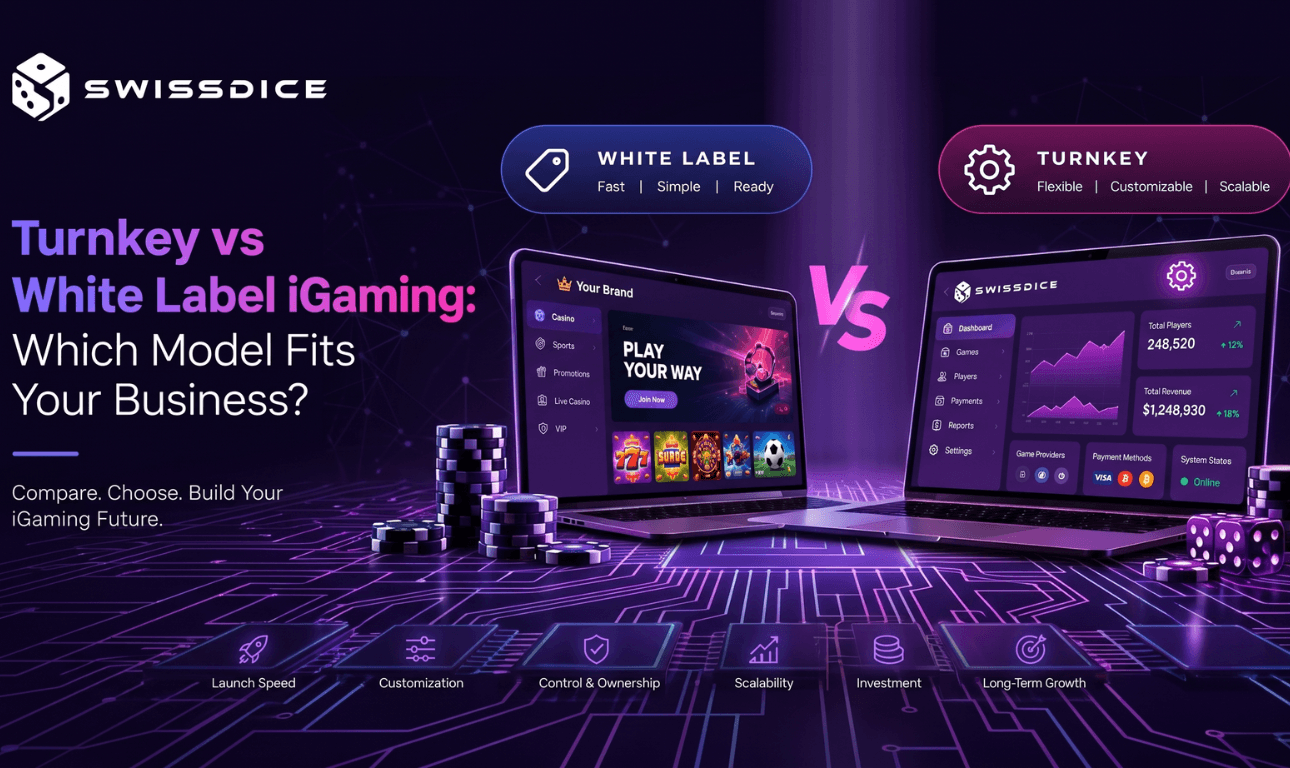
Launching an iGaming business involves more than choosing a casino platform and adding games. The technology model you select can influence your launch timeline, investment, platform control, revenue structure, compliance responsibilities, scalability, and long-term business value.
Two of the most widely used approaches are white label iGaming and turnkey iGaming.
Both allow operators to enter the online gaming market without developing every component from scratch. However, they are designed for different business strategies.
A white label solution generally prioritizes speed, simplicity, and lower technical involvement. A turnkey iGaming platform provides greater customization, operational control, integration flexibility, and scalability.
There is also a third option worth considering: custom iGaming development, which is designed for businesses that require deeper ownership and a highly differentiated technology ecosystem.
So, which model should you choose?
The answer depends on what you are trying to build—not simply how quickly you want to launch.
Turnkey vs White Label iGaming
White label iGaming is generally better for startups, first-time operators, affiliates, and businesses that want to launch quickly with limited technical responsibility.
Turnkey iGaming is generally better for operators that want greater control over branding, integrations, platform functionality, data, and long-term expansion.
Custom iGaming development is better for businesses that require a proprietary platform, unique workflows, specialized features, or deeper technology ownership.
| Business Requirement | White Label | Turnkey | Custom |
| Fast market entry | Excellent | Very good | Low |
| Lower initial investment | Excellent | Moderate | Low |
| Platform customization | Limited | High | Very high |
| Branding flexibility | Moderate | High | Very high |
| Integration flexibility | Provider-dependent | High | Very high |
| Platform control | Limited | High | Very high |
| Data control | Provider-dependent | Greater control | Highest |
| Scalability | Provider-dependent | High | Very high |
| Technical responsibility | Lower | Moderate–high | High |
| Best for | Market entry | Growth-focused operators | Enterprise/proprietary products |
The important point is that white label and turnkey are not simply cheaper and more expensive versions of the same product. They represent different approaches to building and operating an iGaming business.
What Is White Label iGaming?
A white label iGaming solution is a pre-built platform that allows an operator to launch an online casino, sportsbook, or other gaming product under its own brand while relying heavily on an established technology provider.
The provider typically supplies much of the underlying technology and infrastructure.
Depending on the commercial agreement, a white label iGaming platform may include:
- Casino games
- Game aggregation
- Player account management
- Wallet functionality
- Payment integrations
- Bonus management
- CRM tools
- Back-office systems
- KYC and AML integrations
- Reporting
- Hosting
- Technical maintenance
- Security infrastructure
- Customer or technical support
The operator generally concentrates on branding, marketing, player acquisition, promotions, and business growth.
How Does White Label iGaming Work?
The process is usually straightforward:
Select provider → Choose market → Configure brand → Select available products → Configure payments → Complete compliance requirements → Test → Launch
The provider supplies the underlying platform while the operator launches the business using its own brand.
This model can reduce the amount of technical development required before going live.
What Are the Main Benefits of White Label iGaming?
Faster Time to Market
Because the core platform already exists, operators do not need to build a complete casino or gaming ecosystem from the ground up.
This can make white label particularly attractive to businesses testing a new market or validating a new gaming brand.
Lower Initial Technology Investment
The operator typically avoids many of the costs associated with building and maintaining a complete platform infrastructure.
However, lower upfront investment does not necessarily mean lower total cost over the lifetime of the business.
Reduced Technical Complexity
The technology provider generally handles a significant portion of:
- Platform maintenance
- Software updates
- Infrastructure
- Technical support
- Game integrations
- Platform monitoring
This allows operators to focus more heavily on commercial activities.
Ready-Made Gaming Ecosystem
Many white label providers offer access to an existing portfolio of casino games and integrations.
Instead of individually integrating every game provider, the operator can access the provider’s existing ecosystem.
Suitable for Market Testing
If the primary objective is to test:
- A new geographic market
- A new casino brand
- A new acquisition strategy
- A niche gaming concept
white label can provide a relatively efficient starting point.
What Are the Limitations of White Label iGaming?
White label is not automatically the best option simply because it is easier to launch.
The biggest consideration is dependency on the provider.
Limited Customization
Operators may be able to customize logos, colors, layouts, promotions, and other front-end elements, but deeper platform-level changes can be restricted.
Provider Dependency
The provider controls important aspects of the technology ecosystem.
Changes to:
- Platform functionality
- Integrations
- Game availability
- Technical roadmap
- Infrastructure
- Support
may depend on the provider.
Revenue-Sharing Considerations
Some white label arrangements use revenue-sharing or GGR-based commercial models.
This can reduce the operator’s revenue retention compared with certain turnkey arrangements.
The exact commercial model depends on the provider and contract, so operators should evaluate setup fees, platform fees, revenue share, minimum commitments, payment costs, and other charges together.
Limited Technology Ownership
In many white label arrangements, the operator does not own the underlying platform technology.
That can become important when the business grows and requires deeper customization or greater independence.
What Is Turnkey iGaming?
A turnkey iGaming solution is a ready-developed gaming platform that provides the core technology required to operate an online gaming business while giving the operator considerably more control over configuration, integrations, functionality, and user experience.
The platform is already developed, but it can be configured and customized around the operator’s business model.
A turnkey platform can include:
- Casino platform
- Sportsbook integration
- Game aggregation
- Payment gateway integration
- Player account management
- Wallet system
- Bonus engine
- CRM
- Affiliate management
- Risk and fraud controls
- KYC/AML integrations
- Reporting and analytics
- Back-office administration
- API integrations
- Multi-language functionality
- Multi-currency support
- RGS integrations
The exact scope depends on the provider and project requirements.
How Does a Turnkey iGaming Platform Work?
A turnkey project usually starts with a business and technical requirements assessment.
The operator and technology provider define:
Business model → Target markets → Platform requirements → Design → Integrations → Compliance → Testing → Deployment → Support → Scaling
Unlike a simple white label deployment, the operator can have a much stronger influence over how the platform operates.
This makes turnkey particularly suitable for businesses that view the platform as a long-term technology asset.
What Are the Main Benefits of Turnkey iGaming?
Greater Platform Customization
Turnkey platforms can support deeper customization of:
- UI/UX
- Player journeys
- Game lobbies
- Promotions
- Bonus logic
- Wallet workflows
- Reporting
- CRM
- Back-office functionality
- Third-party integrations
This is valuable when differentiation is part of the business strategy.
Greater Operational Control
Operators can have more control over the way their platform operates.
That can include:
- Game management
- Payment configuration
- Player segmentation
- Promotional logic
- Reporting
- User experience
- Business rules
The exact level of control depends on the platform architecture and agreement.
Integration Flexibility
A turnkey platform can be designed to integrate with specific third-party services.
Examples include:
- Payment gateways
- KYC providers
- AML solutions
- Fraud detection systems
- CRM platforms
- Affiliate systems
- Game providers
- Sportsbook providers
- Analytics platforms
- Customer support systems
Better Long-Term Scalability
As an operator grows, its technology requirements often become more complex.
A scalable turnkey architecture can make it easier to:
- Add new game providers
- Introduce new payment methods
- Add new gaming verticals
- Launch additional brands
- Enter new markets
- Expand infrastructure
- Add custom features
Greater Data Control
Data ownership and access should be clearly defined before signing any technology agreement.
Turnkey models can provide operators with greater control over operational and player data than some white label arrangements.
However, data ownership is contractual and architecture-dependent, so it should never be assumed simply because a solution is described as “turnkey.”
What Are the Challenges of Turnkey iGaming?
Greater control also means greater responsibility.
Higher Initial Investment
Turnkey solutions can require more investment because of customization, integrations, infrastructure, compliance requirements, and technical implementation.
Longer Implementation
A turnkey platform may take longer to launch than a basic white label deployment because requirements must be configured, integrated, tested, and approved.
Greater Technical Responsibility
Operators may need access to:
- Developers
- DevOps specialists
- Security professionals
- Product teams
- Technical support
- Compliance specialists
Alternatively, these responsibilities can be outsourced to a technology partner.
More Operational Responsibility
With greater control comes greater accountability for:
- Platform performance
- Security
- Compliance
- Player support
- Payments
- Risk management
- Product updates
This makes turnkey better suited to businesses prepared to operate a technology-driven gaming business.

White Label vs Turnkey vs Custom iGaming: What’s the Difference?
One of the most important decisions is understanding that there are actually three different technology approaches.
White Label iGaming
You use an existing provider ecosystem with your own brand.
Best for: speed and simplicity.
Turnkey iGaming
You use an established platform but have significantly more control over configuration, integrations, branding, and functionality.
Best for: growth and flexibility.
Custom iGaming Platform
You build a platform specifically around your business requirements.
Best for: proprietary technology, maximum differentiation, and deep control.
The right choice depends on how much technology you want to own and how much operational responsibility you are prepared to take.
White Label vs Turnkey vs Custom: Detailed Comparison
| Factor | White Label iGaming | Turnkey iGaming | Custom iGaming |
| Development requirement | Low | Moderate | High |
| Launch speed | Fastest | Fast | Slowest |
| Customization | Limited–moderate | High | Very high |
| Initial investment | Lower | Moderate–high | Highest |
| Technical control | Lower | High | Highest |
| Integration flexibility | Provider-dependent | High | Very high |
| Branding | Available | Extensive | Complete |
| Data access/control | Contract-dependent | Greater potential | Highest potential |
| Scalability | Provider-dependent | High | Designed for requirements |
| Maintenance | Mostly provider-managed | Shared/provider-supported | Operator/team managed |
| Best use case | Market testing | Growth & expansion | Proprietary ecosystem |
Cost of White Label vs Turnkey iGaming
There is no universal price for an iGaming platform.
Anyone providing a single fixed price without understanding the project scope should be treated cautiously.
The total investment can depend on:
- Target jurisdiction
- Gaming verticals
- Number of brands
- Number of games
- Payment methods
- Third-party integrations
- Custom features
- UI/UX requirements
- Infrastructure
- Compliance requirements
- Security requirements
- Technical support
- Licensing arrangements
White Label Cost Structure
A white label arrangement may involve:
- Setup fees
- Platform fees
- Licensing-related costs
- Revenue share
- Payment costs
- Game costs
- Marketing expenses
- Support charges
Turnkey Cost Structure
A turnkey project may involve:
- Platform implementation
- Custom development
- UI/UX
- API integrations
- Infrastructure
- Security
- Licensing
- Game integrations
- Maintenance
- Technical support
Therefore, the better question is not:
“Which model is cheaper?”
Instead ask:
“Which model provides the best total cost of ownership for our expected business scale?”
Revenue Share: An Important Difference to Evaluate
Revenue structure is often overlooked when comparing iGaming technology models.
A white label provider may use a commercial arrangement that includes a percentage of gaming revenue or GGR.
A turnkey agreement may instead use fixed platform, development, licensing, or support fees, although commercial structures vary.
Operators should compare:
Initial investment + recurring platform costs + GGR/revenue share + payment costs + game costs + support + infrastructure
A solution with a lower setup fee may not necessarily be the more economical choice after several years of operation.
Licensing and Compliance: White Label vs Turnkey
Licensing is one of the most important parts of an iGaming business.
The technology model does not automatically determine whether an operator is compliant in every jurisdiction.
Depending on the market and business structure, operators may need to consider:
- Gaming licenses
- KYC
- AML
- Responsible gaming
- Player protection
- Age verification
- Payment regulations
- Data protection
- Technical standards
- Tax requirements
- Advertising restrictions
With white label, some licensing and compliance infrastructure may be provided as part of the provider’s offering.
With turnkey, operators may have greater responsibility for establishing their own regulatory and operational framework.
Always confirm the exact licensing structure with qualified legal and compliance professionals before entering a regulated market.
Which iGaming Model Is Right for Your Business?
Instead of choosing based only on budget, evaluate your business according to six questions.
1. How Fast Do You Need to Launch?
If your objective is rapid market testing, white label can be attractive.
If you can invest more time in implementation for greater flexibility, turnkey may be preferable.
2. How Much Control Do You Need?
If branding and marketing are your main differentiators, white label may be enough.
If technology itself is part of your competitive advantage, consider turnkey or custom development.
3. What Is Your Long-Term Growth Plan?
A single-market experiment and a multi-market iGaming business have very different technology requirements.
For long-term expansion, flexibility becomes increasingly important.
4. Do You Need Custom Integrations?
If your business requires specific payment providers, CRM tools, risk systems, game providers, or proprietary services, assess API and integration flexibility before selecting a model.
5. Who Will Manage Technology?
Ask whether you have:
- An internal technical team
- External developers
- A managed technology partner
- DevOps resources
- Security expertise
The less technical capability you have internally, the more valuable provider-managed infrastructure may become.
6. What Does Success Look Like in Three Years?
This is perhaps the most important question.
Do you want to:
Test one brand?
Choose white label.
Build and scale a serious iGaming operation?
Consider turnkey.
Create proprietary gaming technology?
Consider custom development.
Business Priority vs Recommended iGaming Model
| Business Priority | Recommended Model |
| Launch as quickly as possible | White Label |
| Minimize technical involvement | White Label |
| Test a new market | White Label |
| Build a recognizable casino brand | White Label or Turnkey |
| Need custom integrations | Turnkey |
| Need custom player journeys | Turnkey |
| Expand across multiple markets | Turnkey |
| Require greater data/platform control | Turnkey |
| Build proprietary gaming technology | Custom |
| Need complete platform ownership | Custom |
| Create unique business logic | Custom |
This framework is more useful than simply comparing prices because the right model depends on the business stage and strategic objective.
How to Launch a White Label iGaming Business
A typical white label launch can follow these steps:
Define Your Market
Identify your target jurisdiction, player segment, gaming verticals, currencies, and languages.
Select a Technology Provider
Evaluate:
- Platform stability
- Game portfolio
- Payment options
- Licensing structure
- Security
- Support
- Commercial terms
- Integration capabilities
Develop Your Brand
Configure:
- Logo
- Visual identity
- Website
- Navigation
- Promotions
- Player communication
Configure Games and Payments
Select available game providers and payment methods appropriate for the target market.
Complete Compliance Requirements
Complete the required KYC, AML, responsible gaming, licensing, and other regulatory processes.
Test and Launch
Test:
- Registration
- Deposits
- Withdrawals
- Game sessions
- Bonuses
- Mobile experience
- Account management
- Customer support
Then launch the platform.
How to Launch a Turnkey iGaming Platform
A turnkey project requires a more detailed implementation process.
Business and Technical Discovery
Define the business model, target markets, gaming verticals, revenue strategy, and technical requirements.
Platform Architecture
Determine:
- Front-end
- Back-end
- APIs
- Database
- Infrastructure
- Security
- Gaming integrations
- Payment architecture
UI/UX Development
Create a player experience around your brand and target audience.
Third-Party Integration
Connect:
- Game providers
- Payment gateways
- KYC/AML services
- CRM
- Analytics
- Affiliate platforms
- Risk systems
Compliance & Security
Configure the technology and operating processes according to the target market.
QA and Testing
Conduct functional, security, payment, load, compatibility, and user-experience testing.
Deployment
Deploy the platform to the production environment.
Continuous Optimization
Monitor player behavior, platform performance, conversion, retention, revenue, and operational KPIs.
Can You Move From White Label to Turnkey Later?
Yes, migration can be possible, but it should be planned carefully.
A business may start with white label to validate its market and later move toward a turnkey or custom platform.
This progression can look like:
White Label → Market Validation → Brand Growth → Increased Technology Requirements → Turnkey → Custom Modules
However, migration should be considered before signing the initial white label agreement.
Ask about:
- Data portability
- Player account migration
- Transaction history
- API access
- Domain ownership
- Customer database
- CRM data
- Bonus history
- Game migration
- Payment migration
- Contract termination terms
A low-cost initial solution can become difficult to replace if portability is not addressed from the beginning.
What Should You Ask an iGaming Software Provider?
Before signing an agreement, ask these questions:
Technology
- What platform architecture do you use?
- Is the platform API-first?
- What integrations are supported?
- Can custom APIs be developed?
Ownership
- Who owns the platform?
- Who owns player data?
- Who owns the source code?
- What happens if the contract ends?
Commercials
- Is there a setup fee?
- Is there a monthly platform fee?
- Is there a GGR or revenue share?
- Are there additional integration charges?
Compliance
- Which jurisdictions are supported?
- What licensing responsibilities belong to the operator?
- How are KYC and AML handled?
Scalability
- Can additional brands be launched?
- Can new markets be added?
- Can new payment providers be integrated?
- Can infrastructure scale with player volume?
Support
- Is technical support available 24/7?
- What is the SLA?
- Who handles security updates?
- How are critical incidents handled?
These questions can reveal differences that are not obvious from a product demo.
Why SwissDice for Turnkey and White Label iGaming Solutions?
SwissDice helps businesses select and implement iGaming technology according to their business model, market requirements, product strategy, and growth objectives.
Our iGaming ecosystem can support both rapid market entry and more customized platform requirements.
Our capabilities include:
- Turnkey iGaming platform development
- White label iGaming solutions
- Custom casino game development
- Casino game aggregation
- Game API integration
- Payment gateway integration
- RGS integration
- Bonus and gamification solutions
- Crypto casino solutions
- Custom reporting
- Dedicated technical support
- iGaming consulting
Instead of treating every operator the same, the technology approach can be aligned with the level of control and flexibility the business actually needs.
For a startup validating a new concept, a white label model may provide the right balance of speed and investment.
For an established operator planning multiple brands or markets, turnkey development may provide a stronger foundation.
For businesses building proprietary technology, custom development may be the appropriate next step.
Turnkey vs White Label iGaming: Final Verdict
There is no universally better iGaming model.
The right choice depends on what you want to achieve, how much control you require, and how you expect the business to evolve.
Choose White Label If:
Speed + simplicity + lower technical responsibility are your priorities.
Choose Turnkey If:
Control + customization + scalability are more important.
Choose Custom If:
Technology ownership + differentiation + proprietary functionality are central to your business.
The most important decision is not simply choosing between white label and turnkey.
It is choosing a technology model that can support your business today without creating unnecessary limitations tomorrow.
For operators planning a serious iGaming venture, evaluate the complete picture—including platform control, integrations, licensing, data, commercial structure, scalability, security, support, and exit or migration options.
That is how you turn an iGaming platform from a launch tool into a long-term business asset.
Frequently Asked Questions
What is the difference between turnkey and white label iGaming?
White label iGaming uses an existing provider-managed platform with limited customization, while turnkey iGaming provides a ready-developed platform with greater control over customization, integrations, functionality, and operations.
Is white label iGaming cheaper than turnkey?
White label generally requires less initial technical investment, but total costs depend on platform fees, revenue sharing, licensing, payment processing, game costs, support, and other commercial terms.
Which is faster: turnkey or white label?
White label is generally faster because the platform and much of its infrastructure are already configured. Turnkey can also provide relatively fast deployment, but additional customization and integrations can increase implementation time.
Is turnkey iGaming better for long-term growth?
Turnkey can be better suited to long-term growth when an operator requires greater customization, integration flexibility, platform control, and multi-market scalability.
Can I customize a white label casino?
Some white label platforms allow branding, design, promotions, and selected configuration changes. Deeper functionality and platform-level customization may be restricted by the provider.
Do turnkey iGaming platforms support payment integrations?
Yes. Turnkey platforms can be integrated with payment gateways and other financial services, subject to the platform architecture, target jurisdiction, and provider capabilities.
Who owns player data in a white label iGaming model?
It depends on the contractual and technical structure. Operators should explicitly clarify data ownership, access rights, portability, retention, and exit procedures before signing an agreement.
Can I migrate from white label to turnkey?
Migration can be possible, but the feasibility depends on data portability, APIs, player account architecture, contractual terms, payment systems, and other technical dependencies.
Which model is best for a startup?
A startup focused on rapid market entry and minimal technical complexity may benefit from white label. A startup with sufficient investment and a long-term technology strategy may prefer turnkey.
Which iGaming model gives the most control?
Custom development generally provides the highest potential level of control, followed by turnkey and then white label. However, actual ownership and control depend on the technology agreement and architecture.
Should I choose white label or turnkey for a multi-market casino?
For businesses planning significant multi-market expansion, turnkey can offer greater flexibility for custom integrations, localization, platform configuration, and scaling. The final choice should also account for jurisdiction-specific licensing and compliance requirements.