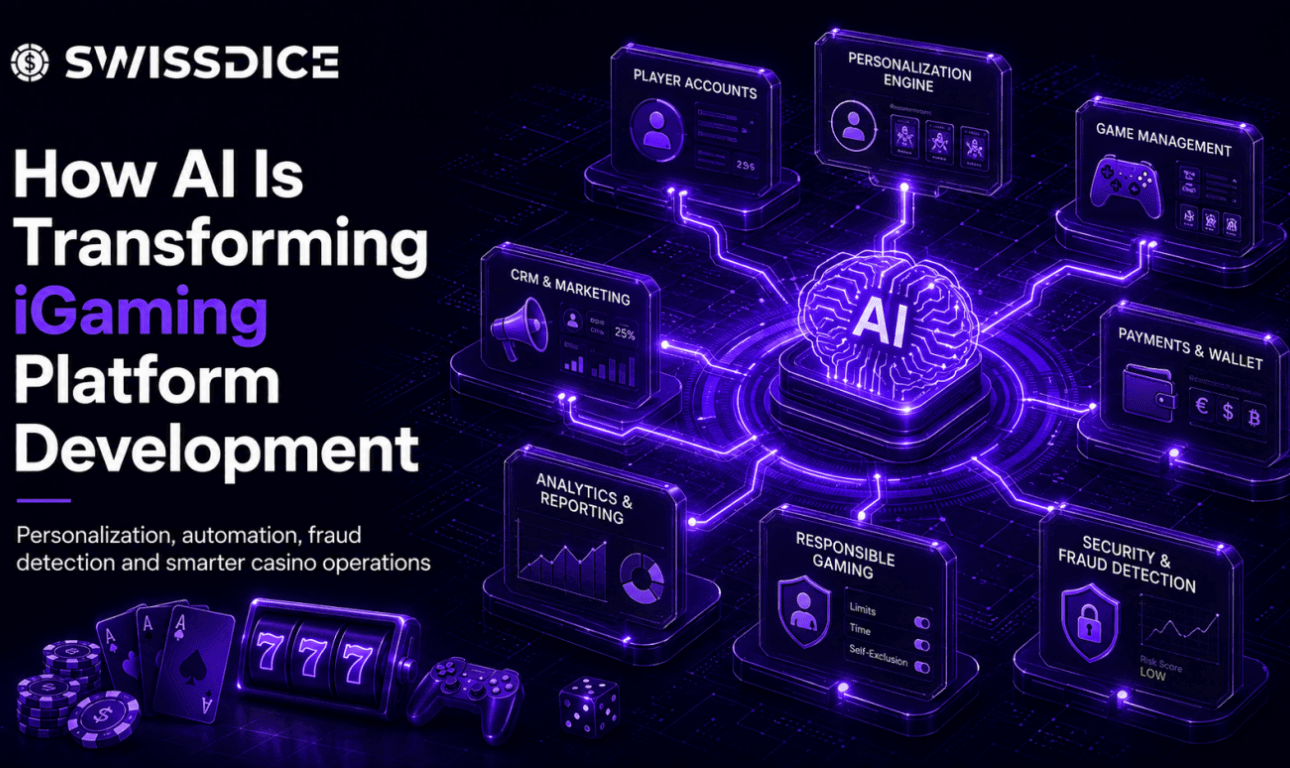
Artificial intelligence is moving from an experimental technology to an increasingly important part of the iGaming technology stack.
In 2026, NEXT.io and The Playa surveyed more than 150 senior decision-makers from operators, platform providers and suppliers. Their research found that approximately four in five iGaming companies already use AI or machine learning in some form.
Separate research from the UNLV International Gaming Institute and KPMG, based on 83 gambling companies, found that the industry’s average AI maturity score was only 45 out of 100. Online operators performed better, scoring an average of 54, compared with 39 for land-based operators. Just one in five companies reported achieving meaningful returns from AI so far.
Those numbers reveal an important distinction.
AI adoption is becoming common. Successful AI implementation is not.
For businesses planning an AI iGaming platform, the challenge is no longer adding a chatbot or generating marketing content with an AI model. The bigger opportunity is designing AI into the data, platform, security, player-management and operational architecture.
This guide explains how artificial intelligence is changing iGaming platform development, where the technology is already delivering value, what operators should build first and which risks should be addressed before AI becomes deeply connected to casino operations.
What Is an AI iGaming Platform?
An AI iGaming platform is an online gaming technology environment that uses artificial intelligence or machine learning to automate, predict, personalize or improve selected platform functions.
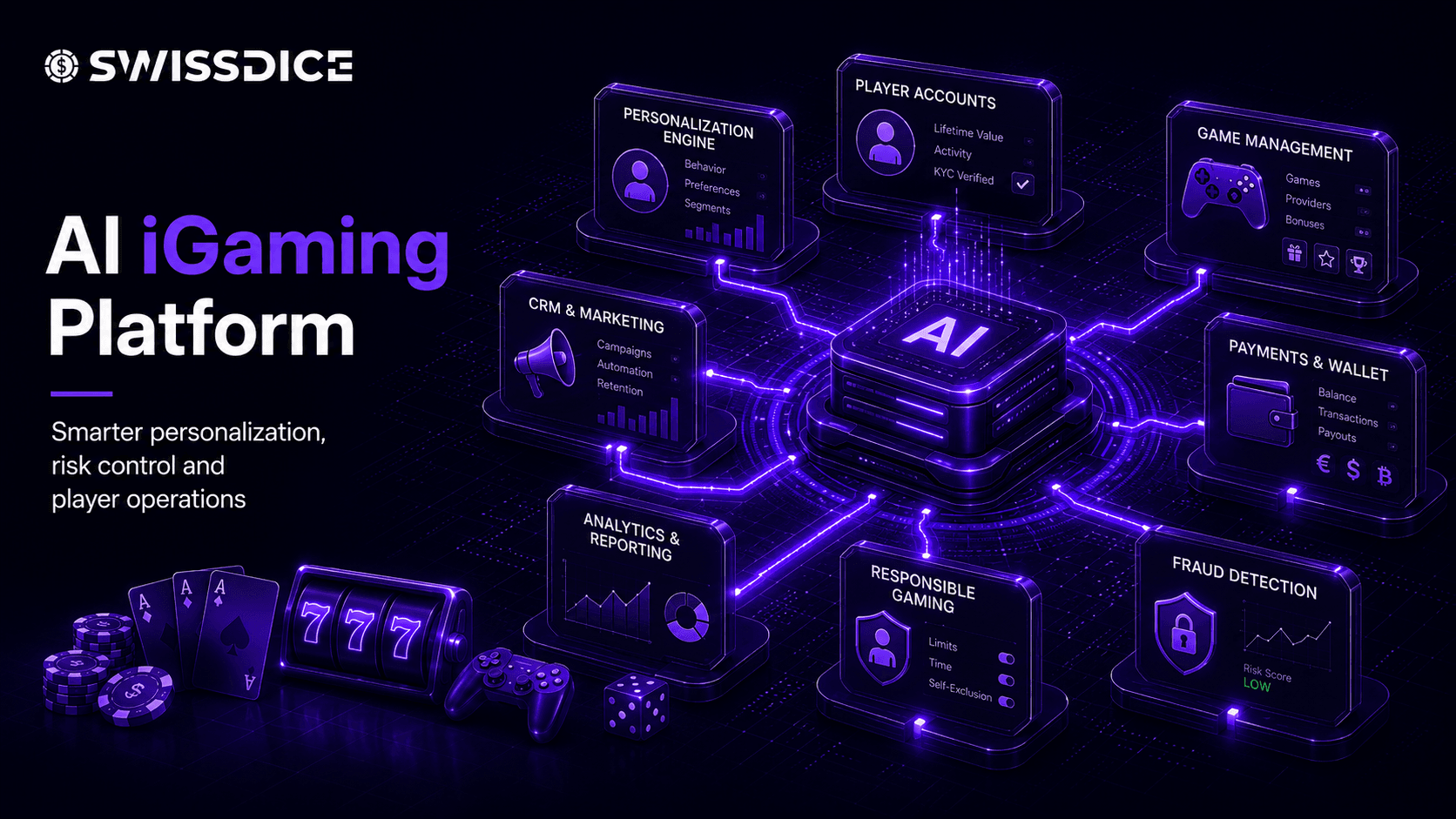
AI can potentially operate across areas such as:
- Player personalization
- Casino lobby recommendations
- CRM and retention
- Fraud detection
- KYC and AML workflows
- Responsible gaming
- Customer support
- Game development
- Software engineering
- QA and testing
- Sportsbook risk management
- Marketing automation
- Payment-risk analysis
- Business intelligence
- Platform monitoring
The important point is that an AI-powered platform is not a separate category of casino software.
AI becomes a technology layer inside the broader iGaming architecture.
A simplified model could look like:
Player Channels
↓
Casino / Sportsbook Frontend
↓
PAM + Wallet + Games + Payments + Bonus Engine + CRM
↓
Data & Event Layer
↓
AI / Machine Learning Services
↓
Recommendations + Risk Scores + Predictions + Automation
↓
Back Office + Operator Decisions + Player Experience
This data layer is critical because AI cannot make useful decisions without reliable and appropriately governed platform information.
AI Adoption in iGaming: What the 2026 Data Shows
The industry’s conversation around AI has shifted quickly.
NEXT.io and The Playa’s 2026 research surveyed more than 150 senior iGaming executives and concluded that AI adoption is now close to universal, with four in five businesses already using AI or machine learning in some capacity. The study covered applications across acquisition, segmentation, predictive analytics, bonus optimization, lobby personalization and customer support.
The KPMG and UNLV State of AI in Gaming 2026 report paints a more nuanced picture.
Among the report’s findings:
- Overall AI maturity across surveyed gaming businesses: 45/100
- Average AI maturity among online operators: 54/100
- Average maturity among land-based operators: 39/100
- Companies reporting meaningful AI ROI: approximately 20%
- Respondents reporting a moderately or strongly supportive AI culture: 66%
- Gaming companies with some responsible-AI practices: approximately 70%
- Companies describing responsible AI as fully embedded throughout the organization: under 5%
AI-related innovation is also becoming more visible across research and intellectual property.
KPMG reports that annual AI-related gaming patent grants increased from 15 in 2010 to 100 in 2025, while AI-focused sessions at industry conferences increased from 3 in 2020 to 81 in 2025.
The takeaway for platform teams is straightforward:
AI is becoming part of iGaming infrastructure, but governance, data quality and implementation maturity remain major differentiators.
How AI Is Changing iGaming Platform Development
AI affects two different sides of platform development.
The first is how developers build the software.
The second is what the finished platform can do.
Understanding this distinction helps operators prioritize investment.
1. AI-Assisted Software Development Is Accelerating Delivery
Generative AI is changing software engineering workflows across iGaming.
Development teams can use AI-assisted tools for:
- Code generation
- Code explanation
- Refactoring
- Unit-test creation
- API documentation
- Technical documentation
- Debugging
- Legacy-code analysis
- Database-query generation
- Prototype development
The goal should not be replacing experienced developers.
It is reducing repetitive engineering work so developers can spend more time on architecture, game logic, integrations, security and business-specific functionality.
There is already a striking real-world iGaming example.
In May 2026, Betsson CTO Fredrik Ögren and Director of Data and AI Cleber de Lima described a development case in which one team’s delivery cycle was reduced from 80 days to five days after reorganizing its development process around AI. The team worked on retention and engagement technology, including bonus and tournament functionality.
That does not mean every project will see a 94% reduction in delivery time.
It demonstrates that AI’s impact can become substantial when workflow, architecture and engineering processes are redesigned around it instead of simply giving developers an AI coding assistant.
Chetu similarly identifies development automation, rapid game prototyping, asset generation, localization and AI-assisted QA as emerging uses of generative AI within iGaming development workflows.
2. AI Is Changing iGaming Product Prototyping
Traditional product development can require separate cycles for:
idea → specification → design → prototype → testing → revision
Generative AI can shorten several of those loops.
During early product development, teams can use AI to explore:
- Casino lobby concepts
- UX variations
- Game mechanics
- Promotional journeys
- Back-office layouts
- Support workflows
- Game artwork concepts
- Product copy
- Localization
- Test data
For casino game development, AI can assist with early:
- Theme exploration
- Character concepts
- Sound concepts
- Interface variations
- Narrative ideas
- Prototype assets
Intellias highlights AI’s ability to accelerate the creation of gaming content, visuals, dialogue, game concepts and other development assets.
Human review remains essential.
AI-generated output may introduce:
- Copyright issues
- Brand inconsistencies
- Hallucinated technical assumptions
- Security vulnerabilities
- Biased content
- Incorrect mathematical logic
For regulated gaming software, fast generation should never replace controlled engineering.
3. AI Is Transforming Software QA and Testing
iGaming platforms contain thousands of interconnected scenarios.
Consider one deposit journey alone:
player → authentication → KYC → cashier → PSP → wallet → bonus eligibility → transaction record → reporting
Now multiply that by:
- currencies
- countries
- games
- payment methods
- bonus rules
- player states
- failed transactions
- device types
Testing this environment manually is difficult.
AI-assisted quality assurance can help generate test cases, identify anomalies and prioritize high-risk workflows.
Chetu identifies use cases including automated scenario simulation, payout-anomaly detection, UI-friction analysis and algorithmic testing.
An AI-assisted QA environment can potentially examine:
API Behavior
Identify unexpected responses between games, payments and platform modules.
Transaction Anomalies
Surface inconsistent wallet or payment behavior.
Regression Risk
Identify functionality most likely to break after a release.
UI Testing
Analyze unusual player journeys or interaction failures.
Log Analysis
Find patterns across large volumes of application and infrastructure logs.
AI therefore has the potential to make QA more continuous rather than something performed only immediately before release.
4. AI Is Creating Personalized Casino Lobbies
One of the most visible AI applications is recommendation technology.
Traditional casino lobbies typically show similar content to most players:
Popular Games
New Games
Slots
Live Casino
Jackpots
An AI-powered casino lobby can behave differently.
Machine-learning systems can analyze signals such as:
- Games previously played
- Game categories
- Session patterns
- Device type
- Time of play
- Language
- Location
- Promotional interactions
The platform can then rank relevant content for each player.
Instead of:
one casino lobby → thousands of players
the model becomes:
player data → recommendation model → individualized lobby
Neural AI describes current personalization applications including game recommendations and customized promotions based on player behavior and betting patterns.
Intellias similarly points to game recommendations, customized content and real-time personalization as important generative-AI applications.
The objective should not simply be maximizing play.
Responsible platform design should also incorporate player-protection rules and avoid personalization strategies that conflict with applicable regulatory requirements.
5. Predictive Analytics Is Changing Player Retention
Traditional CRM often reacts after something happens.
For example:
The player has not logged in for 30 days → send a reactivation campaign.
Predictive AI can identify signals before the player completely disengages.
A churn model might consider patterns such as:
- Declining session frequency
- Reduced engagement
- Fewer deposits
- Changed game preferences
- Reduced promotion interaction
- Support complaints
The platform could produce something like:
Player A → churn probability: elevated
An operator may then use that information within an approved CRM workflow.
This shifts retention from:
reactive segmentation
to:
predictive segmentation
Neural AI highlights predictive analytics for anticipating player behavior, retention and marketing optimization as an increasingly important AI use case in iGaming.
But commercial retention models and responsible-gaming models need clear boundaries.
A player showing declining engagement should not automatically receive increasingly aggressive incentives if other signals suggest gambling-related risk.
6. AI Is Changing Bonus Management
Bonus engines traditionally operate using explicit rules.
For example:
New player + first deposit → welcome bonus
More advanced platforms can use predictive models to inform decisions around:
- Promotion relevance
- Player segmentation
- Bonus abuse
- Campaign targeting
- Offer timing
- Expected redemption
- Promotion cost
- Retention probability
The operator can potentially move from:
one offer for an entire segment
toward:
different approved offers based on predicted relevance
AI can also identify unusual bonus activity such as:
- Multi-accounting
- Coordinated promotion abuse
- Bot activity
- Repeated withdrawal/deposit patterns
- Suspicious referral networks
This makes the bonus engine both a marketing system and a potential risk-data source.
7. AI Is Improving Fraud Detection
Fraud detection is one of the most mature machine-learning applications in iGaming.
Rules-based systems might say:
More than five failed logins → flag account.
Machine learning can identify combinations of signals that would be difficult to describe with one rule.
These can include:
- Login location changes
- Device changes
- Payment behavior
- Unusual betting patterns
- Multi-account relationships
- Velocity
- Session characteristics
- Bonus activity
- Transaction behavior
Neural AI identifies bonus abuse, multi-accounting and unusual player patterns as examples where AI-driven anomaly detection can strengthen iGaming security.
Intellias similarly describes AI being used to analyze behavior, identify threats and improve fraud-detection rules.
However, the threat is also evolving because attackers can use AI themselves.
8. AI Is Making KYC and AML Both Smarter—and Harder
Artificial intelligence can support identity and compliance workflows.
Potential applications include:
- Document analysis
- Biometric verification
- Transaction anomaly detection
- Risk scoring
- Customer screening
- Behavioral analysis
- Device intelligence
But AI creates an adversarial challenge.
The UK Gambling Commission’s 2026 Money Laundering and Terrorist Financing Risk Assessment specifically warns that developments in AI are increasing the sophistication of attempts to bypass customer-due-diligence controls.
The Commission says it has seen increased use of:
- False documentation
- Deepfake videos
- AI-generated face swaps
in attempts to bypass verification.
This is particularly important because Great Britain’s remote casino sector remains rated high risk for money laundering. The sector generated £5.0 billion in gross gambling yield between April 2024 and March 2025, including £4.2 billion from slots.
For platform architects, this changes the security model.
KYC can no longer be treated as:
upload document → verify document
It increasingly needs layered controls around:
identity + device + biometrics + behavior + transaction patterns + human review
AI therefore becomes both part of the defense and part of the threat model.
9. AI Is Becoming Important for Responsible Gaming
One of the most consequential applications of machine learning is identifying potentially harmful gambling behavior earlier.
A responsible-gaming model could analyze patterns involving:
- Deposit frequency
- Deposit escalation
- Session duration
- Late-night activity
- Chasing behavior
- Failed deposits
- Changes in wagering
- Limit changes
- Self-exclusion signals
The platform could then flag a player for an appropriate intervention according to operator policies and regulatory requirements.
Neural AI describes AI-driven responsible-gaming systems that analyze factors including betting frequency, deposits and play duration to identify potentially problematic behavior.
Intellias also identifies automated behavioral monitoring and individualized interventions as areas where AI may strengthen responsible-gaming systems.
Regulators are paying close attention.
The UK Gambling Commission formally published its approach to artificial intelligence in January 2026. Its principles require AI use to be lawful, appropriately transparent and responsible, subject to appropriate human intervention, governance and assurance, and used by people with appropriate expertise.
This suggests that successful AI implementation in regulated iGaming will depend as much on governance as model accuracy.
10. AI Is Transforming Customer Support
Casino and sportsbook support teams repeatedly handle questions such as:
- Where is my withdrawal?
- Why was my bonus rejected?
- How do I verify my account?
- Why is my account restricted?
- What are the wagering requirements?
- How do I reset my password?
Traditional chatbots rely on decision trees.
Generative AI can interpret more natural language and potentially combine information from:
- Help documentation
- Bonus rules
- Account status
- KYC status
- Payment information
- Platform documentation
Neural AI highlights 24/7 AI assistants as a growing application for answering common questions involving deposits, withdrawals, games and technical issues.
The next step is agentic AI.
Instead of:
Player: “Where is my withdrawal?”
AI: “Withdrawals can take 1–3 days.”
an appropriately controlled AI agent could potentially:
identify player → check withdrawal → inspect PSP status → identify issue → create support action → explain result
That difference is important.
Generative AI answers.
Agentic AI can potentially act.
iGaming Business’s 2026 AI market report identifies this shift from generative AI toward agentic systems capable of planning and executing workflows as one of the industry’s emerging technology directions.
11. AI Is Changing iGaming Back-Office Operations
Some of AI’s most useful applications may never be visible to players.
An iGaming back office generates large quantities of information across:
- Players
- Games
- Payments
- Bonuses
- Affiliates
- CRM
- KYC
- Risk
- Customer support
- Infrastructure
AI can help operational teams interrogate those systems more naturally.
For example:
“Show payment methods with the highest failed-deposit rate in Brazil this week.”
or:
“Which casino providers experienced abnormal round failures during the last 24 hours?”
or:
“Summarize the largest changes in first-time depositor conversion compared with last week.”
Instead of building another dashboard for every question, AI can become a conversational interface over governed operational data.
This is likely to become a significant difference between traditional back offices and future AI iGaming platforms.
12. AI Is Improving iGaming Platform Monitoring
Modern iGaming platforms can contain dozens or hundreds of interconnected services.
Failures may originate from:
- Game providers
- PSPs
- KYC providers
- Sports data
- Databases
- APIs
- Wallets
- CDN
- infrastructure
AI-assisted observability can analyze logs, traces, alerts and performance data to identify patterns faster.
Instead of an engineer manually searching thousands of log entries, an AI system could summarize:
“Game-launch failures increased 18 minutes after Provider X API latency exceeded the normal baseline.”
Potential applications include:
- Anomaly detection
- Root-cause suggestions
- Incident summaries
- Log analysis
- Capacity forecasting
- Infrastructure optimization
- Alert prioritization
AI should support—not replace—experienced SRE and DevOps teams, particularly when financial transactions are involved.
13. Generative AI Is Changing Casino Content Operations
Operating a multi-market casino requires large volumes of content.
Examples include:
- Game descriptions
- Landing pages
- Promotional text
- Push notifications
- Email campaigns
- Help articles
- Localization
- Support documentation
Generative AI can accelerate first-draft production and translation workflows.
Chetu highlights rapid multilingual localization and automated content creation among current development applications.
Intellias similarly points to scalable content generation and localization as areas where generative AI can reduce manual development effort.
But regulated marketing requires human oversight.
AI-generated promotional content should pass through checks for:
- Accuracy
- Bonus conditions
- Responsible-gaming requirements
- Jurisdiction rules
- Brand guidelines
- Prohibited claims
Fast content generation is valuable only when editorial and compliance governance scale with it.
14. AI Is Changing Casino Game Development
AI is also beginning to influence how games themselves are created.
Possible development applications include:
Game Ideation
Explore themes, mechanics and player journeys.
Visual Concepts
Generate early artwork directions and design concepts.
Game Prototyping
Accelerate interface and mechanics experiments.
Localization
Prepare text and supporting assets for additional markets.
QA
Generate test scenarios and analyze unexpected behavior.
Analytics
Identify gameplay friction and technical issues after launch.
Intellias argues that generative AI can shorten development workflows and enable more dynamic content and game environments.
However, AI should not be allowed to arbitrarily change regulated casino-game mathematics.
Areas such as:
- RTP
- Probability
- Volatility
- RNG implementation
- Paytables
require controlled mathematical design, validation and—where applicable—independent testing.
AI can assist the development team.
It should not become an uncontrolled mathematical black box.
15. AI Is Changing Sportsbook Platforms
Sportsbooks are particularly data-intensive.
AI and machine-learning models can assist with:
- Odds analysis
- Trading
- Risk exposure
- Market monitoring
- Fraud detection
- Player segmentation
- Sports-data analysis
- Recommendation systems
AI can process large amounts of real-time data faster than traditional manual workflows.
But autonomous pricing and trading require especially strong:
- monitoring
- model governance
- fallback systems
- human oversight
- auditability
because incorrect automated decisions can produce immediate financial exposure.
From Traditional iGaming Platform to AI iGaming Platform
The architectural change can be summarized like this:
| Traditional Platform | AI iGaming Platform |
| Static lobby | Personalized lobby |
| Rule-based CRM | Predictive CRM |
| Manual segmentation | Behavioral segmentation |
| Fixed bonus rules | AI-assisted offer optimization |
| Rules-based fraud checks | ML anomaly detection |
| Reactive responsible gaming | Predictive risk detection |
| Keyword chatbot | Contextual AI assistant |
| Manual reporting | Natural-language analytics |
| Reactive monitoring | Predictive anomaly detection |
| Manual development workflows | AI-assisted engineering |
| Manual test creation | AI-assisted QA |
The platform still needs the traditional systems.
AI does not replace the PAM, wallet, bonus engine or payment layer.
It makes those systems more intelligent when they share reliable data.
Data Architecture Is the Foundation of an AI iGaming Platform
Many operators want AI without first solving their data architecture.
That usually creates disappointing results.
A usable AI environment needs consistent information from systems such as:
- PAM
- Wallet
- Games
- Payments
- CRM
- Bonus engine
- Affiliates
- Customer support
- KYC
- Responsible gaming
- Analytics
Suppose three systems disagree on what counts as an “active player.”
The AI model will inherit that ambiguity.
Before building advanced models, operators should establish:
Event Taxonomy
What does a registration, game launch, deposit, bonus activation or session mean?
Player Identity
How is activity linked to the correct player?
Data Quality
Are events complete and reliable?
Real-Time Data
Which decisions require streaming data rather than daily batches?
Governance
Who can access each dataset?
Retention
How long is data stored?
Consent & Privacy
Can data legitimately be used for the intended AI purpose?
This is why successful AI transformation is often more of a data-engineering project than a model-selection project.
AI Should Not Control Everything
Operators should distinguish between low-risk automation and high-impact decisions.
A useful model is:
AI Can Recommend
Examples:
- Game recommendations
- Support responses
- Marketing segments
- Technical root-cause hypotheses
AI Can Automate With Guardrails
Examples:
- Content classification
- Support ticket routing
- QA generation
- Routine operational reporting
AI Requires Human Oversight
Examples can include:
- Player restrictions
- AML escalation
- Responsible-gaming intervention
- High-impact financial decisions
- Compliance decisions
- Major risk actions
The appropriate level depends on the market, system and regulatory requirements.
The UK Gambling Commission’s current approach explicitly emphasizes appropriate human intervention, governance and assurance when AI is used.
The AI Governance Gap in Gaming
This may become one of the most important competitive issues.
KPMG and UNLV found that approximately 70% of gaming companies have some responsible-AI practices, but fewer than 5% say those practices are embedded throughout the organization.
The research also found that:
58% of regulators surveyed believe the gaming industry cannot effectively self-regulate its AI use.
Only 13% of regulators were aware of licensed operators having internal responsible-AI policies or frameworks.
That suggests operators should build governance alongside technology.
A practical AI governance framework should define:
- Approved AI use cases
- Restricted data
- Model ownership
- Human oversight
- Testing requirements
- Bias evaluation
- Security controls
- Vendor evaluation
- Audit logs
- Incident procedures
- Model monitoring
- Regulatory review
The goal is not slowing AI adoption.
It is avoiding an architecture where nobody can explain why an important automated decision occurred.
Build vs Buy: How Should Operators Add AI?
Operators generally have three options.
Buy AI Features Through Existing Vendors
Examples:
- CRM personalization
- Fraud scoring
- AI support
- KYC automation
Advantage: faster deployment.
Limitation: less control over models and data architecture.
Build Proprietary AI
Develop models and infrastructure internally.
Advantage: maximum control and differentiation.
Limitation: requires substantial AI, data, MLOps and governance expertise.
Hybrid AI Architecture
Use external models and specialized vendors while keeping the operator’s data, orchestration and decision rules under internal platform control.
For many operators, this can be the most practical architecture.
The operator controls:
data + rules + permissions + workflows
while specialized providers supply particular AI capabilities.
A Practical AI iGaming Platform Architecture
A modern architecture could contain six layers.
Layer 1 — Player Experience
- Casino
- Sportsbook
- Mobile
- Web
Layer 2 — Core iGaming Services
- PAM
- Wallet
- Bonus engine
- Games
- Payments
- CRM
- Affiliates
Layer 3 — Data Platform
- Event streaming
- Data warehouse/lakehouse
- Player profiles
- Feature store
- Analytics
Layer 4 — AI Services
- Recommendation models
- Churn models
- Fraud models
- Responsible-gaming models
- Generative AI
- Predictive analytics
Layer 5 — AI Orchestration
Controls:
- When AI runs
- What data it receives
- What actions it can take
- Approval requirements
- Fallback behavior
Layer 6 — Governance & Monitoring
Track:
- Model performance
- Drift
- Bias
- Security
- decisions
- audit history
- regulatory controls
The architecture becomes significantly more important as AI moves from recommendations toward autonomous actions.
How Operators Should Plan AI iGaming Platform Development
Do not begin with:
“We need AI.”
Begin with:
“What business or player problem are we solving?”
A practical roadmap can follow six steps.
1. Define the Use Case
Examples:
- Reduce support workload
- Detect fraud earlier
- Improve game discovery
- Identify player-risk signals
- Accelerate development
2. Audit Available Data
Determine whether the necessary data is:
- Available
- Accurate
- Accessible
- Timely
- legally usable
3. Establish a Baseline
Know current performance before implementing AI.
For example:
Current fraud false-positive rate: X
Without a baseline, ROI cannot be measured reliably.
4. Build a Controlled Pilot
Test one defined workflow.
Avoid connecting an untested model across the entire casino ecosystem.
5. Measure Business + Risk Outcomes
Track metrics such as:
- Accuracy
- false positives
- response time
- operational savings
- player outcomes
- revenue impact
- compliance impact
6. Scale With Governance
Only expand when performance and controls are understood.
This helps close the gap identified by KPMG/UNLV: widespread experimentation but relatively limited proven ROI.
What Will Agentic AI Change Next?
Generative AI creates output.
Agentic AI can potentially perform sequences of actions.
Imagine an approved casino-operations agent receiving:
“Find payment issues affecting Brazilian players today.”
It could potentially:
- Analyze payment data.
- Compare failure rates.
- Identify the affected PSP.
- Check incident logs.
- Generate a summary.
- Create an engineering ticket.
- Alert the payments team.
That is very different from generating a report.
iGaming Business identifies agentic AI as the next stage of the industry’s automation journey, moving from response generation toward systems capable of planning and executing workflows.
But agentic architecture also increases risk.
Every AI agent needs clearly defined:
- Permissions
- Tool access
- financial limits
- approval requirements
- audit trails
- rollback mechanisms
Giving an AI access to a knowledge base is one thing.
Giving it access to wallets, player restrictions or payment systems is another.
Challenges of Building an AI iGaming Platform
Legacy Architecture
Older platforms may lack clean APIs and centralized data.
Data Silos
PAM, CRM, wallet and game systems may store inconsistent player information.
Regulatory Complexity
Different markets may impose different expectations regarding automated decision-making and player protection.
Explainability
Operators may need to understand why models flagged a player or transaction.
Privacy
Personalization depends on behavioral data that must be handled appropriately.
Cybersecurity
AI systems create new integrations, credentials and attack surfaces.
Model Drift
Behavior can change over time, reducing model accuracy.
AI-Enabled Fraud
Deepfakes and synthetic documents make identity verification harder.
ROI Measurement
A technically impressive model is not necessarily commercially valuable.
These constraints explain why AI maturity remains behind adoption.
What Should an AI iGaming Platform Measure?
AI projects should have measurable outcomes.
Development
- Release cycle time
- defects
- test coverage
- developer productivity
Personalization
- recommendation interaction
- discovery
- conversion
Fraud
- fraud detected
- false-positive rate
- prevented losses
Support
- resolution time
- escalation rate
- first-contact resolution
Responsible Gaming
- model precision
- intervention effectiveness
- false positives
Infrastructure
- incident-detection time
- downtime
- anomaly-detection precision
Do not use “AI implemented” as a KPI.
The objective is measurable product or operational improvement.
AI in iGaming: Opportunity vs Risk
| AI Opportunity | Platform Risk |
| Faster development | Insecure generated code |
| Personalization | Excessive behavioral targeting |
| Fraud detection | False positives |
| Automated KYC | AI-powered identity fraud |
| Responsible gaming | Incorrect risk classification |
| Customer support | Hallucinated answers |
| Predictive analytics | Biased predictions |
| Agentic automation | Unauthorized actions |
| Content generation | Regulatory inaccuracies |
| AI game development | Uncontrolled game logic |
Good AI architecture manages both sides of this table.
How SwissDice Approaches AI iGaming Platform Development
SwissDice develops iGaming technology across platforms, casino products, integrations, payments, game development, RGS infrastructure and supporting backend systems.
An AI iGaming platform should therefore be approached as an integrated architecture rather than a standalone AI feature.
Depending on project requirements, AI-oriented development can be designed around areas such as:
AI-Ready Data Architecture
Structure platform events and data so analytics and machine-learning services can use them effectively.
Intelligent Player Segmentation
Connect approved behavioral models with CRM and player-management workflows.
AI-Driven Casino Personalization
Develop recommendation layers for relevant casino content and player experiences.
Fraud & Risk Integrations
Connect machine-learning and anomaly-detection technology with player, payment and transaction workflows.
AI-Assisted Customer Support
Integrate conversational AI with appropriate support knowledge and account systems.
Operational Analytics
Use AI-assisted reporting and anomaly detection across relevant platform information.
AI-Assisted Development
Apply appropriate generative AI tools across engineering, QA, documentation and development workflows.
Responsible AI Architecture
Design permissions, human review, logging and governance around AI-driven platform functions.
The appropriate AI strategy depends on the operator’s data maturity, platform architecture, jurisdiction and business objectives.
Frequently Asked Questions About AI iGaming Platforms
What is an AI iGaming platform?
An AI iGaming platform is an online gaming environment that uses artificial intelligence or machine learning within areas such as personalization, fraud detection, CRM, responsible gaming, customer support, analytics, software development or operational automation.
How is AI changing iGaming platform development?
AI can accelerate coding, prototyping, documentation, testing and debugging while also enabling new platform functionality such as recommendations, predictive analytics, fraud detection and automated customer support.
How widely is AI used in iGaming?
A 2026 NEXT.io/The Playa survey of more than 150 senior industry decision-makers found that roughly four in five iGaming companies already use AI or machine learning in some form.
Is AI delivering ROI for iGaming operators?
Results remain mixed. KPMG and UNLV’s 2026 research found that only about one in five surveyed gaming companies reported meaningful AI returns, despite widespread adoption and investment.
Can AI personalize an online casino?
Yes. AI can analyze approved behavioral signals to rank games, segment users, personalize content and support relevant promotions. The design must still respect responsible-gaming, privacy and regulatory requirements.
Can AI detect gambling fraud?
Machine-learning models can help identify anomalous behavior associated with account takeover, bonus abuse, multi-accounting and suspicious transactions. AI should normally complement rules and human review rather than operate as an unquestioned source of truth.
Can AI improve responsible gaming?
AI can potentially detect behavioral patterns associated with increased gambling risk and support earlier intervention workflows. Models need appropriate validation, governance and human oversight.
Can AI automate KYC?
AI can assist document analysis, biometric verification and anomaly detection. However, AI is also increasingly used by attackers to create deepfakes and synthetic documents, so identity architecture requires multiple layers of protection.
Will AI replace iGaming developers?
AI is more likely to change developer workflows than remove the need for experienced engineers. Platform architecture, security, integrations, game mathematics and regulated-system design continue to require specialist expertise.
What is agentic AI in iGaming?
Agentic AI refers to systems capable of planning and executing multi-step actions rather than only generating an answer. Potential applications include support workflows, reporting, monitoring and back-office automation, but these systems require strict permission and governance controls.
Final Thoughts: AI Is Becoming Part of the iGaming Platform Stack
The transformation of iGaming is not about putting an AI chatbot on top of an existing casino platform.
The deeper shift is architectural.
AI is becoming connected with:
development + data + personalization + CRM + fraud + KYC + responsible gaming + support + analytics + operations
The 2026 evidence shows that adoption is already widespread, but maturity and measurable returns remain much lower.
That creates an opportunity for operators building the next generation of gaming technology.
Instead of asking:
“Where can we add AI?”
ask:
“Where can AI produce a measurable improvement, what data does it need, what can it control, and how will we govern it?”
That is the difference between adding AI features and building a genuinely intelligent AI iGaming platform.