
Crash Game Builder
Build and configure real-time crash games with technology for round management, multiplier mechanics, betting, cash-out, player sessions, wallet connectivity and backend integration.
SwissDice provides crash game builder technology for gaming businesses, studios and iGaming technology providers that want to create configurable crash gaming experiences and connect them with the infrastructure required for testing, deployment and distribution.

Build and Configure Real-Time Crash Games
A crash game builder provides a structured environment for configuring the mechanics and technology behind a crash-style gaming experience.
Unlike a simple game interface, a production crash game requires backend infrastructure capable of managing rounds, processing bets, updating multiplier states, handling player cash-outs and settling results.
SwissDice's crash game technology can be designed around the complete lifecycle from game configuration and round management through wallet integration, testing and backend deployment.
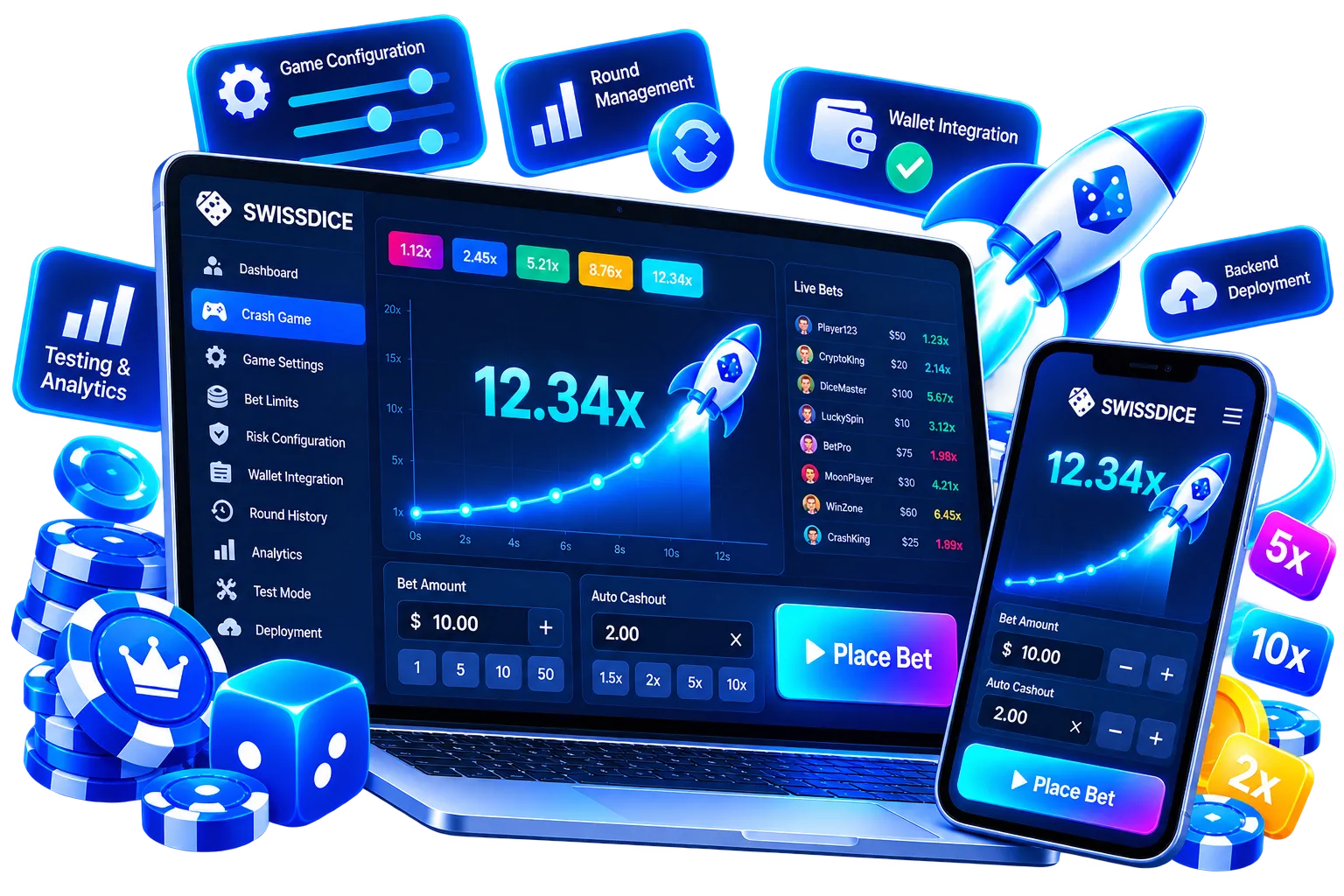
What Is a Crash Game Builder?
A crash game builder is software used to create and configure games in which a multiplier changes during a real-time round and players can act according to the defined game mechanics before the round ends.
Depending on the architecture, a crash game builder can provide control over:

Round configuration

Multiplier behaviour

Betting rules

Cash-out rules

Auto cash-out

Player sessions

Game history

Game interface

Wallet integration
Game mathematics

Reporting

Backend connectivity
How Does a Crash Game Builder Work?
A typical crash game follows a continuous round lifecycle.

Game Configuration
The game team defines the supported mechanics, betting parameters, multiplier behaviour, cash-out rules and other game settings.
Round Creation
The backend creates and initializes a new game round with a unique round identifier.
Bet Placement
Players submit their bets during the permitted betting period. The backend validates the player session, account and transaction requirements.

Round Execution
Once the round begins, the game engine manages the active round and provides the current game state to connected players.
Multiplier Updates
The multiplier changes during the round according to the configured game model. Real-time updates are communicated to connected players.
Cash-Out
Players can manually cash out before the round ends. Where supported, auto cash-out can automatically trigger a cash-out at a predefined multiplier.
Round End and Settlement
When the round ends, the backend finalizes the outcome, processes applicable settlements and records the completed round.
Crash Game Builder Features
Round Management
Create, start, manage and close game rounds through a centralized backend environment.
Multiplier Configuration
Configure the multiplier behaviour and related game parameters according to the intended mathematical model.
Bet Management
Support the required betting lifecycle, including bet placement, validation, acceptance and transaction processing.
Manual Cash-Out
Allow players to initiate cash-out during an active round according to the configured game rules.
Auto Cash-Out
Provide predefined cash-out settings that can automatically trigger an eligible player action at a configured multiplier.
Multiple Betting Positions
Where supported by the game design, players can manage multiple betting positions within a round.
Player Sessions
Manage active player sessions and maintain the required connection between the player interface and backend game state.
Round History
Maintain historical round information so players and administrators can review completed game activity.

Administration
Provide controls for game configuration, monitoring, player activity, round management and operational reporting.
Real-Time Crash Game Architecture
Real-time communication is a fundamental part of crash game technology because multiple connected players need to receive consistent game-state updates.
Player Interface
Provides the visual crash game experience and player interaction controls.
Real-Time Communication
Transfers game-state updates between the backend and connected players according to the implementation architecture.
Crash Game Engine
Controls round execution, game rules, multiplier behaviour and supported gameplay logic.
Round State
Maintains the current state of the active round so connected players receive consistent information.
Wallet and API Layer
Connects the game with player accounts, wallets and other required platform services.
Settlement
Processes the financial result of eligible bets and cash-out events according to the configured game rules.
Reporting
Records supported game activity, round information, transactions and operational data.
Crash Game Mathematics and Fairness
The mathematical model behind a crash game determines how outcomes and multiplier behaviour are generated.
Multiplier Model
The multiplier behaviour should be defined according to the intended game mathematics and gameplay experience.

Probability and RTP
The mathematical model can be evaluated against defined probability and RTP requirements where applicable.

House Edge
Where the product uses a house-edge model, the expected relationship between player returns and operator margin should be defined as part of the mathematical design.
Fairness Model
The outcome-generation and fairness approach should be defined during architecture according to the business, technical and regulatory requirements.
Where a specific provably fair model is required, the appropriate verification mechanism should be designed and tested as part of the implementation.

Simulation and Statistical Testing
Large-scale simulations can be used to compare observed outcomes with the expected mathematical model before deployment.
Crash Game Wallet and Transaction Integration
A crash game typically requires close coordination between the game engine and player wallet.
Bet transactions
Balance validation
Cash-out transactions

Settlement
Balance updates
Transaction history

Player account communication
Crash Game Testing and Validation
Crash games require testing across real-time gameplay, mathematical behaviour and transaction processing.
Game Logic Testing
Validate round states, betting periods, multiplier behaviour, cash-out rules and round completion.

Real-Time Testing
Evaluate game-state communication and consistency for multiple connected players.
Mathematical Testing
Compare simulated outcomes with the intended mathematical model, RTP and probability requirements.
Cash-Out Testing
Test manual and automated cash-out scenarios across different round conditions.

Transaction Testing
Verify betting, cash-out and settlement communication with the wallet environment.

Edge-Case Testing
Test scenarios such as disconnected players, interrupted sessions, failed transactions and unexpected client states.

Performance Testing
Evaluate backend and real-time communication performance under expected player and round volumes.
RGS Integration and Crash Game Distribution
Crash games can connect with an RGS or suitable gaming backend when the architecture supports the required integration.
Target Environment Architecture
The appropriate architecture depends on the RGS, platform and API requirements of the target environment.

Deployment & Distribution
Once integrated and tested, crash games can be prepared for deployment and distribution through supported gaming platforms.
Game execution

Game configuration
Player sessions
API communication
Game reporting

Operator connectivity

Distribution
Crash Game Builder for Different Businesses
Tailored technology architecture for gaming studios, platform operators, providers and emerging ventures.

Game Studios
Create proprietary crash games while maintaining control over game mechanics, configuration and content.
Casino Operators
Develop crash gaming experiences that can be integrated into an existing casino or gaming platform.
iGaming Technology Providers
Add configurable crash game technology to a broader gaming ecosystem.
Gaming Startups
Build an initial crash product with an architecture that can support future configuration and platform integrations.
Crash Game Customization Options
The level of customization can be aligned with the business and technical requirements of the project.
Round lifecycle
Multiplier model
Betting rules
Cash-out rules
Auto cash-out

Multiple betting positions

Game interface
Game history
Player sessions
Wallet integration

Game mathematics
Reporting
RGS integration
API connectivity
Why Choose SwissDice for Crash Game Builder Technology?
SwissDice combines real-time game technology with RGS, API, wallet and iGaming platform capabilities.
This allows crash game projects to be considered as part of a complete gaming ecosystem rather than as an isolated frontend.
Game Configuration
Round Engine
Real-Time State
Betting
Cash-Out
Settlement
RGS/API

Platform
Distribution
Custom Game Development
Bespoke game design, mechanics, frontend interfaces and mathematical models tailored to your brand.
RGS Technology
Remote Game Server architecture supporting round state, RNG fairness, session orchestration and reporting.
Games API Integration
Standardized API communication for seamless wallet connectivity, bet lifecycle events and settlement.
Gaming Platform Connectivity
Broad casino platform, aggregator and distribution network integrations for rapid market launch.