iGaming Security, Fraud & Anti-Collusion Engineering
Build prevention and investigation tools around defined threats, permitted data and a reviewable operating process.
Define your security boundary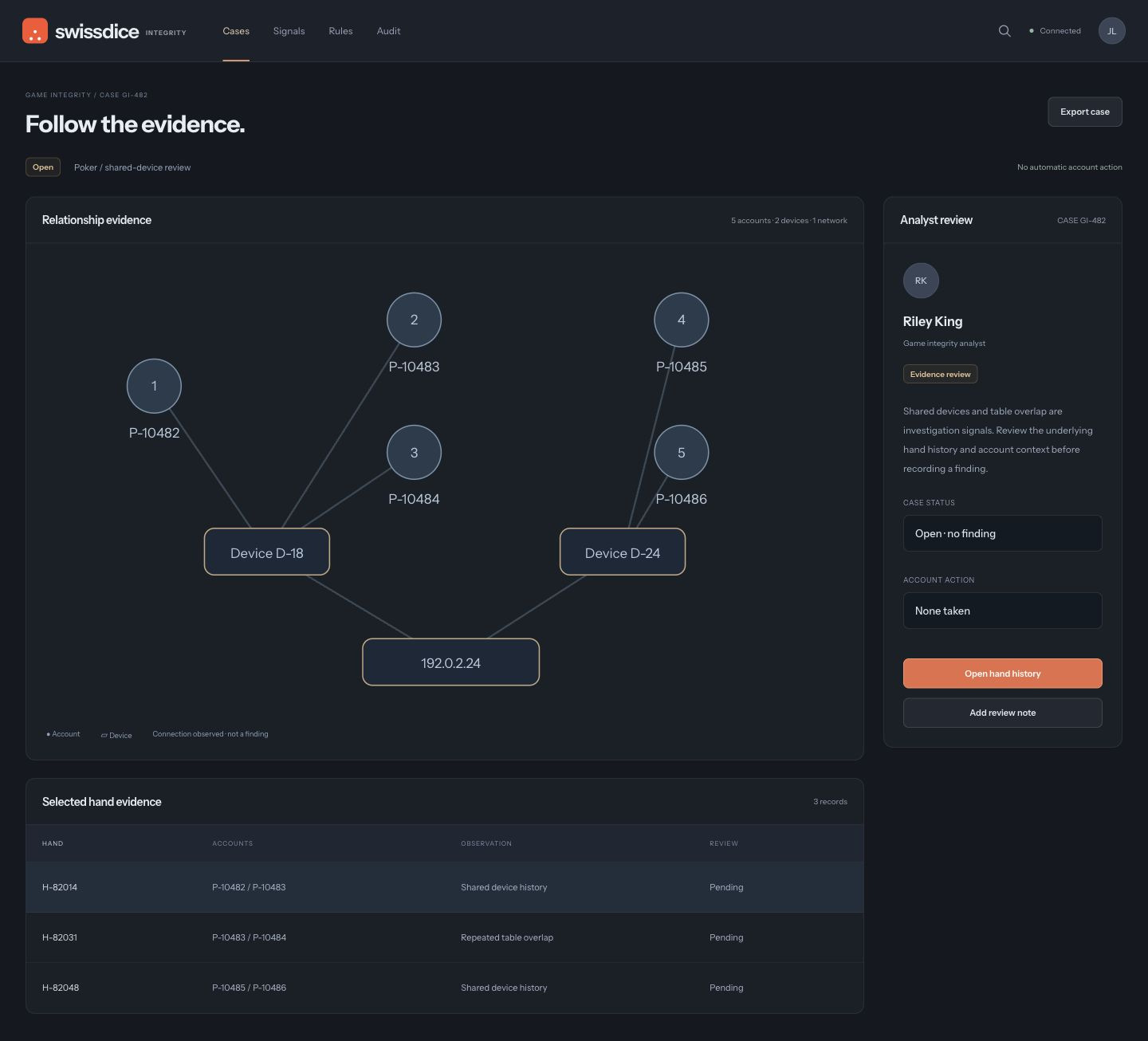
What does iGaming security engineering cover?
iGaming security engineering implements technical controls against defined threats. Fraud and anti-collusion systems support detection and investigation of suspicious behavior, but they do not guarantee that abuse is impossible. A useful scope combines prevention, relevant signals, permissioned decisions, audit evidence and an operating process for reviewing cases and false positives.
Player access.
Staff authority.
Provider trust.
iGaming security engineering: threats, access and trusted interfaces
The assessment covers player authentication, staff access, provider callbacks, tenant boundaries and financial actions in the agreed system. We identify assets, actors and trusted interfaces, then choose controls and tests appropriate to the risk. A protected homepage or WAF alone does not establish that account and wallet APIs are safe.
The security brief identifies application/API assets, player and staff roles, authentication and session recovery, administrative privileges, provider trust and tenant isolation. It records where rate limits, validation, step-up authentication, secrets and audit controls belong. Engineering, automated scanning, an independently scoped penetration test and staffed incident response produce different evidence. The proposal names the agreed assessment environment, permitted methods, exclusions and finding owners before testing or remediation starts.
- Authentication and authorization requirements
- Provider, admin and tenant trust boundaries
- Sensitive data and secret-handling controls
Poker anti-collusion and fraud investigation workflows
Device, account, payment and gameplay information can inform a case where the operator is permitted to use it. We define the purpose and limits of each signal, what staff can see and how a decision is recorded. Collusion and bot investigations need context such as hand histories and linked events, not an unexplained score with automatic punitive action.
Game-integrity requirements are specified separately from identity or payment fraud. A poker investigation may need completed-hand actions, table/tournament and participant references, relevant account relationships, rule/model versions and a defined observation window. Shared device or network information is a signal with possible innocent explanations. The review workflow retains the evidence, confidence and limitations, false-positive or reopened-case history, decision owner and any approved restriction. Access to private game information and financial adjustments has its own authorization boundary.
- Fraud and collusion-provider integration
- Case evidence and permissioned review tools
- False-positive, escalation and appeal inputs
Security assessment, fraud signals and review questions
Discuss your requirementsCan you guarantee zero fraud or hacking?
No. Controls reduce defined risks but cannot establish that every attack or abuse case is impossible. We document the assessed scope, test results, unresolved findings and the operational response needed after release.
Is a penetration test included?
It can be separately scoped or coordinated with an independent specialist. Application engineering, automated scanning and a penetration test answer different questions, so their responsibilities and evidence should be explicit.
Can fraud detection automatically close accounts?
Only within an approved operating policy and authorization model. Sensitive decisions need suitable evidence, review and audit history; a model score should not silently bypass the platform’s account controls.
How is poker collusion investigated?
The software can provide relevant hand histories, account relationships and behavioral signals under appropriate access controls. The operator needs a defined review process, and technical tools do not guarantee that all collusion is detected.
How do poker anti-collusion tools differ from payment-fraud tools?
Payment/account tools examine signals such as identity, device relationships, account access and transactions. Poker integrity also requires game context: completed hand histories, actions, table/tournament references and a defined sample. Chip dumping, coordinated play, bots and multi-accounting are distinct hypotheses with different evidence. We specify the permitted inputs, review interface and rule/model evaluation for the selected games. A suspicious pattern or shared IP is not by itself a finding of collusion or authority to confiscate funds.
Can security work cover an existing casino or sportsbook platform?
A takeover begins with the available code, API/provider contracts, environments, architecture and authorized access. We agree the threat scope, permitted assessment methods, finding severity and remediation ownership. Missing source or supplier rights can limit what can be tested or changed. Tests use an approved environment and data; disruptive production testing is separately planned. Engineering fixes, independent penetration testing and ongoing incident response are identified as separate responsibilities.
What is included in security development cost and handover?
Cost follows the system boundaries, access model, integrations, investigation features, testing depth and remediation scope. Specialist assessments, licensed fraud products and staffed response are separate items when required. Handover includes the threat/control map, implemented configuration and code rights, finding/retest evidence, unresolved risks and operating escalation instructions. Rule/model changes need versioned evaluation and false-positive review. Acceptance demonstrates agreed controls and scenarios; it does not promise zero fraud or a permanently attack-proof system.
Finding → owner →
remediation → recheck.
Retain reproducible evidence and incident context. A scanner, WAF or isolated fix does not establish whole-platform assurance.
Verify fixes and operational readiness
Security findings need reproducible evidence, remediation ownership and a recheck. We scope logging, alerts and incident response without exposing secrets or unnecessary player data. Testing includes attempts to bypass roles, repeat financial commands, cross account boundaries or submit untrusted provider data, with the exact assessment limits recorded.
- Risk-based security acceptance scenarios
- Remediation and independent test coordination
- Incident evidence and response runbooks
Threat findings, review signals and verified fixes
- Threat and trust-boundary model
- Security and authorization requirements
- Fraud or collusion investigation workflows
- Implemented controls and test evidence
- Prioritized findings and remediation register
- Monitoring and incident-response documentation
Follow the risk from account access to financial events
Trace threats across account and financial journeys
Inventory the relevant assets, access paths and game or payment events. Agree review access and separate technical weaknesses from fraud-policy decisions before the assessment begins.
Implement prioritized controls and investigation signals
Build or improve the selected safeguards and review workflows around documented findings. Keep signal quality, role access and the evidence behind an operator decision inspectable.
Verify fixes and operational response
Retest the scoped issues and exercise adverse account or transaction scenarios. Deliver supporting evidence and escalation guidance without treating a technical review as a blanket security guarantee.
Focus your security and fraud controls
Describe the system boundary, abuse patterns or security concerns and the controls already in place. We will scope threat assessment, detection or prevention work, investigation access and validation without assuming every flagged event is confirmed fraud.
Let’s build