
Plinko Game Builder
Build and configure Plinko games with flexible technology for board layouts, rows, multipliers, risk profiles, probability models, visual presentation and backend integration.
SwissDice provides Plinko game builder technology for gaming businesses, studios and iGaming technology providers that want greater control over Plinko game configuration, mathematics, testing and deployment.

Build and Configure Plinko Games
A Plinko game builder provides a structured environment for configuring the mechanics and presentation of a Plinko-style game without treating every game variation as an entirely separate technology implementation.
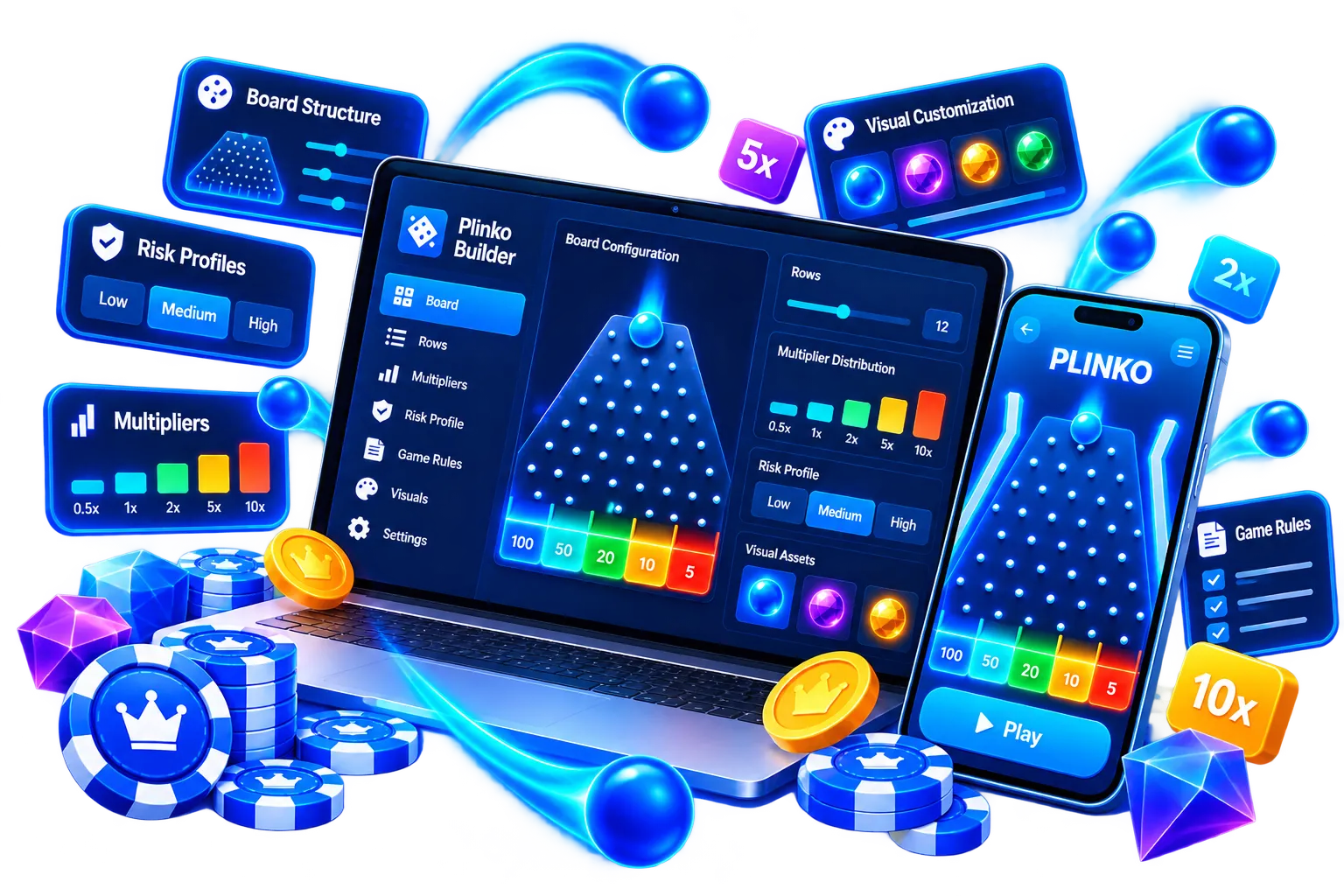
Depending on the architecture, businesses can configure board structures, rows, multiplier distributions, risk profiles, game rules, mathematical parameters and visual assets while connecting the game with the required backend infrastructure.
This makes the builder suitable for businesses creating proprietary Plinko content or adding configurable Plinko experiences to a wider gaming ecosystem.
What Is a Plinko Game Builder?
A Plinko game builder is software used to create and configure games based on a pegboard-style structure where a ball or game object follows a defined path toward possible outcome positions.
The final outcome can be associated with different multipliers or reward values according to the game's mathematical model.
A configurable builder can provide control over:

Board structure

Number of rows

Ball-path mechanics

Landing positions

Multiplier configurations

Risk profiles

Game rules

Probability models

RTP requirements

Visual assets

Backend connectivity
The exact capabilities depend on the builder architecture and the game model being implemented.
How Does a Plinko Game Builder Work?
A typical Plinko game builder follows a workflow from game configuration through testing and deployment.

Game Configuration
The game team defines the board, rows, outcome positions, multipliers and supported game rules.
Probability Model
The probability model determines how possible outcomes are distributed across the available positions.
Outcome Generation
The game engine processes the configured mechanics and mathematical model to determine the outcome of each game round.
Game Execution
The player-facing game client displays the configured board and game behaviour while communicating with the backend environment.
Backend Communication
The game can communicate with an RGS, gaming platform, wallet and other required systems through supported APIs.
Result and Reporting
Game results and relevant activity can be recorded for reporting, administration and operational monitoring.
Plinko Game Builder Features
Board Configuration
Configure the structure of the Plinko board according to the intended gameplay experience.
Row Configuration
Define the number and arrangement of rows through which the ball travels.
Multipliers
Configure potential outcome multipliers according to the game's mathematical and risk model.
Risk Profiles
Create different risk configurations by adjusting the relationship between probability distributions and potential outcomes where supported by the architecture.
Game Rules
Define the rules that control gameplay, round processing and supported game behaviour.
Visual Assets
Configure the visual presentation of the board, ball movement, multipliers and other game elements.
Plinko Game Mathematics and Probability
Probability and mathematics are central to Plinko game design because the distribution of possible outcomes affects both gameplay and expected results.
Depending on the implementation, mathematical configuration can consider:
Board structure
Number of rows
Possible landing positions
Multiplier distribution
Risk profiles
Outcome probabilities
RTP
Round behaviour
Mathematical simulations
A structured mathematical layer allows teams to evaluate whether the configured game behaves according to its intended model before deployment.
Probability Distribution
The configuration can define how possible outcomes are distributed across the board and available multiplier positions.
RTP
Where supported, the mathematical model can be configured and evaluated against a defined RTP requirement.
Risk Levels
Different risk profiles can be designed by changing the relationship between lower-probability outcomes and higher-value multipliers.
Multiplier Distribution
Multiplier values can be arranged according to the intended mathematical model and player experience.
Mathematical Simulation
Simulation can be used to evaluate large numbers of game rounds and identify differences between the expected and observed behaviour of the configured model.
Plinko Game Testing and Validation
Plinko games should be tested across both technical and mathematical requirements before production deployment.
Game Logic Testing
Validate board behaviour, game rules, round processing and outcome handling.
Probability Testing
Evaluate whether observed outcome distributions align with the intended mathematical model.
RTP Testing
Test expected RTP behaviour over appropriate simulation ranges and according to the defined game model.
Multiplier Testing
Verify multiplier configuration, display and outcome processing.
Integration Testing
Test communication between the game and connected RGS, APIs, wallets or gaming platforms.
Performance Testing
Evaluate response times, backend communication and system behaviour under expected usage conditions.
Plinko Game Architecture
A Plinko game can operate as part of a broader gaming technology architecture.
A typical implementation may include:
Game Client
Provides the player-facing Plinko interface and visual gameplay experience.
Game Engine
Processes the configured game rules and gameplay flow.
Probability and Outcome Layer
Applies the mathematical model and processes the game's outcome logic according to the configured architecture.
RGS
Provides backend infrastructure for supported game execution, configuration and operator connectivity.
API Layer
Connects the game with required gaming systems and external services.
Wallet
Handles supported balance and transaction communication where wallet integration is required.
Gaming Platform
Provides the wider environment through which the game can be offered to players.
Reporting
Captures supported game and operational data for monitoring and administration.
RGS and Gaming Platform Integration
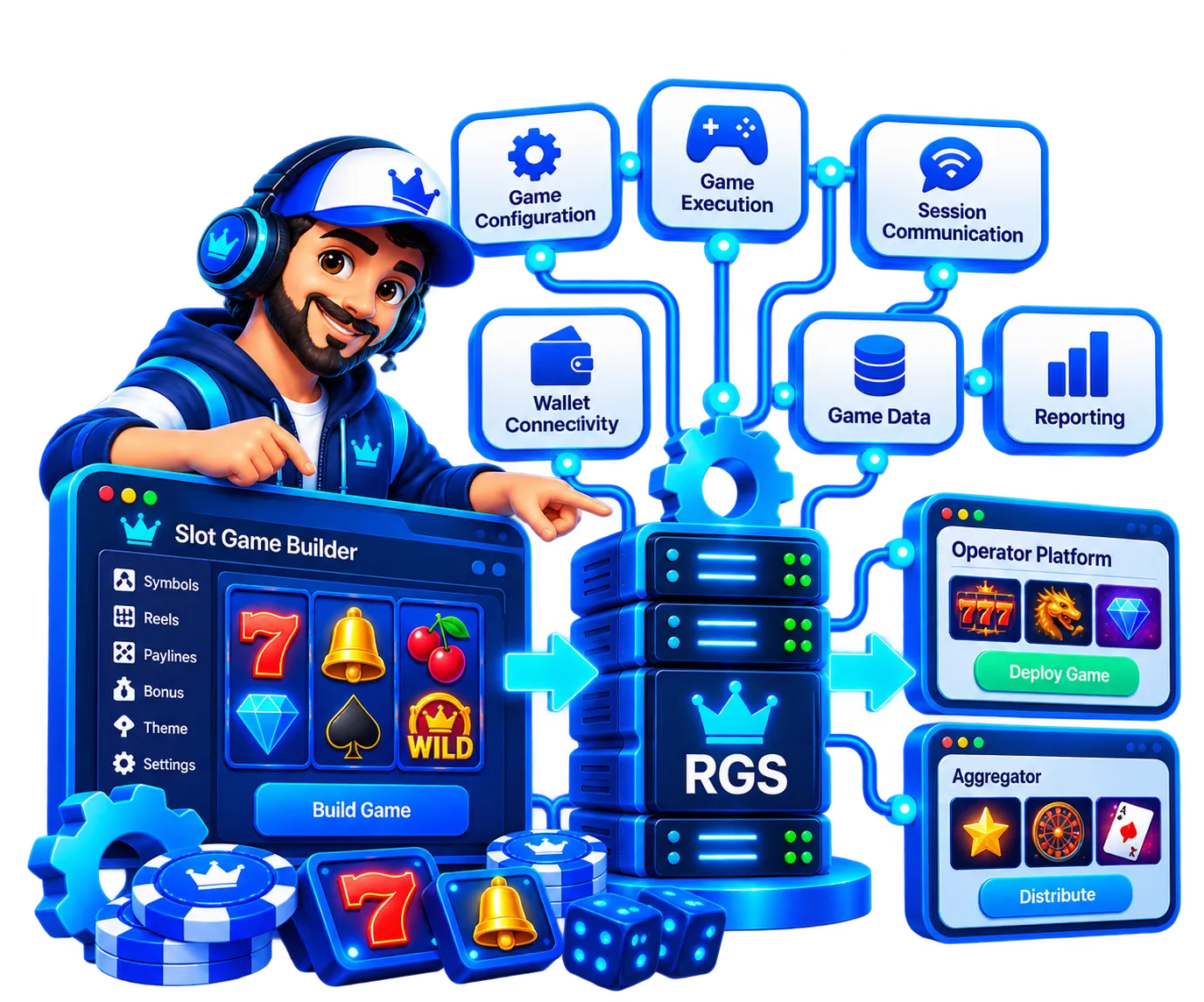
Plinko games can be connected to an RGS or suitable gaming backend where the architecture supports the required integration.
Integration requirements may include:
Game sessions
Game configuration
Wallet communication
Transaction handling
Player activity
Game results
Reporting
API communication
The integration model depends on the target RGS, gaming platform and API architecture.
SwissDice can help align the Plinko builder with the backend technology required for the intended deployment environment.
Plinko Game Deployment and Distribution
After configuration, testing and integration, the finished Plinko game can be prepared for deployment through supported gaming environments.
Deployment requirements can include:
RGS connectivity
Gaming platform integration
Game configuration
Wallet connectivity
API integration
Game version management
Reporting
Distribution controls
This creates a technology path from Plinko configuration to testing, backend integration and distribution.
Plinko Game Builder for Different Businesses
A Plinko game builder can support different types of gaming businesses:

Game Studios
Create configurable Plinko titles and manage multiple game concepts through a structured technology environment.

Casino Operators
Develop proprietary Plinko experiences that can be integrated into an existing gaming environment.

iGaming Technology Providers
Add Plinko content capabilities to a broader gaming technology ecosystem.

Gaming Startups
Launch configurable Plinko products while maintaining flexibility for future game variations and platform integrations.
Plinko Game Builder Customization
The level of customization can be aligned with the requirements of the game and business.
Potential customization areas include:
Board layout
Number of rows
Multipliers
Risk profiles
Probability model
RTP requirements
Game rules
Visual presentation
Game engine
Backend architecture

RGS integration

API connectivity
Wallet integration

Reporting
The exact configuration options depend on the underlying game architecture and intended deployment model.
Why Choose SwissDice for Plinko Game Builder Technology?
SwissDice combines game technology, backend infrastructure and iGaming integration capabilities to support Plinko products beyond the player-facing game interface.
Our approach can connect:
Plinko Game Configuration
Mathematics
Game Engine
RGS
API Integration
Platform
Distribution
This allows businesses to consider the complete technology lifecycle when creating and deploying Plinko content.
SwissDice can also support related requirements such as custom game development, RGS technology and gaming API integration when those capabilities are required as part of the wider project.