Dedicated iGaming Development Teams
Scope iGaming team augmentation, co-development or a dedicated delivery workstream around the backlog and the decisions you retain.
Plan your engineering engagement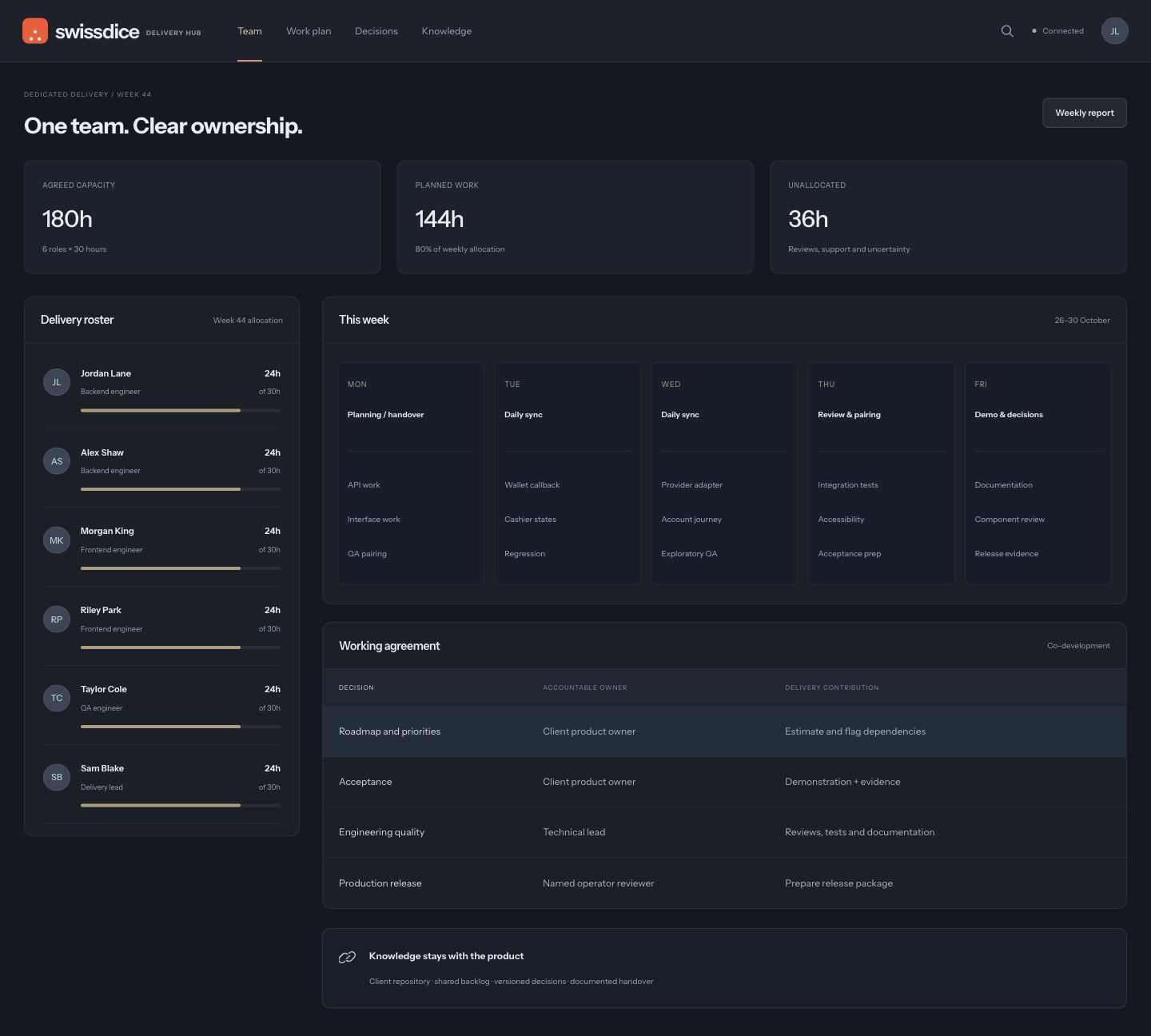
How does a dedicated iGaming development engagement work?
A dedicated iGaming development engagement assigns an agreed capability mix and delivery responsibility to your product backlog. It can support team augmentation, co-development or a defined delivery team. Roles, allocation, access, acceptance criteria and support coverage are confirmed for the project before work is committed.
Choose the delivery responsibility that fits your team.
Compare how work is prioritized, built and accepted. The scope confirms skills and allocation without assuming an immediately available roster or an unlimited support commitment.
| Workstream | Project scope | Dependencies to confirm |
|---|---|---|
| Team augmentation | Agreed specialists contribute within your backlog, tools and review process. | Your delivery leadership, approved access and confirmed capability allocation. |
| Co-development | A commissioned workstream or module is delivered alongside your internal team. | Clear interface ownership, shared milestones and acceptance decisions. |
| Dedicated delivery | An agreed team structure takes responsibility for a defined product backlog. | Confirmed staffing, technical decision rights, review cadence and handover terms. |
Agree team allocation, decision rights and delivery governance
Team augmentation places specialists within your delivery process. A dedicated delivery team may own a defined backlog and technical boundary. Co-development splits responsibilities between your existing team and the commissioned specialists.
The engagement should identify who sets priorities, approves architecture, reviews code, accepts work and handles production support. These responsibilities matter more than a generic list of available roles.
The proposal records confirmed capabilities, allocation, service hours, working-time overlap, reporting cadence, billing basis and dependencies alongside the engagement model. Name the product/backlog owner, architecture and code reviewers, acceptance owner and production decision makers. Define onboarding, dependency escalation, changes to scope or allocation, leave/absence coverage and replacement or continuity arrangements. Progress reviews connect accepted backlog items to working journeys, QA evidence, open risks and spend; access to specialists or a role list alone does not establish delivery ownership or capacity.
Responsibility, capability
and handover need their own evidence.
Agree allocation and the decisions each team owns.
Choose the engineering boundary around your retained stack and backlog. Establish how work is prioritized, reviewed, accepted and reported before onboarding.
Build the required mix around the actual work.
Assess the roles, suitability and availability needed for the engagement. Define access, review practices and continuity alongside the proposed allocation.
Carry source, quality evidence and knowledge through delivery.
Agree who accepts the work and which evidence accompanies it. Keep repository knowledge, operating instructions, unresolved dependencies and handover responsibilities current.
The proposal confirms the available capabilities, allocation, responsibilities, commissioned rights and support scope for your engagement.
Platform.
Game.
Quality.
Delivery.
Required capabilities follow the retained stack and backlog. Availability and specialist suitability are confirmed separately.
Build a capability plan around the platform
A platform programme may need backend and frontend engineers, mobile specialists, game developers, QA engineers, DevOps, designers, analysts or technical leadership. The appropriate mix depends on the backlog and retained vendor products.
We scope the skill requirements and availability for the agreed work. Specialist game mathematics, independent security testing, trading or legal functions require their own capability and approval checks.
Build knowledge transfer into the engagement
Define the backlog and engagement
Review the platform, retained vendors, workstreams and team structure. Identify the capabilities and allocation required, then confirm availability and the proposed responsibility boundary before agreeing an engagement.
Onboard and deliver in reviewable increments
Set up approved access, environments, review standards and communication. Demonstrate agreed player or operator journeys with code-review and test evidence, while keeping decisions and external dependencies visible.
Review capacity and transfer knowledge
Review the backlog, quality and delivery responsibilities at agreed intervals. Scope any capacity change explicitly, and hand over code, documentation and open work with controlled access removal when the engagement ends.
Plan secure onboarding, continuity and knowledge handover
Agree repository access, review standards, environments, issue tracking, documentation and communication before work begins. A defined onboarding plan limits dependence on undocumented production access.
Regular reviews should show completed journeys, quality evidence and open dependencies. The exit plan covers knowledge transfer, access removal, outstanding work and the rights to commissioned deliverables.
Use customer-approved accounts, least-privilege access and separated environments, with repository, code review, test, documentation and deployment responsibilities agreed before onboarding. Track the commissioned modules, retained vendor terms and open dependencies through each increment. The exit or transition plan includes current source/configuration, build/run instructions, test evidence, operating knowledge, remaining backlog, rights and acceptance status, plus revocation of accounts, credentials and queued access where applicable. Distinguish ongoing engineering allocation, defect/warranty terms and an expressly agreed incident or on-call support service; handover should name the owner of each.
Capability plans and visible delivery records
- Role, availability and delivery-responsibility plan
- Prioritized backlog and acceptance criteria
- Repository, environment and access onboarding plan
- Working software, code review and QA evidence
- Delivery reports, dependencies and decision records
- Knowledge transfer and exit handover
Team models, capability confirmation and software handover questions
Discuss your requirementsCan we choose augmentation, co-development or a dedicated team?
The engagement model follows the work and the responsibilities your team wants to retain. Augmentation works within your delivery process; co-development divides defined modules; a dedicated delivery team may own an agreed backlog. The required skills and actual availability are checked before a commitment is made.
Which roles can be included?
Discovery can identify backend, frontend, mobile, game engineering, QA, DevOps, design, analysis or technical leadership requirements. The proposal confirms the capabilities and allocation available for the selected scope. Specialist mathematics, security, trading or legal work requires its own suitability and approval checks.
Who controls priorities and accepts the work?
That is agreed for the engagement. The responsibility plan names the backlog owner, technical approvers, code reviewers and acceptance decision makers. Delivery reviews show working journeys, test evidence, unresolved issues and external dependencies.
Will we own the code and retain access?
Rights to commissioned code, assets and documentation are specified in the agreement. Third-party software and vendor services keep their own terms. Repository access, documentation, knowledge transfer and exit assistance should be agreed before onboarding.
Does a dedicated team include continuous production support?
Not automatically. Engineering allocation and production support are different commitments. Service windows, incident response, on-call arrangements and handover responsibilities must be explicitly scoped and confirmed.
How are team size, cost and start date established?
The backlog, retained architecture, required skills, allocation, working-time overlap and governance determine the proposed team. Availability, suitability, service hours, billing basis and start dependencies are confirmed before a commitment. We do not infer immediate capacity from a list of roles. Changes in allocation or scope follow an agreed review and approval process.
How do you handle onboarding, continuity and specialist replacement?
The engagement plan sets access approvals, environments, repository and review practices, documentation and an onboarding backlog. It also defines absence coverage, knowledge sharing, escalation and any proposed replacement process, subject to confirmed capability and availability. Customer acceptance and production permissions remain with the named owners; continuity is supported by current records rather than one person’s undocumented access.
Can a dedicated team work alongside our existing platform vendors?
Yes, subject to the retained vendors’ interfaces, access and terms and the agreed engineering boundary. Map who owns architecture, API changes, deployments, incidents, acceptance and vendor coordination. The delivery plan records dependencies and confirms which source, configuration, tests and documentation the commissioned team can hand over. A dedicated engagement does not transfer third-party rights or automatically include continuous production support.
Scope your iGaming development team.
Bring a prioritized backlog, current stack and the work your internal team will retain. Identify code reviewers, acceptance owners, collaboration languages or time-zone needs, and preferred code-ownership terms so the proposed engagement matches your delivery responsibilities.
Let’s build