Poker
Agreed variant, action sequence and hand settlement.
Build the table, the competition and the operational evidence around a precise multiplayer ruleset.
Plan your card-game platform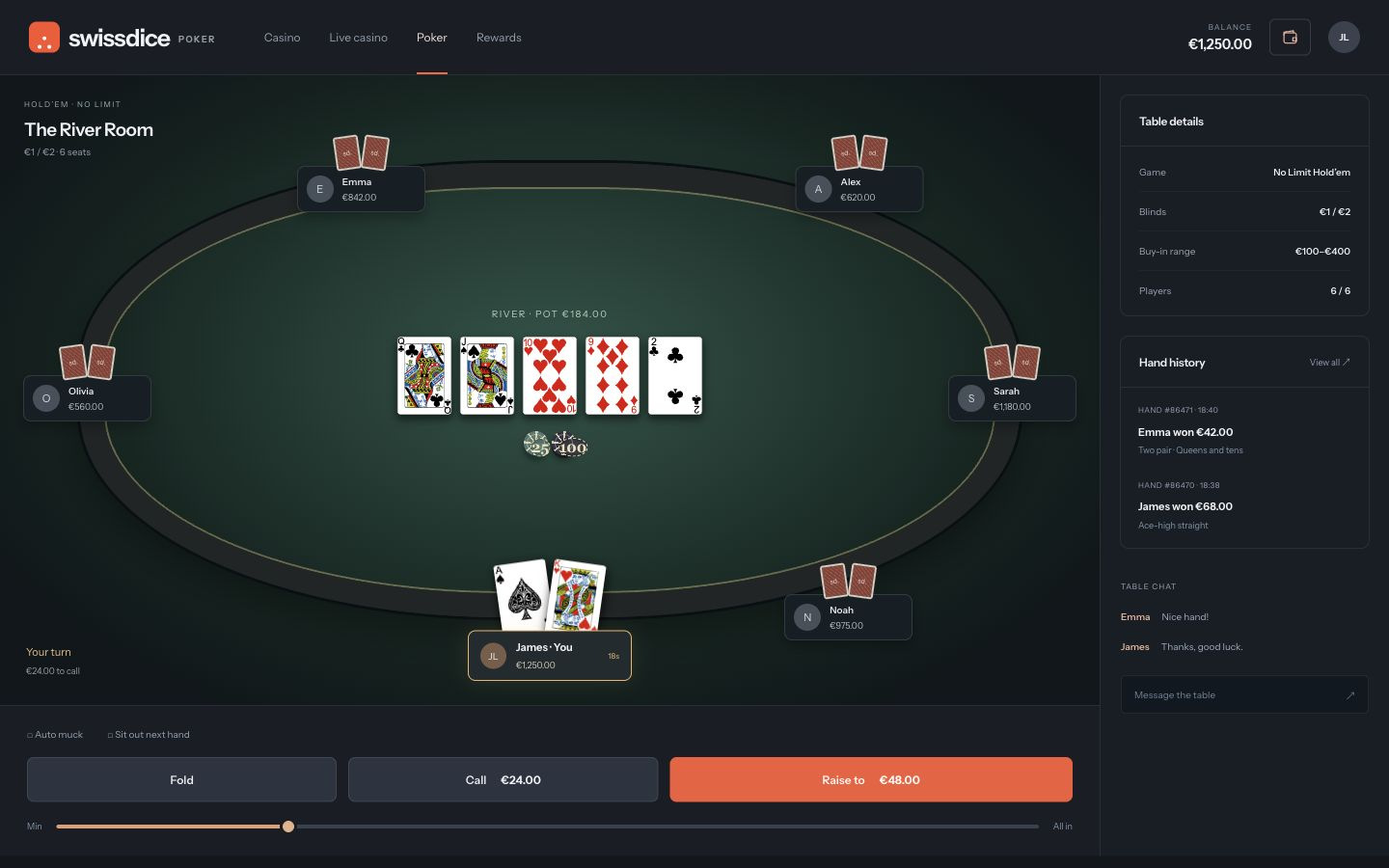
Specify seating, buy-in boundaries, hand records and leaving-table settlement.
Specify registration, starts, blind or stage changes, elimination, prizes and cancellation.
Specify the approved Rummy, Teen Patti or other format, with distinct actions, outcomes and settlement.
A poker or card-game platform combines multiplayer game services with player accounts, table discovery, financial transactions and operator controls. Cash tables, tournaments and regional formats have different rules, settlement and scaling requirements. Shared liquidity or network access is a separate provider and operating dependency, not a consequence of developing the software.
A technically correct platform still needs enough eligible players in the right tables or competitions. The product plan separates private or standalone tables from any contracted network. Tournament formats require registration, start rules, prize allocation, cancellation and settlement behavior. We scope the operational controls and reporting needed for those decisions.
Choose the required tournament formats and options explicitly: sit-and-go or scheduled starts, late registration, re-entry, rebuys, add-ons, blind progression, breaks, bounties and prize allocation can change both the engine and the operating tools. The rules also resolve a paused or cancelled event, unfinished hands and refunds. Shared liquidity, eligible player pools and network reporting remain contracted dependencies rather than a promised feature of custom code.
Software does not supply players or shared liquidity. Any network connection requires its own agreement.
Shared accounts and a lobby can support several products, while each game needs its own rules, financial behavior and acceptance evidence. A development engagement does not supply a player network.
| Workstream | Project scope | Dependencies to confirm |
|---|---|---|
| Cash tables | Commission agreed table formats, stakes, seating and reconnect behavior. | Approved rules, account restrictions and authoritative hand records. |
| Tournaments and competitions | Build registration, scheduling, prize rules and cancellation workflows. | The chosen competition format, entry conditions and financial approvals. |
| Regional card formats | Specify separate Rummy, Teen Patti or other agreed rulesets. | Variant-specific testing, distribution rights and intended-market review. |
| Network connections | Assess a contracted network or standalone player-pool arrangement. | An eligible network agreement and confirmed technical/operating access. |
Agreed variant, action sequence and hand settlement.
Chosen variant, valid declarations and scoring.
Selected table rules, actions and outcomes.
Rummy, Teen Patti and other regional card products are scoped as distinct rule systems. The brief identifies the chosen variant, supported actions, winning conditions, table or competition structure and financial settlement. Shared account, lobby and wallet services can support several formats, while the authoritative game state and acceptance evidence remain specific to each approved ruleset.
The product scope also records private-table access, player matching, disconnections, timeouts and permitted automated actions. Rule changes receive versioned configuration and regression checks, and the hand history or equivalent game record provides enough detail for a support reviewer to reconstruct the accepted sequence. Regional language, device and presentation requirements are agreed alongside those game rules.
Anti-collusion and bot controls depend on useful evidence and human review, not a blanket promise that cheating is impossible. We scope session signals, hand histories, account links and permissioned case handling. Sensitive decisions need an audit trail, with appropriate data access and a review process for false positives and player disputes.
Signals support investigation; they do not prove that every flagged player has cheated.
Choose the poker or regional card formats, table rules, tournament structures and liquidity assumptions. Document turn authority, reconnect behavior and the evidence needed for disputed hands.
Implement the agreed seat, action and table lifecycle with account and wallet connections. Keep client presentation separate from server decisions and permitted operator actions.
Rehearse disconnections, interrupted hands, entry refunds and prize settlement. Review replay and anti-collusion investigation tools against the retained operations policy.
Software development does not supply a player network. If shared liquidity is required, an appropriate network agreement and technical integration must be separately confirmed, including eligibility, reporting and operating responsibilities.
Potentially, but each variant needs its own rules, game-state model, settlement logic and market assessment. Shared accounts and infrastructure can be evaluated without assuming the underlying game engines are interchangeable.
Timeout, reconnection and default-action rules are agreed for each format and shown to players where required. The server preserves authoritative state, while hand history and financial records allow support to investigate the outcome.
No responsible technical proposal can guarantee that. The scope can include prevention controls, detection signals and investigation tools, with defined operator review and response processes.
The brief names the required rules, such as a selected Hold’em or Omaha variant, and the cash, sit-and-go or scheduled tournament model. Options including fast-fold seating, re-entry, rebuys, add-ons, bounties and multi-table play are estimated and tested individually. Rummy and Teen Patti use their own authoritative rules and scoring; they are not treated as cosmetic versions of the same poker engine.
Player, spectator, replay and authorized investigation views need separate visibility rules. The chosen game rules determine revealed cards; folded or otherwise private information is not exposed to ordinary clients or public replay by default. Investigation access records the authorized role and reason, with audit and retention requirements agreed for the operation. Reconnect and multi-table tests check that one account cannot obtain another seat’s hidden state.
The proposal separates the selected game engine, desktop and mobile client, lobby, cash or tournament operations, wallet connections and investigation tools. Acceptance uses the approved rules to verify legal actions, timeouts, reconnects, side pots, fees, ties, cancellation and financial reconciliation, with representative simultaneous tables and players. Deliverables include versioned rules, hand histories, test evidence, operator controls and release and support documentation. Network entry, player acquisition and ongoing staffed room management require separate arrangements.
Bring the game variants, table or tournament rules, seating model and distribution targets. We will define authoritative game state, interrupted-play recovery, financial events and the operator controls needed for the selected card-game scope.
Let’s build