Account state
The named account and preference sources determine current restrictions and permitted communication channels.
Connect your chosen CRM to reliable profile, event and preference data. Then verify the audience and workflow behavior that the integration is meant to support.
Scope your CRM connection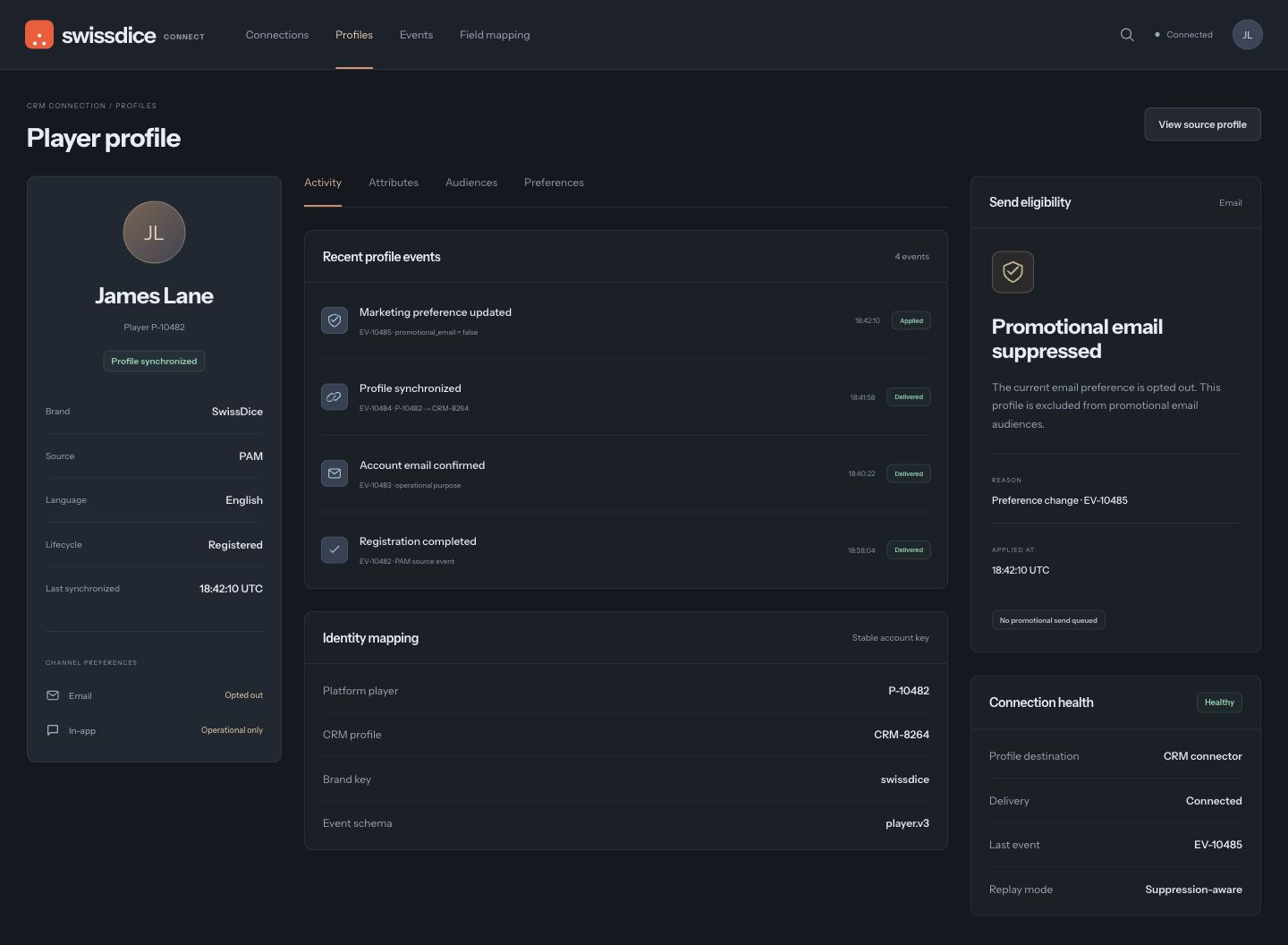
iGaming CRM integration connects platform profiles, events and preferences to an external engagement system. It allows the chosen tool to build audiences and automate messages using agreed data. Developing a custom CRM, integrating a vendor and running ongoing campaigns are different scopes; this service covers the technical connection and its operational handover.
The same player may appear in a PAM, wallet, sportsbook and support system. We define a stable identity mapping and document which profile attributes can be shared. Brand, account status and lifecycle events receive explicit definitions, preventing separate systems from assigning different meanings to a registration, deposit or active player.
Event contracts record required fields, source occurrence time, unique business references and separate delivery attempts. The mapping names the authority for profile attributes, brand context and current preferences, including a supported identity merge or change. A changed email address is not sufficient evidence to merge two players. Server events, client interactions and historical imports retain their own meaning; an acknowledged API request does not prove correct journey membership.
Server and client events have different authority. Catch-up data needs its own replay contract.
A profile existing in the CRM does not mean every channel or campaign is permitted. We map subscription choices, opt-outs and the communication purpose, including how a preference change is captured and updated. An operational account message and a promotional offer may require different routing and controls.
Player-protection restrictions and other reviewed exclusion rules must reach the engagement tool and affect the intended audiences. We test the timing of suppression changes and define an investigation path for inconsistent state. Where evidence of preferences is needed, the design distinguishes the current send permission from the history describing how that preference was obtained.
Acceptance uses test profiles representing different lifecycle, consent and account states. We check that expected events enter the CRM, update the correct person and produce the intended eligible or suppressed audience. Replayed events, changed identifiers and delayed deliveries are included so a catch-up process does not trigger an inappropriate message sequence.
Monitoring separates an accepted request from a processed profile, intended journey membership and downstream delivery feedback. Rate limits, failed deliveries, quarantined records and approved replays have named owners and review procedures. The handover includes mappings, credentials, sandbox evidence, alert thresholds and vendor/version change responsibility. Campaign strategy, creative production and daily execution remain separately assigned to the marketing team or an agreed managed service.
Yes, subject to the product’s supported interfaces and your platform’s data access. We review required profiles, events, preferences and campaign outcomes before defining the connection and any gaps that need separate development.
It should not be assumed. Subscription and send permissions must follow the reviewed consent and communication policy. The integration maps those states explicitly rather than equating account creation with permission for every message.
They can if delivery and campaign logic are not designed together. We define unique event references, replay rules and test audiences so recovery behavior is understood before historical or repeated events are sent.
This page covers the technical integration and handover. Lifecycle strategy, campaign creation, VIP operations and ongoing reporting can be agreed as separate managed services with clear permissions and approval ownership.
We map stable account and brand identifiers and decide which system owns each field and preference. Merge, correction, retention and deletion behavior must use supported source and destination interfaces under the approved data policy. Tests check that a changed identifier does not create another marketing profile, revive an opt-out or expose another brand’s data. Historical evidence and current send eligibility remain distinct, with unresolved mappings routed for review.
The connector follows the selected vendor’s retry, rate-limit and deduplication contract. Failed or uncertain deliveries retain the original business reference and can be investigated or replayed through an approved path. Delivery, bounce, complaint and unsubscribe feedback are mapped where supported; a successful outbound request alone does not mean a message reached the player. Recovery tests include late preference changes and replay without restarting an inappropriate journey.
The estimate names the retained CRM, PAM and event interfaces, required brands and channels, identity quality, supported preferences and any historical import. Custom journey logic or a replacement CRM is separate development. Acceptance follows test profiles from source event to the correct audience and suppression behavior, with recovery and feedback checks. Handover names credential rotation, monitoring, vendor support, schema changes and the campaign owner; supplier licences and day-to-day marketing work are budgeted separately.
Review CRM objectives, available platform data, profile ownership, consent requirements and account exclusions before selecting events.
Implement identity, profile, event and preference flows, with recovery and duplicate behavior matched to the vendor interface.
Use test profiles to verify triggering, suppression and lifecycle changes, then hand over monitoring and schema-change ownership.
Bring the CRM vendor, platform event catalogue, identity model and approved communication rules. We will map profiles, consent, suppression and replay behavior, then define test audiences and handover responsibilities before campaign activation.
Let’s build