iGaming Performance, Availability & Disaster Recovery
Investigate capacity, failure behavior and restoration with evidence tied to the architecture you actually operate.
Define your performance and recovery scope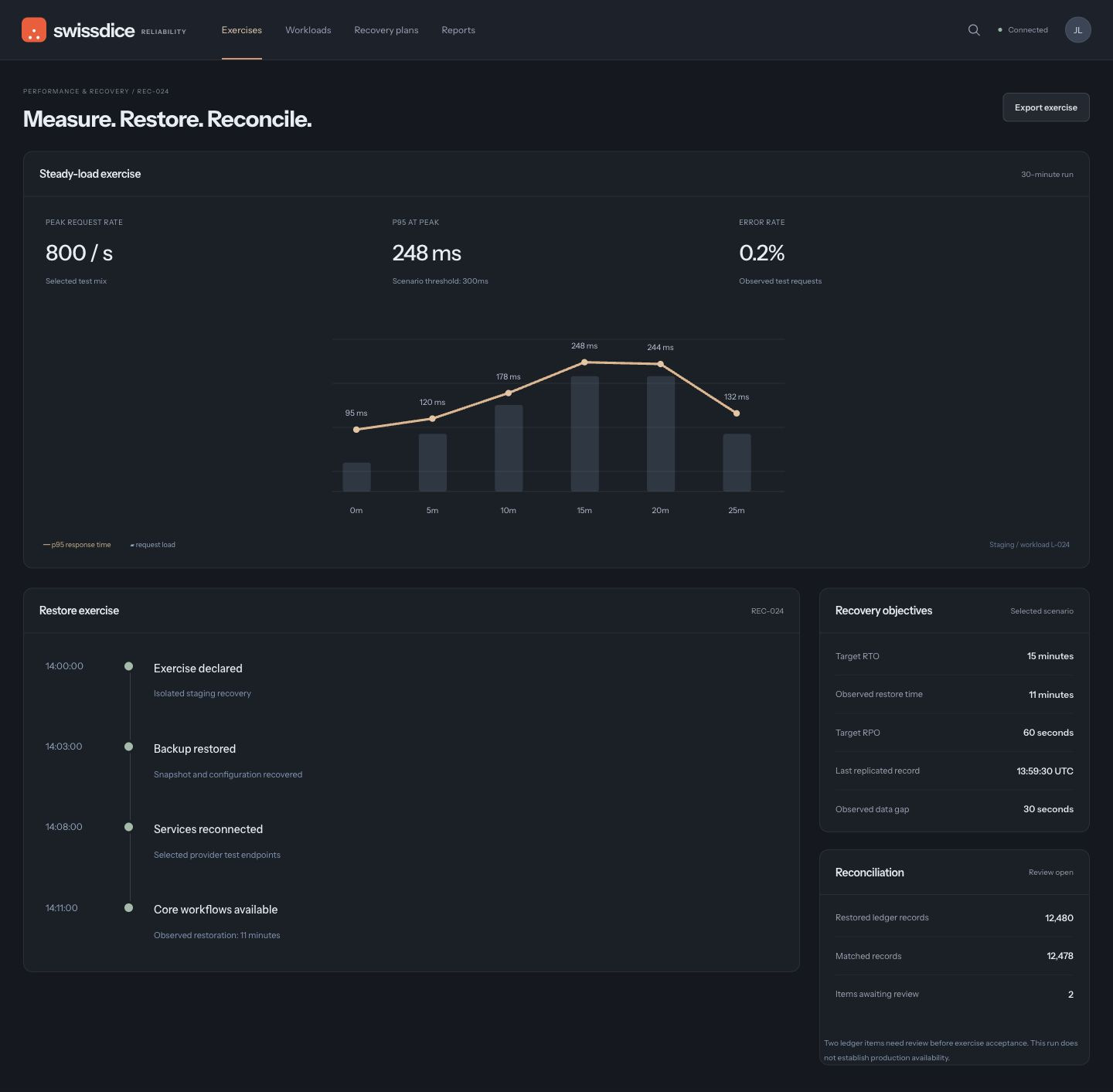
What does iGaming performance and disaster recovery engineering cover?
Performance engineering measures and improves how a system handles an agreed workload. Availability and disaster recovery address continuity and restoration after defined failures. Useful targets include journey latency, capacity, recovery time and acceptable data loss, but they must be agreed for the actual architecture and verified through relevant tests.
One workload.
Several journeys.
- Lobby and game sessions
- Live event updates
- Financial callbacks
- Operator investigation
Define concurrency, percentiles, errors and test conditions. A small synthetic test is not production capacity.
iGaming load testing, journey latency and capacity evidence
A realistic workload includes the mix of lobbies, live updates, bet placement, payment callbacks and staff actions that the operation expects. We establish baseline latency, throughput, errors and resource use, then isolate application, data and provider bottlenecks. Reported results state the environment and limitations so a small synthetic test is not presented as proof of production capacity.
The measurement brief states build/configuration, dataset, test duration, ramp and burst shape, concurrency and arrival rate. It separates browser/device rendering, network/CDN delivery, application/database work and external provider time instead of treating one page-speed score as platform capacity. Reports show the agreed latency percentiles, errors, saturation and backlog alongside the generated workload. Stubbed providers, small datasets and a load generator that reaches its own limit are disclosed; repeat tests compare equivalent conditions.
- Workload model and performance budgets
- Baseline and bottleneck investigation
- Event-burst and concurrent-transaction scenarios
Design failure behavior and recovery targets
We identify critical services, dependencies and the business impact of interruption. The team agrees recovery objectives and safe degraded behavior, including what transactions must stop when authority is unavailable. Recovery includes configuration, secrets, data and provider connectivity, not only restarting an application process.
- Dependency and failure-mode assessment
- Recovery time and data-loss objectives
- Failover and degraded-service design
Can you guarantee a particular uptime percentage?
An availability commitment requires a defined service boundary, measurement method, exclusions and operating agreement. Engineering can improve and test resilience, but a sales percentage alone does not prove sustained production availability.
What are RTO and RPO?
Recovery time objective describes the target restoration time, while recovery point objective describes the intended limit on data loss. They are business and engineering requirements to agree and test for the specific system.
Is having backups enough?
No. The team must verify restoration, application compatibility, required secrets and configuration, provider connectivity and the consistency of restored data. Rehearsals expose issues that backup-success notifications cannot establish.
Can we test without risking production?
Many scenarios can be exercised in a representative environment, with controlled production tests only when specifically planned and authorized. The results should state how closely the test environment and workload match the live system.
Does passing a load test prove disaster recovery is ready?
No. A load test measures a stated workload in a stated environment. Recovery acceptance separately exercises the agreed failure and restoration path, records the observed recovery time and data gap, and checks configuration, secrets, provider connectivity and financial records after restoration. Failed or unmatched items remain named exceptions for investigation and retest. Neither a latency result nor a successful backup notification alone establishes production availability or complete recovery.
How does mobile performance testing differ from backend load testing?
Mobile testing examines device, browser, rendering, asset delivery and real network conditions across representative player journeys. Backend load testing examines an agreed mix of requests, concurrent work, data, queues and external dependencies. A fast lobby does not prove peak bet acceptance or payment callback capacity, and a server throughput result does not prove a usable mobile interface. We join the observations with traceable timings while preserving each test’s environment, workload and limitations.
Does an active-active deployment guarantee no lost transactions?
No architecture label establishes that outcome. The design must define write authority, replication and consistency, failure detection, transaction identity and what happens during an uncertain provider response. Recovery tests exercise the supported failure and reconnection paths, then reconcile the financial records. Targets, observed recovery time, recoverable data point and unresolved discrepancies are recorded separately. Cross-region replication also needs the approved location, data and provider constraints for that project.
What is delivered after a performance and disaster-recovery engagement?
The agreed package includes the workload model, environment/build references, test configuration and results, bottleneck findings, recovery objectives, runbooks and observed restoration evidence. It names untested dependencies, discrepancies and required follow-up work. Handover can include repeatable test assets and a retest plan in the formats and rights agreed. Infrastructure consumption, external test access, active production experiments and ongoing availability coverage are separately scoped cost items.
Restore.
Reconnect.
Reconcile.
Recover configuration, secrets, data and provider connectivity. Then verify the scoped account and financial journeys.
Disaster recovery drills, reconciliation and controlled failback
A backup is useful only if it can be restored into a working system. We rehearse the agreed recovery path and validate accounts, transactions and integrations afterward. Incident runbooks define ownership and communication, while follow-up work addresses the gaps the exercise revealed. Ongoing availability commitments are separately agreed and measured.
The recovery exercise records the failure, available consistent recovery point, restoration steps and the time through agreed journey validation. Restoring infrastructure health is an intermediate step. The runbook assigns authority for promoting a restored system, preventing competing writers, reconnecting providers and resolving transactions whose external outcome is unknown. Account/ledger checks compare the restored records with authoritative provider references where available. Exceptions, observed data gaps, manual steps and later failback are documented with owners and retest criteria.
- Backup restoration and failover exercises
- Post-recovery account and ledger validation
- Incident runbooks and improvement findings
Workload evidence, recovery targets and restoration tests
- Workload and resilience assessment
- Measured baseline and prioritized improvements
- Capacity and recovery target specification
- Load, failure and restoration test evidence
- Financial consistency validation after recovery
- Incident and disaster-recovery runbooks
Measure the workload and prove recovery
Model representative load and recovery objectives
Define account, gaming, betting and payment workloads with the dependencies that affect them. Agree measurable capacity and recovery targets without inventing service guarantees.
Measure bottlenecks and rehearse failures
Test the selected workloads, degradation paths and recovery procedures in an agreed environment. Keep measurements tied to configuration and test conditions so improvements can be compared.
Verify restored service and financial consistency
Exercise restoration, replay and reconciliation after the scoped failures. Deliver capacity findings, recovery evidence and operating triggers for the systems actually tested.
Set your performance and recovery targets
Bring the critical journeys, traffic patterns, system bottlenecks and recovery objectives you need to assess. We will define representative load, failure scenarios, backup dependencies and restoration evidence before scoping optimization or disaster-recovery work.
Let’s build