Compliance & Responsible Gaming Technology Development
Translate reviewed requirements into player limits, account restrictions and inspectable enforcement.
Map your control requirements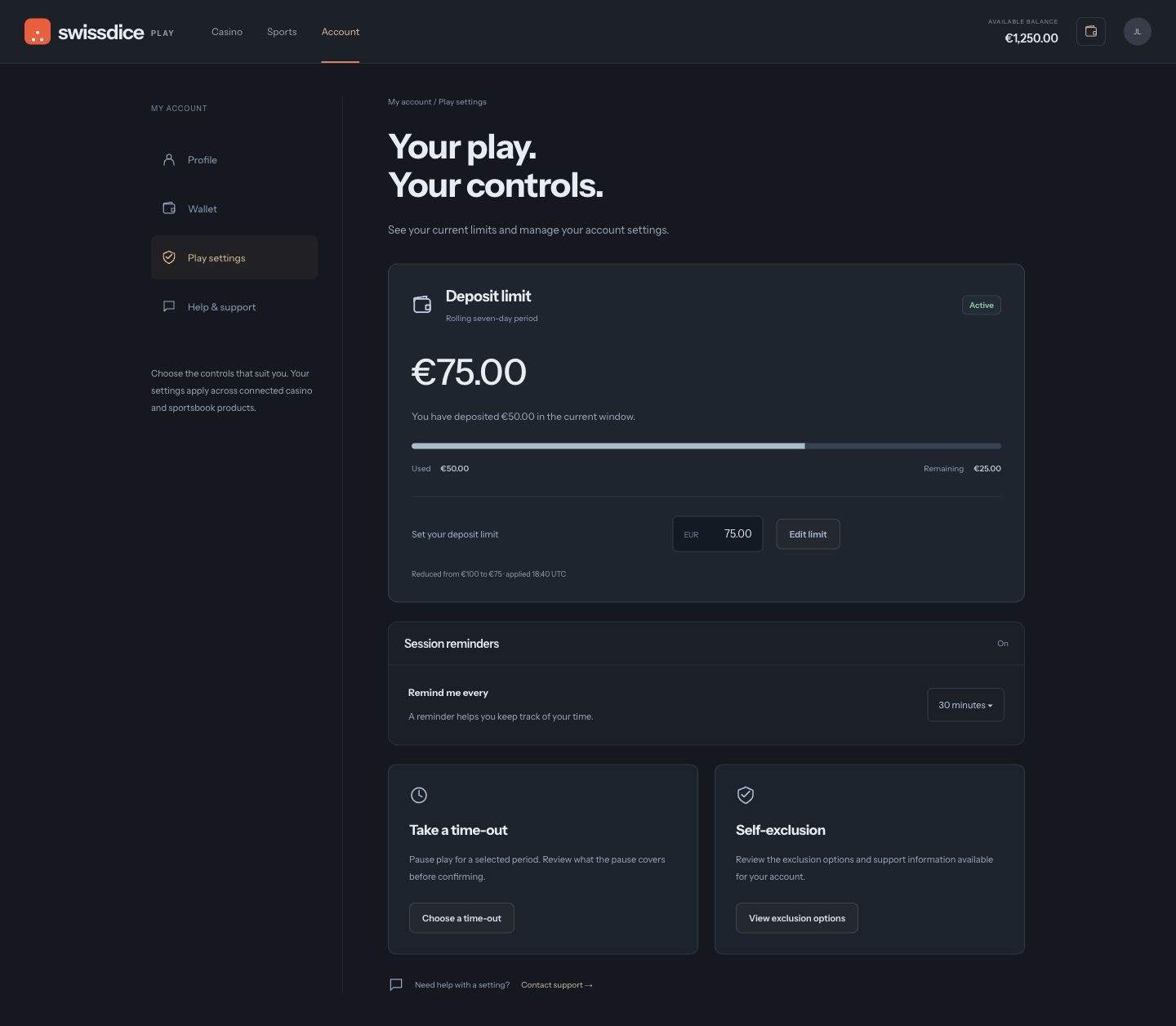
What does responsible gaming software development cover?
Compliance engineering implements specified technical controls and evidence workflows. Responsible gaming technology can include financial or time limits, cooling-off, self-exclusion and related account behavior. The software supports an operating framework; it does not replace legal assessment, staff procedures, independent review or approval by the relevant authority.
Responsible-gaming software requirements and control ownership
The project records each approved requirement, the system that enforces it and the evidence needed to verify it. Identity, age, location and screening integrations have different providers and failure states. We define pending review, unavailable-service and rejected-action behavior explicitly, rather than allowing an integration outage to create an unintended bypass.
The implementation brief identifies the approved policy source and version, affected products/brands/channels, control owner, effective time and acceptance evidence. It separates identity/age checks, access location, financial limits, self-exclusion, session tools and risk-review signals. A configurable product or analytics score does not enforce every action by itself. Interfaces and staff tools explain the relevant pending, restricted or unavailable state, while authorized operator stakeholders retain policy interpretation and case decisions.
- Control ownership and requirement traceability
- Verification and market-access workflows
- Provider failure and manual-review states
Change recorded.
Next action checked.
Decision retained.
Cached eligibility is not current authority. Financial limits, self-exclusion, KYC/AML review and messaging rules each need a defined scope.
Player limit enforcement, concurrent actions and exclusion updates
A limit or exclusion can affect deposits, wagers, sessions, promotions and communications differently. We map those effects with the operator and test account changes during active journeys. Connected products must receive or check the relevant state according to the agreed architecture, with logs that allow staff to establish what was enforced and when.
A limit specification defines the counted event, amount/unit, currency handling, time zone, fixed or rolling period, reservations and release/reversal behavior. Concurrent requests need a consistent authority so they cannot each consume the same remaining allowance. Limit changes have an effective-time and approval policy; cooling-off, exclusion and reinstatement follow their own reviewed rules. Tests cover active sessions, repeated events, disconnected products and CRM updates. Existing settlement, permitted withdrawal and access to support are treated according to their separate obligations rather than blocked indiscriminately.
- Deposit, wagering, loss and session control scope
- Cooling-off and self-exclusion state model
- Cross-product and CRM restriction propagation
Requirements maps, limit controls and audit evidence
- Approved requirement and control matrix
- Identity and market-control integrations
- Responsible gaming and account-state workflows
- Cross-system restriction acceptance tests
- Audit trails and reporting exports
- Operational and technical handover
Support audits and controlled change
Controls evolve, and market activation should be based on approved configuration rather than hidden code branches. We scope permissioned changes, version history and reporting exports. Acceptance evidence demonstrates the defined scenarios and records limitations, while the operator and appointed specialists decide whether the product is ready for its intended release.
- Versioned market and control configuration
- Permissioned exceptions and change review
- Technical audit evidence and reporting
Source → interpretation →
configuration → test.
Pin reviewed applicability and effective versions. Legal assessment, operating procedures and independent decisions remain separate responsibilities.
Responsible gaming controls and implementation questions
Discuss your requirementsDoes this service provide legal advice or licensing?
No. It implements agreed technical requirements and can coordinate with your appointed advisers and reviewers. Legal assessment, operating permissions and regulatory decisions remain with the appropriate qualified parties.
Can self-exclusion work across casino and sportsbook?
It can be designed across connected products where interfaces and operating requirements support it. We map the authoritative account state, propagation timing and action-level enforcement, then test active-session and failure scenarios.
What happens if a verification provider is unavailable?
The approved policy defines whether the action remains pending, is blocked or enters a controlled review. We implement and test that behavior rather than assuming an outage should allow unrestricted access.
Can the system support different market rules?
Yes, through an agreed configuration and release model. Each market needs approved requirements, provider availability and acceptance evidence; a country selector alone does not establish compliant operation.
Can you integrate a responsible-gaming product or build custom controls?
The scope can integrate a selected limits, exclusion or risk-analytics product, implement platform controls, or combine them. We compare the approved requirements with the product’s actual APIs, supported markets and account architecture. The design names the authoritative source for each control and the systems that must enforce it. Risk classification, limit enforcement and staffed player intervention remain distinct. Required supplier agreements and independent policy/assessment inputs are confirmed before release.
How are concurrent wagers and changing player limits tested?
The specification defines counted amounts, current usage, reservations, period boundaries and adjustment behavior. Tests submit competing requests against the same allowance, repeat an event, cancel or reverse it and change the control during an active session. The expected decision comes from the approved policy and authoritative state. Evidence retains the action, version, time and resulting records. No universal limit, reset period or rule for increasing a limit is assumed across all operations.
What is delivered for responsible-gaming software acceptance and handover?
The package includes the requirement/control matrix, approved configuration versions, relevant adapters and player/staff workflows, tests and recorded limitations. It identifies propagation, provider-outage and reconciliation behavior, change permissions, audit exports and monitoring/escalation owners. Cost depends on products, brands, integrations, control types and existing architecture. Legal advice, licences, independent certification and staffed protection operations are separate responsibilities; technical acceptance does not establish universal market compliance.
Translate approved policy into enforceable behavior
Translate approved requirements into control ownership
Map the supplied policy and specialist requirements to account, payment, game and operator actions. Identify the systems and roles that must enforce each limit, exclusion or review state.
Implement controls across connected services
Build the commissioned restrictions and audit events around authoritative account state. Keep policy configuration and overrides subject to the agreed permissions and change procedures.
Prove enforcement and review evidence
Test boundary conditions, concurrent actions and changed restrictions across the selected integrations. Deliver requirements-to-test traceability and operational evidence for review; external approvals remain separate.
Map the controls your product must enforce
Bring the reviewed requirements for your products and markets, existing account controls and responsible-gaming workflows. We will translate the approved obligations into permissions, restrictions, audit evidence and implementation acceptance criteria.
Let’s build