Relevant search pages
Intent, crawlable content, useful internal structure and technical consistency.
Connect casino SEO strategy, B2B iGaming content and AI-search visibility work to clear page ownership and inspectable evidence.
Plan your search and content scope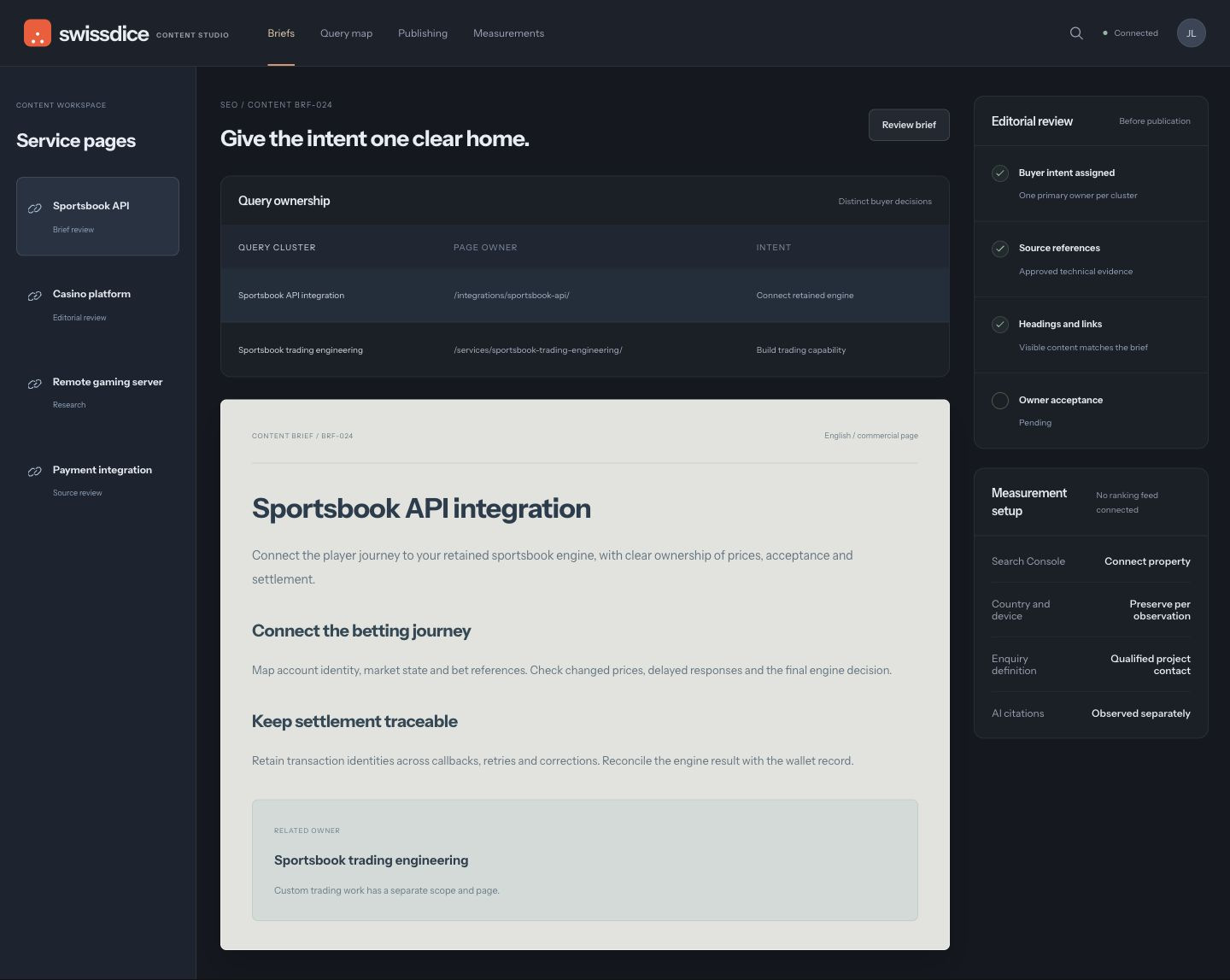
iGaming SEO services improve relevant search visibility through useful content, technical SEO, clear site structure and credible evidence. Answer engine optimization (AEO) and AI-search work use the same foundations: accurate answers, understandable entities, accessible pages and consistent supporting information rather than a guarantee of citation.
The content plan maps commercial, comparison and informational queries to appropriate pages before titles and headings are finalized. Related phrases belong together when they answer the same intent; separate pages need a meaningful difference in purpose. We can document competitor observations and available keyword data with dates and source limits, then prioritize gaps that the business can answer with genuine expertise and evidence.
Preserve unavailable measurements and review actual competitor scope. Create another page when it serves a distinct purpose, and consolidate overlapping answers when they belong together.
Connect briefs, content, design and implementation. Review performance and JavaScript delivery, relevant editorial outreach and the refresh schedule; preserve source and image provenance.
Separate implementation from observed changes and explicit citations from uncited mentions. Keep absent measurements visible and use the findings to prioritize the next technical or content improvement.
A useful page needs visible content, understandable headings, internal links and a clear next step. Technical review covers indexability, canonical URLs, redirects, sitemaps and structured data that matches the page. Claims, images and examples need provenance. We avoid treating metadata or schema as a substitute for a substantive answer, and changes are checked against the actual rendered website rather than a content spreadsheet alone.
Editorial work turns the intent map into service briefs, clear answers, related questions and useful comparisons. Review author expertise, original evidence, source dates, factual claims and image rights before publication; schedule refreshes when products or requirements change. Technical delivery checks mobile rendering, performance, JavaScript content, crawl paths and matching metadata or schema. Digital PR and relevant editorial outreach can be scoped, with placement quality, attribution and commercial relationships reviewed rather than treating purchased links or invented citations as authority.
Intent, crawlable content, useful internal structure and technical consistency.
Direct explanations, understandable headings and visible supporting detail.
Specific entities, current sources, defined scope and credible original evidence.
Accessible content, clear entities and measurements tied to a named source, date and search surface.
These describe related workstreams. No label or markup guarantees inclusion, citation or a search position.
The measurement plan defines qualified enquiries, relevant impressions, query visibility and page performance with the tools and access available. Rankings vary by query, location, device and time, so reports should preserve those conditions. AI citations and search inclusion are not controlled by the agency. Reviews connect observed results to practical content and technical work without promising a position or attributing every change to a single edit.
A baseline records the actual query, country, device, date and source, alongside the intended landing page and available search or analytics access. Compare branded and non-branded discovery, relevant landing-page engagement and defined enquiry stages; separate implementation dates from observed changes. AI visibility observations retain the named engine, prompt, date, location where known and cited destination. The review cadence covers content decay, technical regressions, ownership conflicts and unanswered buyer questions, with account, content and reporting access included in handover.
Review the site, business goals, analytics access and available keyword data. Separate confirmed measurements from assumptions and record the starting technical and content condition.
Prepare or improve the pages assigned to each intent, then validate rendered content, links and indexability. Keep claims and examples grounded in reviewable evidence.
Use dated search and conversion data to review performance. Improve weak answers, technical barriers and page relationships while retaining a clear record of changes and data limitations.
No. Search systems, competitors and audience behavior are outside the agency’s control. The service can deliver research, implementation and measurement, but it cannot guarantee a ranking or a fixed date for results.
Google states that its existing SEO foundations remain relevant to AI features and that no special additional optimization is required. Structured data should accurately describe the visible page rather than invent a shortcut.
No. Closely related queries often belong on one strong page. Separate pages need a distinct audience or decision purpose; otherwise they risk duplicating content and competing with each other.
The gap is reported explicitly. Search observations, customer questions and official product research can inform hypotheses, but they are not relabeled as measured volumes, difficulty scores or verified ranking positions.
We separate the language of the published page from the country in which a query is researched. Each observation retains its query, country, device, date and available metrics; an unavailable value stays unavailable. English commercial queries and local buyer questions help shape the service brief, but demand in another language is not presented as measured demand for an English phrase. Related markets can share one English page where the buyer intent and offer are the same. A separate market page needs a useful, verified difference rather than a city or country name swapped into duplicate copy.
The agreed scope can include a dated competitor and query baseline, page-owner map, prioritized technical backlog, service and editorial briefs, authored content, internal-link improvements, implementation acceptance and periodic reports. Digital PR, design, development and additional research tools are identified separately where relevant. Deliverables and review milestones are defined independently of search positions or AI citations.
Scope the number and condition of pages, research markets, content workload, technical access, implementation responsibility and reporting cadence. Separate agency work from media, tools and third-party costs. Record ownership and access to authored content, analytics, Search Console, research exports and change history, with an agreed transition pack. Discovery and delivery milestones can be estimated; search-engine response times cannot be promised.
Record a repeatable set of relevant prompts and the engine, observation date, location where known, response and cited URLs. Check whether the cited page supports the statement and distinguish an explicit citation from an uncited brand mention. Compare observations cautiously because answers vary. Google Search Console includes Google AI-feature traffic within its Web reporting; that aggregate alone does not prove a citation for a particular prompt.
Share the website, priority audiences and languages, existing content inventory and availability of search and analytics data. Define a qualified enquiry and identify publishing and technical owners so the proposed SEO programme addresses observed gaps, page priorities and measurable business actions.
Let’s build