Connect the catalogue. Preserve the differences.
Casino Game Aggregation Platform Development
Bring provider content into a consistent integration layer, with explicit rights, supported capabilities and traceable rounds.
Scope your aggregation layer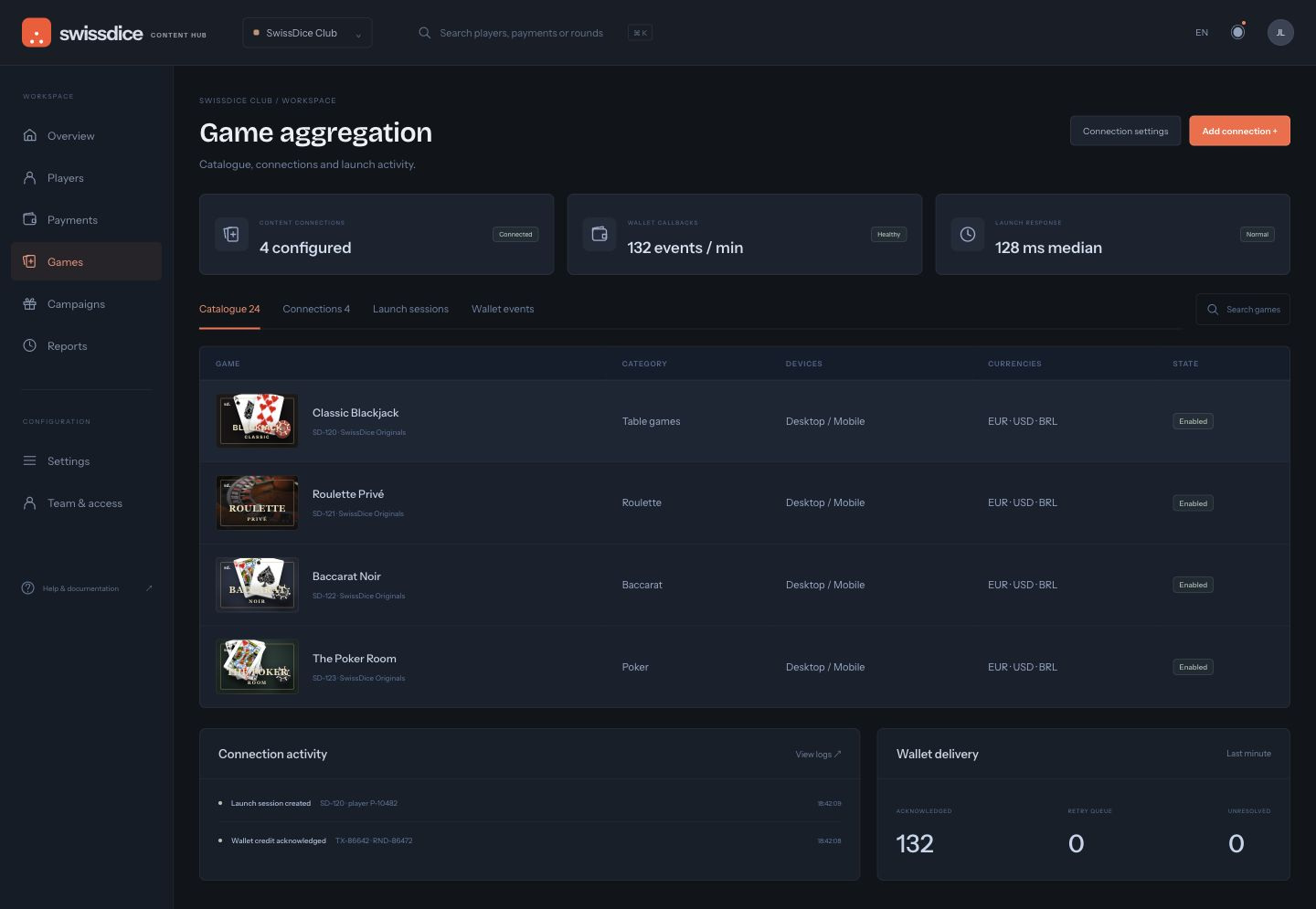
The service, clearly defined
What is a casino game aggregation platform?
A casino game aggregator connects multiple content providers through a common integration layer. It can normalize catalogues, launch sessions and financial messages while preserving provider-specific rules and evidence. Building aggregation technology does not create a game library or grant distribution rights; those require appropriate agreements with the relevant content owners.
Casino catalogue, game launch and provider adapters
Providers vary in game identifiers, currencies, session expiry, bonus features and wallet behavior. The aggregator contract should expose a consistent interface where feasible and make exceptions explicit. We define catalogue mappings, availability rules and adapter versions so operators know which capabilities are supported for each provider and market.
- Provider capability and content-rights matrix
- Unified catalogue, session and transaction contracts
- Versioned adapters and exception documentation
EXAMPLE NORMALIZED CONTRACT
- Game identity
- Catalogue ID ↔ source game ID
- Launch request
- Account, session and permitted content
- Wallet behavior
- Named authority and event contract
- Supported features
- Explicit provider capabilities
- Availability
- Rights, operator and market scope
A common interface retains documented exceptions rather than hiding them.
Scope and responsibilities
Choose the integration layer your business needs.
An aggregation build connects content providers and operator systems. Content rights, provider approvals and responsibility for game execution remain explicit parts of the selected arrangement.
| Workstream | Project scope | Dependencies to confirm |
|---|---|---|
| Operator content connection | Build catalogue, launch and wallet adapters for approved suppliers. | Provider/aggregator contracts, interfaces and market entitlements. |
| Aggregation middleware | Normalize agreed provider interfaces, reporting and onboarding workflows. | Access to each supplier contract and a defined round/transaction model. |
| Game runtime connection | Connect studio-owned games or an RGS through supported distribution interfaces. | Authoritative game logic, testing evidence and operator acceptance. |
One accepted round. Several references.Keep the chain
OPERATORoperator-r-21 ↕AGGREGATORaggregate-r-304 ↕GAME SERVERgame-r-109
Keep the chain
investigable.
Synthetic correlation example / preserve the connection between round and transaction histories.
Make rounds and money traceable across the chain
An operator, aggregator and game server may each record the same round with different references. We design correlation and reconciliation so an accepted wager, win, rollback or bonus event can be traced end to end. Repeated callbacks, delayed results and interrupted sessions are acceptance scenarios, with controlled tools for investigations and corrections.
- Round and transaction correlation model
- Idempotent callback and rollback behavior
- Provider-to-operator reconciliation reports
A controlled route to release
Onboard game providers through repeatable checks
Map provider, catalogue and wallet contracts
Inventory the selected provider interfaces, game metadata, currencies and wallet models. Confirm commercial access and the event contracts for sessions, rounds and financial callbacks.
Build adapters with recoverable round state
Implement the supported game launches and provider events with traceable identifiers. Keep retry, rollback and reconciliation behavior explicit across the operator, aggregator and content chain.
Qualify catalogue and provider changes
Test sandbox journeys, interrupted rounds and metadata updates before activating each provider. Hand over adapter versions, onboarding checks and operational lookup for the connections delivered.
Operate a repeatable provider onboarding process
Every new provider should pass a defined technical, content and support review before activation. We scope sandbox access, configuration, regression tests, monitoring and escalation routes. For B2B distribution, tenant permissions and commercial reporting must also identify which operator can access which titles, markets and currencies under the actual agreements.
Operator and provider credentials need separate scopes, secure rotation and revocation procedures. Availability and financial callbacks must be checked against the intended operator and environment, not accepted because a game identifier exists in the catalogue. We test cross-tenant requests, disabled credentials and mismatched round references, with permissioned access to any player or commercial data used in support and reporting.
- Sandbox certification and activation checklist
- Operator and provider access controls
- Integration health and incident ownership
ACTIVATION / DEPENDENCY REVIEW
- AgreementProducts and distribution permissions.
- SandboxCredentials, configuration and interfaces.
- Contract testsLaunch, wallet, retries and recovery.
- Operating handoverMonitoring, support and escalation.
A title can leave the lobby.Its accepted history
CURRENT CATALOGUEControl new launches. ROUND HISTORYRetain original references.
Its accepted history
must stay explainable.
Reflect the permitted availability and publishing state.
Keep the evidence needed for recovery and reconciliation.
Manage catalogue changes without breaking active play
Content operations must handle more than adding a new title. A provider may change metadata, deprecate a game, alter market availability or temporarily disable launches. We define how the catalogue records those changes and how staff approve or publish them across the permitted operators and brands.
New sessions and already accepted rounds may require different handling during a suspension. The adapter and operating runbook preserve outstanding transaction visibility while preventing launches that are no longer allowed. Reporting keeps historical identifiers even when a title disappears from the current lobby. This allows finance and support to investigate older activity without depending on today’s catalogue to reconstruct the original game reference.
- Catalogue lifecycle and availability versioning
- New-session versus outstanding-round controls
- Historical identifiers retained for reconciliation
Your release package
Provider adapters and traceable game-round evidence
- Aggregation architecture and integration specification
- Catalogue and provider capability model
- Operator-facing API and provider adapters
- Round, wallet and rollback test evidence
- Provider activation and monitoring workflow
- Content entitlement and reporting controls
Questions before the next move.
Aggregation, provider rights and distribution questions
Discuss your requirementsDoes the project include a licensed game library?
Only if separately agreed with authorized content suppliers. The development scope covers technology and integrations; access to particular titles, providers or markets depends on valid commercial and content permissions.
How is aggregation different from an RGS?
An RGS hosts and executes game logic for its titles, while an aggregator connects content from different sources to operators. They can interact, but have different responsibilities for outcomes, sessions, distribution and reporting.
Can we retain our existing wallet?
Yes, if the required transaction and session interfaces are available. We define which system is authoritative for balances and test callbacks, duplicate events, rollbacks and reconciliation across the full integration chain.
How do you add new game providers?
A repeatable onboarding process reviews interfaces, content permissions, sandbox behavior, financial scenarios and support responsibilities. Activation follows acceptance evidence and a recorded capability matrix rather than a generic claim of one-click compatibility.
Can the aggregator serve several operators?
That can be included through tenant-aware credentials, entitlements, reporting and configuration. The architecture must isolate operators and enforce the specific content rights and commercial terms available to each.
Can the aggregator pass free spins, jackpots and bonus events?
Supported promotional features are recorded per provider and game in the capability matrix. We map award identifiers, eligibility, expiry, currency and transaction references through the operator, aggregation layer and game service. Provider-specific jackpot or bonus behavior remains explicit, with tests for retries, interrupted rounds and reconciliation. Availability depends on the selected interfaces and content agreements.
What happens when a connected game provider is unavailable?
The integration distinguishes blocked new launches from rounds already accepted by that provider. Show an appropriate unavailable state, monitor recovery and keep outstanding round and wallet references available for reconciliation. A circuit breaker or controlled retry can be included where the interface supports it. An accepted round must not be silently rerouted to a different provider or recreated as a new wager. Any alternative content offered for a new session still requires the agreed availability and content rights.
How do you measure aggregation performance and provider health?
Track launch latency, callback response times, failures, pending rounds and reconciliation exceptions separately for each provider and operator. Test the intended catalogue size, session traffic and event bursts with realistic upstream response behavior. The report identifies which delays belong to the aggregation layer and which depend on a provider or wallet. Monitoring, alert ownership, capacity limits and recovery targets are agreed for the delivered connections rather than inferred from a generic uptime percentage.
What affects the cost and rollout of a custom game aggregator?
Count the provider interfaces, wallet models, supported capabilities, operator tenants, catalogue operations and reporting requirements actually being delivered. Legacy mappings, promotional events, round recovery and entitlement checks affect adapter and regression work. Commercial content agreements, supplier charges and ongoing provider onboarding remain separate from building the middleware. A useful rollout proves one complete provider-to-operator journey, then activates additional connections against the same documented acceptance checklist.
Your ambition. Our next conversation.
Map your game aggregation workflow
Identify your operators, game providers, existing interfaces and wallet model. We will define the common session, round and transaction contracts, provider-specific exceptions and reconciliation evidence needed for the aggregation scope.
Let’s build