iGaming AI, Personalization & Support Automation
Scope support assistance, recommendations and operational automation around a measurable task and controlled authority.
Choose your AI workstream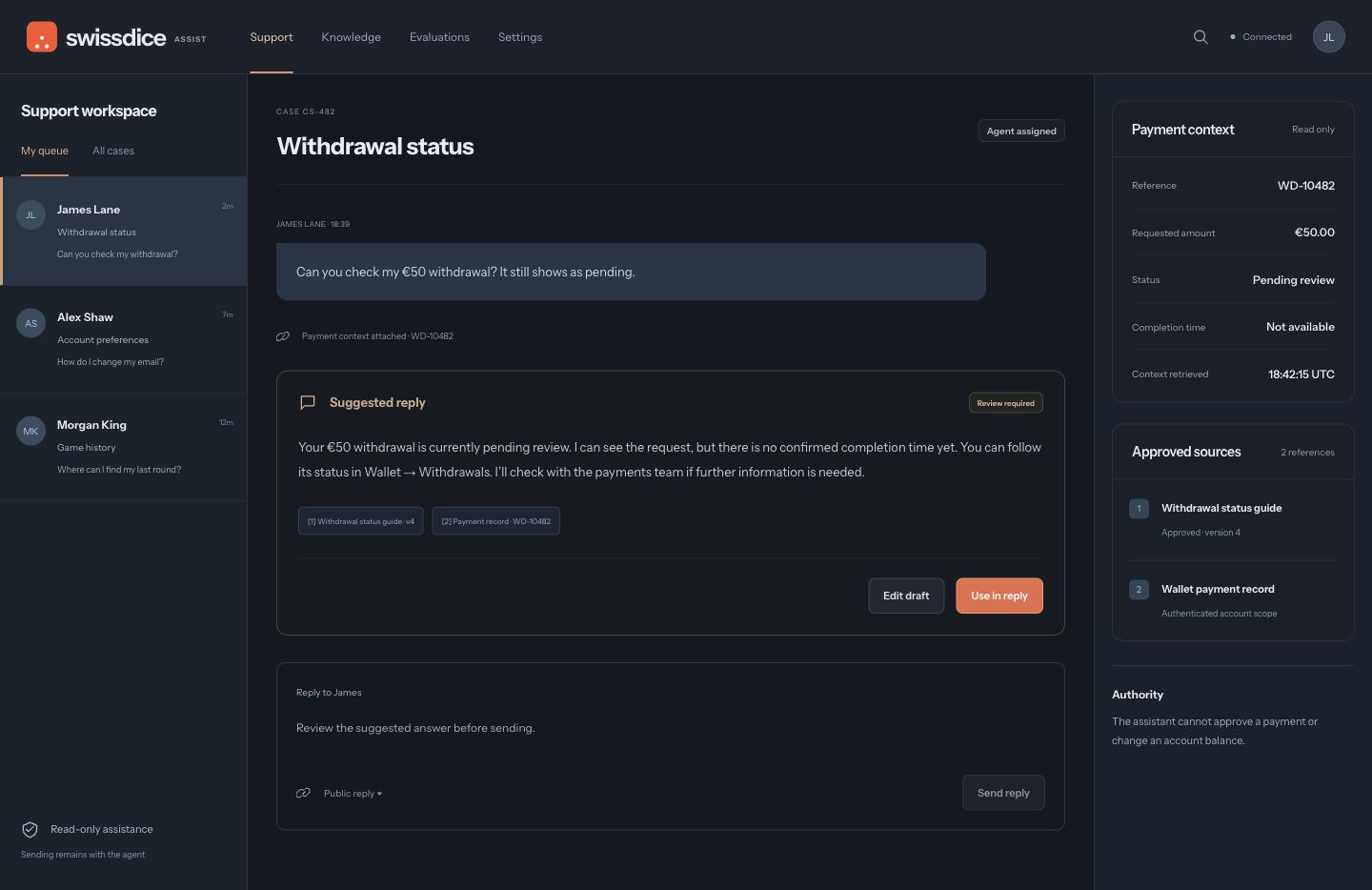
What does iGaming AI development include?
AI and personalization services apply defined models or automation to tasks such as content recommendations, analysis and support assistance. They do not automatically improve business outcomes or replace staff judgment. A useful implementation includes data controls, evaluation, human oversight where needed and a way to fall back when the model is uncertain or unavailable.
iGaming AI use cases, eligible recommendations and grounded assistance
The project starts with a task and a baseline: helping staff find an answer, ranking available content or identifying a segment for review. We define success measures and compare rule-based and model-based approaches. Recommendations must respect product availability, account restrictions and the approved player-protection policy before they are shown or acted upon.
A recommendation brief defines the eligible game or offer catalogue, available consented inputs, cold-start behavior and a fallback when history or the model is unavailable. It separates relevance from permission: account, content and communication restrictions are checked by their authoritative systems. A support assistant uses approved knowledge sources with a retained retrieval/model version, can say when the answer is unsupported and offers a human handover. Neither a generated answer nor a recommendation grants access to private account information.
- Use-case, baseline and evaluation definition
- Availability and account-control filters
- Data suitability and dependency assessment
Availability and account controls come first.
- Candidate A
- Available and permitted → eligible
- Candidate B
- Unavailable → excluded
- Candidate C
- Account restricted → excluded
Fixed eligibility example, without profiling or a live recommendation model.
A demo answer
is one observation.
- Approved answer and source match.
- Missing evidence triggers a fallback.
- Unavailable content is excluded.
- Untrusted text grants no permission.
- Provider failure has an operational route.
These are evaluation requirements, not fabricated test pass rates or commercial uplift.
AI evaluation, release monitoring and inference cost
Acceptance needs representative scenarios, failure cases and a documented fallback. We test incorrect or unsupported answers, unavailable products, unusual inputs and provider outages. Monitoring tracks the agreed quality and business measures without assuming that a successful demo proves ongoing accuracy, safety or commercial uplift.
Evaluate response time and operating cost alongside answer quality. Agree a representative request mix, expected usage and the provider charges or infrastructure costs the customer will bear, then measure that workload within a stated environment. Define usage limits, timeouts and a fallback when the service is unavailable or exceeds the approved budget. A model or retrieval change should repeat the relevant quality, permission, latency and cost checks before wider release.
Evaluation retains the task, reference dataset, model/prompt/retrieval versions and acceptance thresholds so changes can be compared. Tests examine unsupported answers, stale sources, hostile instructions in retrieved text, private-data exposure and failed tool requests as well as useful responses. Release monitoring tracks quality, fallback and handover rates, eligible recommendations, latency and usage cost with agreed definitions. The receiving team gets configuration, evaluation evidence, model/provider dependencies and a rollback or disable route; supplier data handling, retention and access are confirmed for the selected deployment.
- Offline evaluation and controlled release plan
- Quality, drift and incident monitoring
- Fallback, rollback and operator feedback workflows
Evaluation cases, authority limits and monitored releases
- AI use-case and evaluation specification
- Data and model-provider boundary assessment
- Recommendation or assistant implementation
- Human review and action-permission controls
- Failure, fallback and quality test evidence
- Monitoring and model-change documentation
AI scope, source grounding and automation questions
Discuss your requirementsDo we need AI for every automation?
No. Rules or ordinary workflow software may be simpler and more reliable for a given task. We evaluate the business need, data and verification burden before recommending a model-based approach.
Can an assistant change player balances?
Any account or financial action requires explicit authorization, controlled interfaces and audit evidence. A conversational interface should not bypass the permissions and review steps of the underlying operational workflow.
Can you guarantee better retention or revenue?
No. We can design controlled evaluation and measurement, but results depend on data, product, audience and operations. A deployment should be judged against a baseline and real observed outcomes.
How do you reduce incorrect support answers?
The scope can include approved source retrieval, constrained tasks, evaluation datasets, uncertainty handling and human escalation. These controls reduce specific failure modes but do not establish perfect accuracy.
Does personalization change game outcomes or sportsbook prices?
Content ranking and support assistance do not require authority to change game mathematics, accepted bet prices or settlement records. We define the permitted inputs and outputs for each use case and enforce those limits at the underlying services. Any separately commissioned pricing or game-design work needs its own specification, validation and release approvals. Recommendations still follow product availability, account restrictions and the approved player-protection policy.
How do you evaluate a casino recommendation engine before release?
We agree the task, eligible catalogue, permitted data, baseline and offline test set before selecting a model. Evaluation includes sparse history, new content, removed or restricted titles and unavailable services. Online experiments, where appropriate, separate relevance measures, commercial outcomes and protection constraints, with a comparison method and stop conditions. A vendor model score or historical correlation alone does not prove player benefit or incremental revenue in the customer’s platform.
How does a grounded iGaming support assistant hand over to a person?
The assistant retrieves approved current knowledge, identifies unsupported or conflicting information and follows an agreed escalation route. The handover can include the question, relevant source/version and minimal conversation context through authorized support tools. Identity, account changes, complaints and financial issues retain their own permitted workflows. We test missing sources, failed integrations and hostile instructions in supplied content. The chosen model provider’s access, retention and data-processing terms are assessed during commissioning.
What is included in AI development cost and operating handover?
Scope depends on the use case, knowledge/data preparation, model or retrieval approach, platform integration, evaluation and monitoring. Model/API usage, hosting, storage and human support capacity have separate operating costs and budgets. Handover includes versioned configuration, test evidence, source update ownership, fallback/escalation rules and release/disable instructions. It states whether model training, third-party licences and ongoing tuning are included. No model choice by itself establishes a safe or profitable production workflow.
Prove the use case before expanding automation
Choose the bounded automation use case
Agree the user problem, allowed data, evaluation cases and measurable acceptance criteria. Define where human review and existing platform authority must remain in control.
Build and evaluate with restricted access
Implement the selected model or service integration within those boundaries. Test correctness, inappropriate outputs and escalation behavior using relevant examples rather than relying on a demonstration alone.
Release through monitored decision gates
Compare the agreed quality and operational measures before expanding use. Deliver access controls, review procedures and rollback conditions for the particular automation workflow.
Choose a measurable AI workstream
Describe the personalization or support task, available data, permitted actions and the people who approve outcomes. We will define evaluation examples, human handoff, fallback behavior and monitoring before scoping an AI-assisted workflow.
Let’s build