Find the right content.
Understand categories, availability and account context.
Casino website UX, sportsbook UI design and accessible gaming interfaces built around real tasks, clear states and implementable components.
Discuss your product experience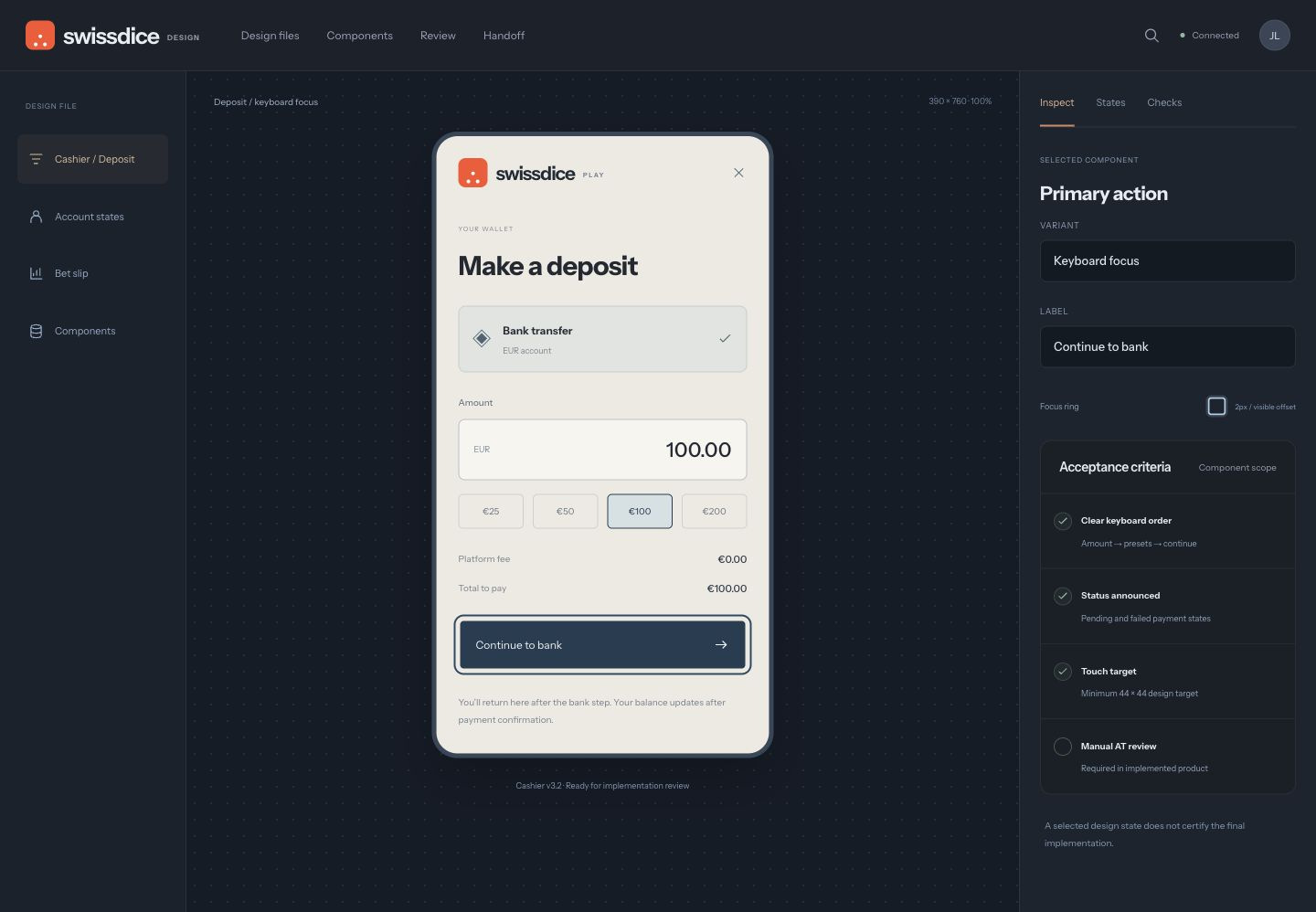
iGaming UI/UX design defines how people discover content, complete tasks and understand system feedback. Accessibility adds explicit requirements for interaction, semantics, readability and alternatives. A design engagement should include behavior and acceptance criteria, not only static screens, and should test representative player and staff workflows.
We map task goals, user roles and decision points, then organize the information the user needs at each stage. Account verification, payment status and bet acceptance receive clear states and language. Wireframes and prototypes are reviewed against actual platform capabilities so the design does not promise an action the backend cannot support.
Understand categories, availability and account context.
Read rules, see status and recover from an interruption.
Retain navigation and explain the authoritative state.
Component specifications include labels, keyboard behavior, loading feedback, content limits and motion preferences.
The design system defines typography, spacing, components, motion and responsive behavior. Reusable patterns help keep lobbies, account pages and back-office tools consistent without forcing every workflow into the same layout. Component documentation records keyboard behavior, focus states, loading feedback and content limits, making implementation and later changes easier to review.
Accessibility checks need more than a color contrast score. We evaluate keyboard paths, visible focus, labels, error identification, zoom behavior and screen-reader semantics against the agreed standard and scope. Automated checks support that work, while manual review and representative user testing address behavior that cannot be established from a scanner alone.
The evaluation plan identifies the target, such as WCAG 2.2 Level AA, the included pages and complete workflows, and the browsers and assistive technologies used. Representative sampling must still follow a task through registration, account controls, cashier errors or a bet decision where those journeys are in scope. Findings record the tested build, criteria, reproduction steps, limitations and retest status. Third-party game frames and provider-controlled screens need explicit scope and ownership; a prototype review does not establish conformance of the implemented product.
Agree player and operator tasks, device contexts, accessibility needs and the system states the interface must communicate. Identify content, provider and account-control constraints before visual design.
Design information architecture and interactive flows for normal, pending, failed and restricted states. Review navigation, forms, game discovery and financial feedback as complete tasks.
Evaluate the agreed workflows, interaction semantics, readability, keyboard behavior and alternatives. Record findings against the design acceptance criteria rather than presenting attractive screens as sufficient evidence.
Deliver responsive components, prototypes, content guidance and documented interaction states. Define implementation and follow-up review responsibilities so the eventual build can be checked against the approved design.
Yes. We can audit current journeys, identify supported frontend changes and redesign agreed areas. Backend limitations, provider interfaces and existing player expectations inform the scope instead of treating the project as a cosmetic reskin.
We agree the standard, scope and verification method, then document the results and known issues. Accessibility is maintained through implementation and content changes; an initial design or automated score alone is not a complete assurance.
Yes. Motion should support orientation or feedback, use appropriate rendering techniques and respect reduced-motion preferences. We define performance budgets and avoid making essential information dependent on animation.
They should include the important exceptional states in the agreed scope. Clear feedback for pending payments, changed odds, unavailable games and restricted accounts is part of usable product design.
Agree the target level, product boundary, representative pages and complete user processes before testing. Review keyboard navigation, focus, labels, status feedback, error recovery, zoom and the selected assistive technologies against applicable success criteria. Record automated and manual findings with the tested build and evidence, then retest implemented fixes. Provider-controlled games and payment screens require declared coverage and remediation ownership. Selected design screens or a scanner score cannot establish whole-product conformance.
Choose representative tasks and a baseline before changing the interface. Usability sessions can measure task completion, time, errors, comprehension and recovery for game discovery, registration, cashier or bet-slip journeys. Report the participant and device scope, findings and limitations alongside the proposed revisions. Product analytics or a permitted experiment can extend the evidence after implementation. A polished prototype alone does not prove higher deposits, retention or revenue, and those outcomes are not guaranteed.
Scope the user roles, journeys, exceptional states, device layouts, research participation and accessibility evaluation first. Handover can include editable designs, interactive prototypes, tokens, component variants, responsive rules, content guidance and interaction specifications. We identify implementation ownership, review checkpoints and retest work separately. Estimate milestones around approved journeys, the component system and implementation evidence; custom game art, frontend coding and ongoing experimentation are included only when commissioned.
Identify the player or operator workflows, target devices and accessibility concerns in scope. We will plan the interface review, design system, prototypes and acceptance scenarios around real account, payment and gaming tasks.
Let’s build