Payment processing
Clear player-facing status
Return screen and funding are separate
Bring approved payment methods into your existing cashier, wallet and finance workflows—with traceable provider references and explicit exception handling.
Scope your payment integration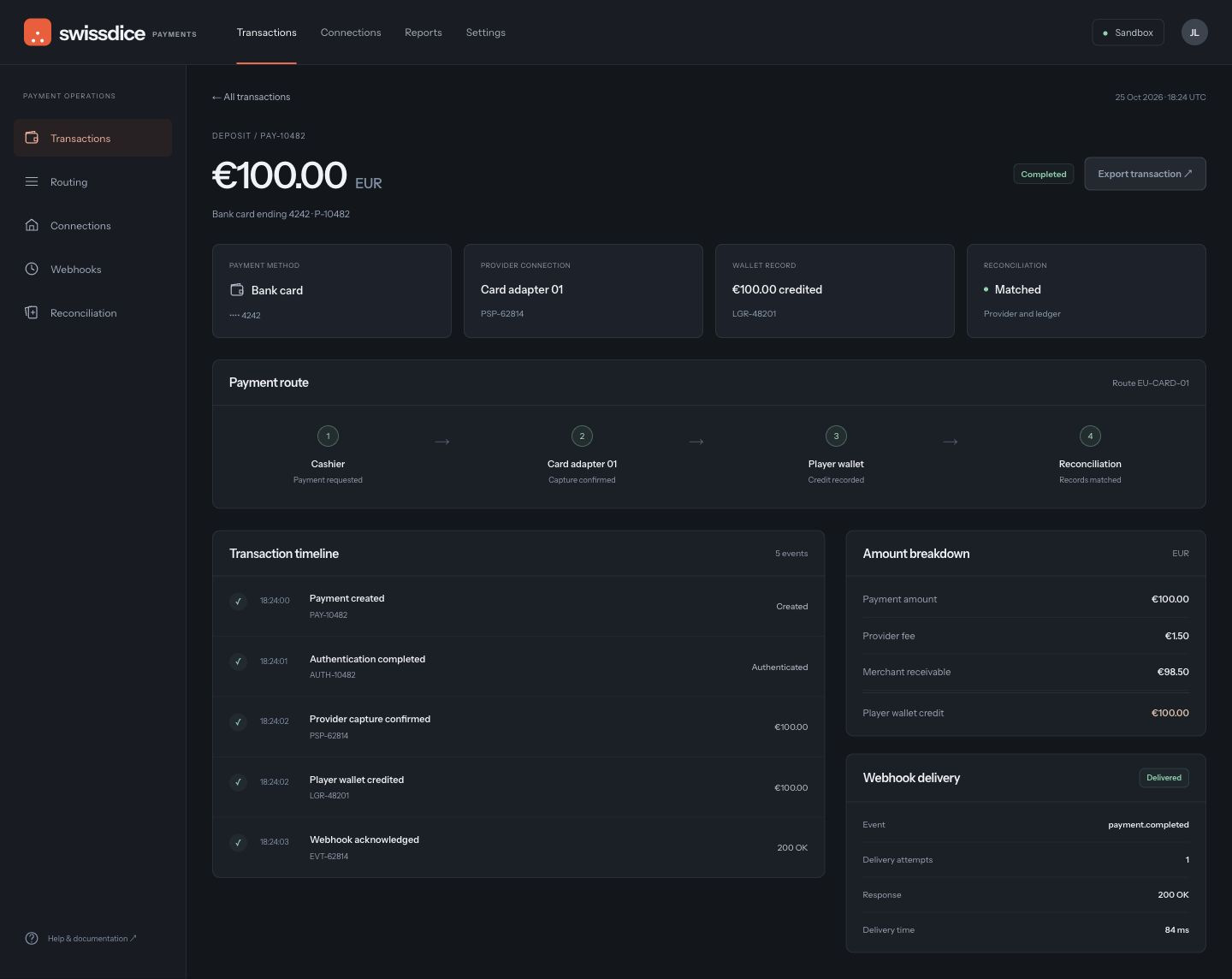
Payment gateway integration connects an operator’s cashier and wallet to an external payment service provider. It translates provider-specific payment states, callbacks and reconciliation information into a consistent platform workflow. Merchant onboarding, supported markets, currencies, processing fees and settlement arrangements remain governed by the payment-provider agreement.
Clear player-facing status
Selected provider contract
Correlated payment and ledger history
A completed browser journey is a player-facing status. Confirm the authoritative provider event before applying its permitted wallet effect.
Clear player-facing status
Selected provider contract
Correlated payment and ledger history
Verify the provider event using the required payload and credentials. A success-shaped message cannot establish payment authority by itself.
Clear player-facing status
Selected provider contract
Correlated payment and ledger history
Recognize the original transaction under the provider’s duplicate rules, retrieve its recorded decision and avoid applying the same financial effect again.
Clear player-facing status
Selected provider contract
Correlated payment and ledger history
Keep an unresolved payout distinct from a confirmed failure. Follow the provider status and reconciliation path before retrying or selecting another route.
Clear player-facing status
Selected provider contract
Correlated payment and ledger history
Preserve the link between the payment and supported correction. Test partial amounts, repeated delivery and how the resulting history is explained to finance and the player.
A payment can be initiated, awaiting player action, pending review, successful, declined or later reversed, depending on the method. We map the states exposed by each PSP and define which changes can affect the player’s spendable balance. A browser redirect is treated according to the provider specification and is not assumed to be sufficient evidence of received funds.
The cashier design also considers permitted methods, currencies, transaction limits and account restrictions. Players receive useful status information without seeing internal risk logic or raw provider errors. Operations staff can locate the related PSP and wallet references and understand which party owns the next action.
Hosted payment fields, tokenized methods and provider redirects create different data and interface boundaries. We document where sensitive payment information is entered, which references the operator retains and how additional authentication or player action is resumed. The design minimizes unnecessary card-data handling; payment-security assessment responsibilities follow the actual integration scope. A provider’s own certification is not treated as certification of the operator’s entire platform.
Reconcile the selected PSP’s financial definitions, including reserves, reversals, currencies and report cutoffs where applicable. A player-wallet credit and bank settlement are separate records.
The implementation joins cashier records, wallet entries and available provider reports using agreed identifiers and financial definitions. Fees, currencies, reversals and settlement periods need to be understood by the finance team. Differences appear in an exception process instead of being concealed by a dashboard total.
Acceptance includes deposits, withdrawals, declines, delayed confirmation, duplicate events and the provider’s supported refund or reversal path. We verify that account restrictions and approvals remain effective during each journey. Production activation follows the merchant and provider readiness checks, with a tested support and reconciliation handover.
Refunds, reversals, disputes and chargebacks can arrive after an earlier successful payment, and partial amounts need references to the original transaction. Settlement batches may also include charges, reserves, currency conversions or adjustments. Finance definitions distinguish the player-wallet effect from processor settlement, with agreed time zones, cutoffs and gross-to-net explanations. Operational review and approvals remain visible when a payment or account is restricted.
Callbacks may be repeated or arrive after a request times out. The integration needs stable transaction identifiers, authenticated messages and provider-supported idempotency rules. We keep an uncertain transaction distinguishable from a failed one, so the system does not blindly retry a payout or create a second wallet credit.
Payment orchestration can introduce routing and fallback choices, but those choices must respect transaction state. We document when another route can be attempted and when the original provider must first be queried or reconciled. Secrets remain in controlled server-side configuration, with production and sandbox access separated.
Idempotency scope, key lifetime and regional/account behavior are provider-specific. A global duplicate guarantee cannot be assumed.
Review merchant approval, eligible markets, methods, currencies, sandbox access and the platform’s existing wallet and restriction model.
Connect initiation, callbacks, player status, approvals and reconciliation while documenting retries and uncertain-state recovery.
Test the agreed deposit and withdrawal scenarios with finance stakeholders, then coordinate controlled provider activation and monitoring.
The integration service does not automatically include a merchant account. The selected PSP reviews the business and defines supported products, markets, fees and settlement terms. We coordinate technical onboarding after the required provider access is available.
Yes, where an approved provider supports the method and the operator’s product and markets. We assess currency behavior, redirects, confirmation states, withdrawal support and reconciliation requirements before estimating a new payment connector.
The design links provider transaction identifiers to a controlled wallet event and applies the agreed duplicate and idempotency rules. Acceptance tests repeat messages and simulate delayed responses to confirm that financial effects are not applied twice.
Yes, subject to the selected provider interfaces and routing design. We define method availability, routing rules, transaction-state ownership, reporting and recovery before enabling fallback or additional provider routes.
The selected PSP and checkout design determine the data flow. Hosted fields, tokenized references or redirects can keep sensitive payment entry within provider-controlled components, while the operator retains the permitted transaction references and status. We document authentication steps, return states, credential ownership and diagnostic redaction. Required payment-security assessments depend on the real implementation and operating arrangement; adding a gateway does not automatically certify the whole platform.
Map each supported refund, dispute or correction to its original payment and the provider’s current status. Partial amounts, duplicate notifications and late events need separate tests. Finance compares wallet entries with processor reports using the same currency, period, fees, reserves and adjustments. A refund, chargeback and failed payment are different events; their treatment follows the actual provider agreement and approved operating workflow. Unexplained differences stay in an owned exception queue.
The estimate names the PSP, methods, currencies, checkout design, wallet contract and routing rules. Additional authentication, asynchronous confirmation, refunds, withdrawals and finance reporting can each add distinct work. Milestones prove the provider state map, repeated/uncertain-event recovery and reconciled sandbox journeys before controlled activation. Merchant underwriting, processor charges, required assessments and commercial approvals remain separate dependencies. The handover includes monitored exceptions, credential rotation and the provider/version maintenance responsibility.
Identify the payment providers, methods, currencies and operating markets, with your current cashier and settlement model. We will map deposits, withdrawals, callback states, refunds and reconciliation to the supported provider workflows.
Let’s build