Market transition
Price change, suspension and supported correction.
Bring your selected sportsbook into the player experience you operate. Define interface control, session handoff and financial authority before connecting the first market.
Scope your sportsbook connection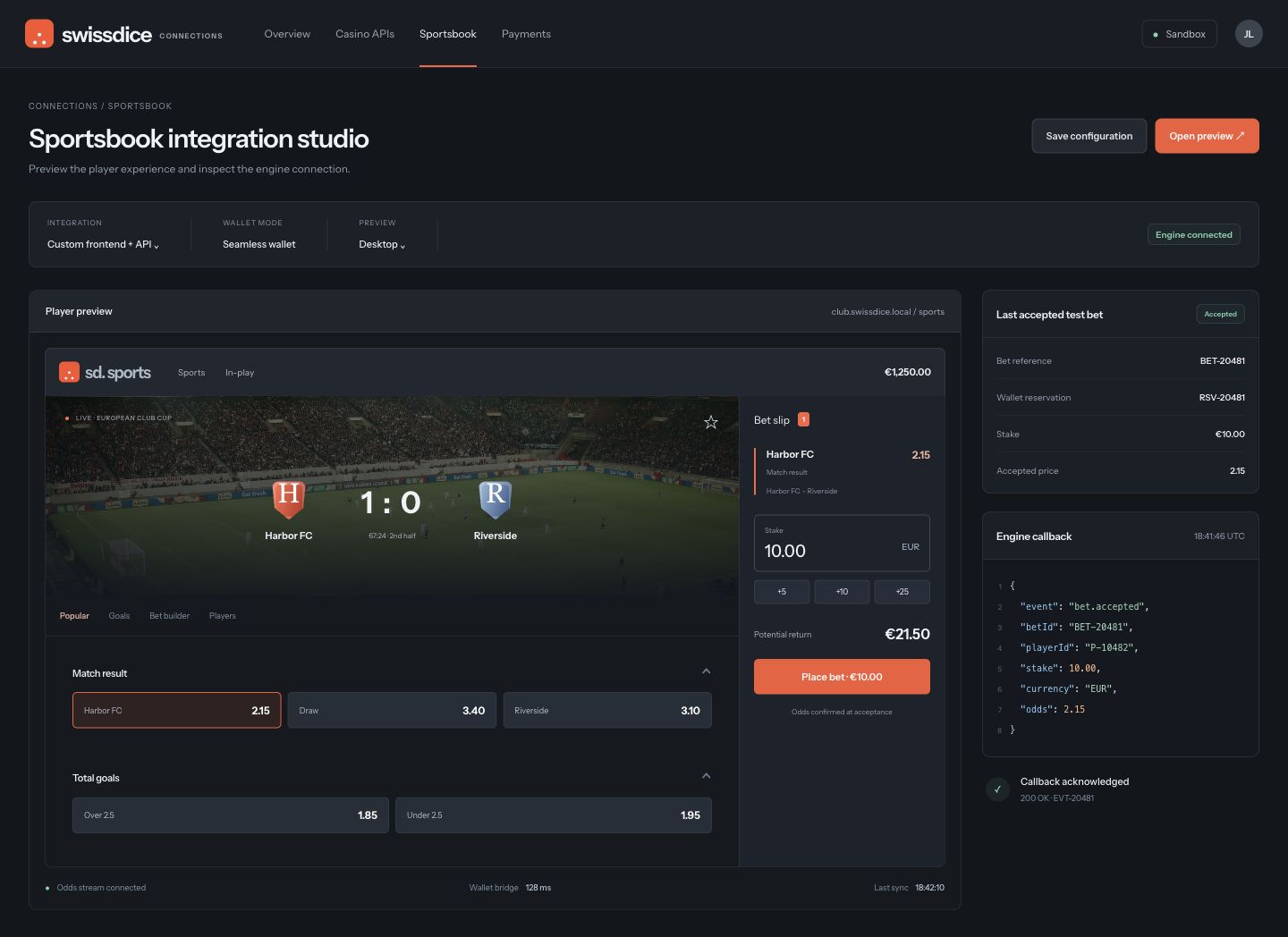
A sportsbook API integration connects a supplier’s betting functions to a custom interface or platform. An iFrame integration embeds a supplier-controlled player interface while connecting the agreed account and wallet workflows. The appropriate choice depends on which experience, engine behavior and operational decisions your team needs to control.
An API-based frontend can support a distinct navigation, event discovery and bet-slip experience, but the supplier’s interface still defines the available market and transaction functions. We check documentation, SDK support, versioning and realistic test access before committing to customization that the engine cannot expose.
An iFrame can reduce frontend implementation, yet it introduces its own requirements: session handoff, responsive sizing, domain configuration, navigation behavior and account continuity. We review these interactions on target devices and make the boundaries clear. Styling an embedded interface is not the same as owning the underlying sportsbook engine.
An odds or sports-data API supplies information; it does not by itself accept a wager or authorize a wallet entry. Pricing, risk decisions, market suspension and bet acceptance remain with the agreed engine and operating roles. Feed normalization, freshness and recovery can be scoped through sports data and odds integration without confusing that work with a full sportsbook connection.
These routes give the operator different control. The integration brief names the supplier product, betting authority and interfaces so a sports betting API that supplies odds data is not mistaken for a complete sportsbook.
| Workstream | Project scope | Dependencies to confirm |
|---|---|---|
| Engine API | Connect supported accounts, wallets, bet placement and settlement functions. | A contracted engine, available endpoints and defined trading ownership. |
| Embedded sportsbook | Integrate the supplier-hosted player experience and supported branding/account flows. | An approved iframe/embedding agreement and supported customization. |
| Odds and sports data | Import event, market, pricing and result data into the chosen system. | Data rights, event mapping and a separate betting/trading implementation. |
Look up the request through the engine’s supported status or reconciliation path. Preserve the accepted engine and wallet references; a timeout alone does not establish acceptance or rejection.
The integration maps player identity, account restrictions, currencies and wallet authority to the supplier’s supported model. Bet requests, accepted wagers, rejected selections, cash-out and settlement need unambiguous responses. Where a transaction becomes uncertain, the platform must follow the supplier-approved reconciliation process instead of guessing the player’s final balance.
Sportsbook data and financial events may arrive asynchronously. We define identifier mapping, duplicate detection, ordering and corrective events, including voids or resettlement when supported. The operator back office should expose enough reference data to investigate a bet while preserving separation between support staff, traders and financial approvers.
The interface must explain a changed price, stake limit or suspended selection before submitting an action under the engine’s acceptance rules. Requests carry the appropriate selection and price context, while server-side account restrictions remain effective if the client state is stale. Partial cash-out, bet builders, bonuses and position corrections are included only when the engine exposes the required contracts. A successful data refresh is not proof that a bet was accepted.
Testing covers a normal pre-match bet, in-play price movement, a suspended market, insufficient funds and a restricted account. Additional scenarios address accepted versus pending requests, session expiration, duplicate events and the engine’s supported result-correction behavior. Test expectations are agreed with the supplier rather than inferred from a competitor demo.
The release plan includes market visibility controls, provider escalation and transaction monitoring. We retain the evidence needed to confirm that the frontend, sportsbook and wallet agree on the bet’s state. A staged rollout gives operations staff a clear way to investigate exceptions and disable the new product if acceptance conditions are no longer met.
Price change, suspension and supported correction.
Restrictions, expiry and permitted session recovery.
Engine references, repeated messages and retained wallet authority.
This page covers integration with the engine selected for your project. A separately commissioned sportsbook build, licensed engine, odds feed and staffed trading service each have different responsibilities and commercial terms that must be defined.
Yes, when the supplier exposes the required functions and your frontend can support them. We assess event discovery, market presentation, bet-slip behavior, authentication and wallet responses before confirming the retained interface scope.
Not necessarily. The embedded interface still needs the agreed session, player account, balance and restriction workflows. The supplier’s supported account and wallet model determines which integration work remains.
The behavior follows the sportsbook specification. We map corrective financial events to original bet and wallet references, test duplicate and late delivery, and provide an investigation path so operations can explain the final account history.
No. An odds feed provides prices, events or results under its data agreement. A wagering service also needs an engine that accepts or rejects bets, account and wallet controls, the applicable operating permissions, risk responsibilities and settlement/correction workflows. We separate the feed connector from the wagering-engine integration so the estimate names what is retained, procured or commissioned. Access to bookmaker prices does not grant bet-placement or streaming rights.
The selected engine defines the available features and acceptance rules. We map updated prices, rejected or suspended selections, stake changes and any required player confirmation into clear interface states. Cash-out and bet-builder actions retain their engine and financial references, including supported partial or corrective events. Account restrictions are checked at the authoritative boundary. The scope and tests do not assume that every engine supports the same controls or accepts every request.
The estimate depends on API versus embedded delivery, retained frontend/PAM/wallet interfaces, required engine features and sandbox quality. Bet-state mapping, negative tests, supported corrections and measured workload evidence form explicit milestones. Supplier onboarding, engine fees, feeds and staffed trading remain separate commercial scopes. Handover names version compatibility, monitoring, escalation, change testing and the maintenance owner; an advertised provider launch time is not a guarantee for a different platform.
Identify the retained PAM, wallet, frontend, sportsbook supplier and provider access. Decide which engine functions and UX controls are required.
Develop the account bridge, player interface and event handling with supplier sandbox validation and stakeholder demonstrations.
Run acceptance cases across market transitions, money movements, session failures and operational reporting before controlled release.
Identify whether you need an engine API, an embedded sportsbook or an odds-data feed, with the supplier and retained frontend. We will map player sessions, wallet authority, bet states and provider acceptance scenarios for the chosen integration.
Let’s build