Mission events.
Qualifying actions and defined milestones.
Build missions, casino leaderboards and competitions around eligible events and explainable rules. Scope jackpot funding and awards separately.
Design your competition mechanics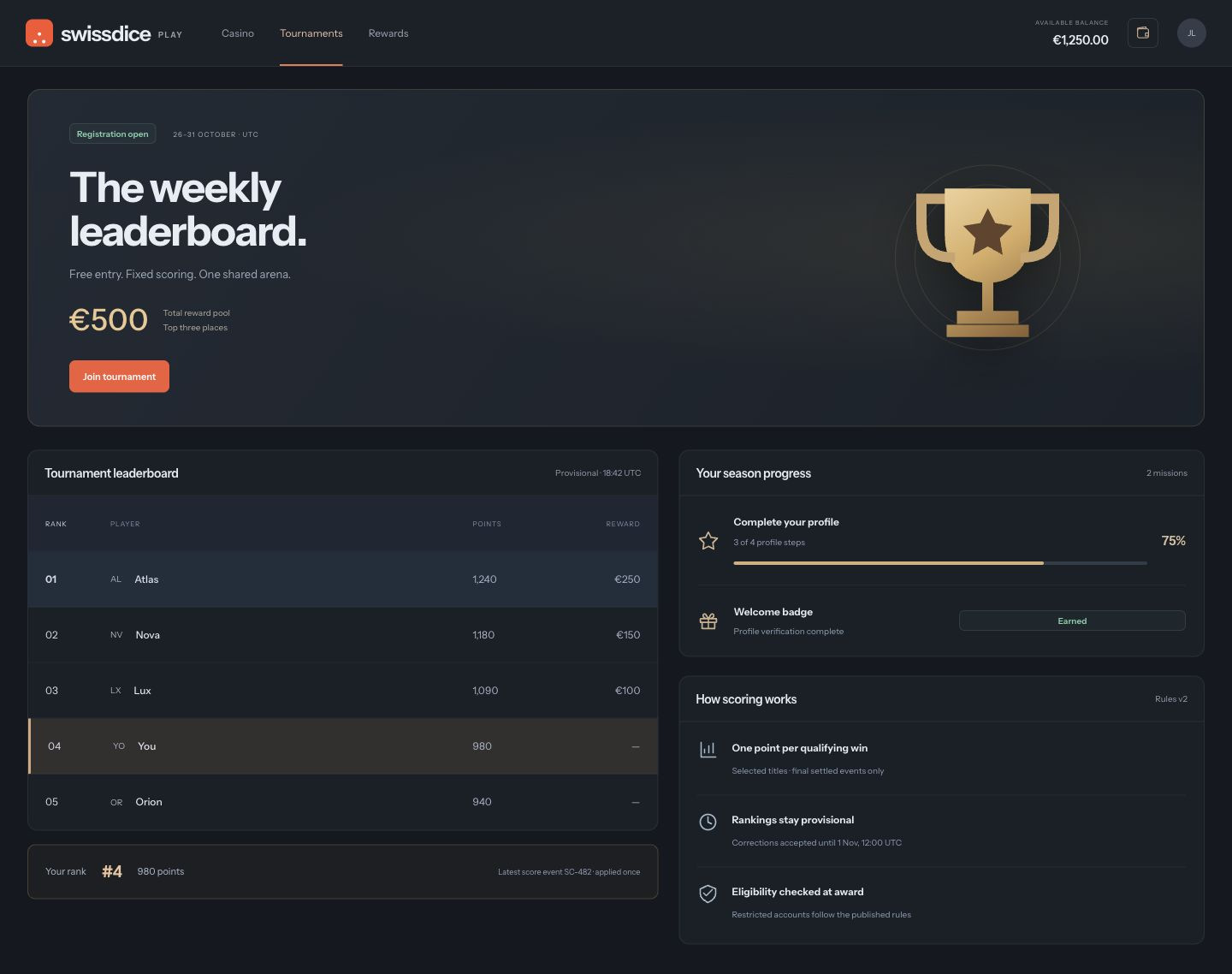
Gamification software adds defined progression, missions or competition to a platform. Tournaments compare eligible activity under published scoring rules, while jackpots follow a separate contribution and award model where used. The implementation must preserve eligibility, calculation evidence, restrictions and financial reconciliation for the specific feature.
A mission or leaderboard requires a trusted source of activity, clear qualifying rules and a defined scoring period. We map source events, account restrictions, ties, corrections and late data before implementation. Players and operators should be able to see whether a result is provisional, final or under review.
The scoring contract defines the provider and game identifiers, eligible events, currency normalization, score precision, window/time zone and tie-break order. Repeated delivery cannot add the same score twice. Late or reversed events follow a stated correction and finalization policy, with provisional and final standings distinguishable. Cross-provider or cross-vertical competitions need comparable source events and explicit eligibility; a visually shared leaderboard does not establish that different suppliers report equivalent activity.
Qualifying actions and defined milestones.
Rankings, periods, ties and corrections.
Contributions, triggers, awards and reconciliation.
Provider rights, specialist mathematics and independent review requirements follow the selected model.
A progressive or other jackpot model may involve contributions, funding, triggers, award allocation and external networks. Those responsibilities need an explicit technical and specialist boundary. We scope the interfaces and evidence required for the chosen model; a visual counter alone is not a jackpot system or proof of its correctness.
Teams need creation, preview, approval, scheduling and settlement tools, with permissions appropriate to the financial impact. We define reward delivery, cancellation and exceptional corrections, then test repeated or reordered activity events. Reporting connects a displayed ranking or award to the underlying calculations and wallet entries.
An operating package links the approved rule version and eligible catalogue to start/stop schedules, preview, enrollment, scoring history and the award queue. Prize delivery has a stable award reference, retry/reconciliation behavior and a defined route when the wallet or reward provider is unavailable. Test cases include ties, disqualification under the approved policy, corrected results, cancellation and restricted accounts. Handover records integration contracts, administration rights, funding dependencies, release evidence and ongoing monitoring ownership.
Potentially, if the platform receives suitable activity data and the provider agreements permit the feature. We assess event consistency, scoring definitions, game exclusions and correction behavior before confirming cross-provider support.
No. The counter is presentation. The underlying model also needs funding, contribution, trigger, award and reconciliation behavior, with specialist and independent testing requirements addressed where applicable.
The approved rules define provisional and final periods, correction handling and any dispute process. We keep calculation history and test replay behavior so operators can explain a revised ranking.
Eligibility and reward delivery follow the approved account and player-protection rules. The scope must define behavior when a participant becomes restricted before scoring or payout is complete.
Yes, these can be scoped as distinct rule sets. The brief defines qualifying activity, progress counters, levels or badges, reset periods and the reward attached to completion. We test repeated events, corrections, overlapping campaigns and changes in account eligibility so a displayed achievement matches the recorded progress and permitted reward.
They can when the connected systems expose authorized, sufficiently defined events for the agreed scoring model. We map identifiers, currencies, event times, reversals and eligible content before treating them as comparable. Turnover, win amount, round count and win-to-stake ratio are different criteria. The competition brief states its limits, tie-breaks, correction window and prize rules. Provider access and product-specific permissions are confirmed separately.
A funded jackpot needs defined contribution, pool, trigger, award and reconciliation behavior with an authoritative ledger or approved supplier. The display consumes that state; its counter does not determine a win. The design states what happens during delayed events, interruptions, reversals and an uncertain award response. Mathematics, independent assessment and any market-specific approvals are separately scoped with the appropriate specialists. A tournament prize fund and a game-linked jackpot should not be assumed to use the same logic.
The estimate depends on missions and progression, scoring sources, leaderboard scale, competition types, funded jackpot boundaries, reward integrations and administration. Provider licences, specialist mathematics/assessment and ongoing campaign operation are separate dependencies. Acceptance exercises the agreed event history, ties, duplicates, corrections, finalization and one-time prize delivery, plus mobile presentation and operating handover. Engagement or revenue uplift requires measured evidence after launch; it is not a development acceptance result.
Specify the competition, achievement or jackpot model with its event sources and authority. Separate presentation effects from the mathematics and rules that determine participation and rewards.
Implement the selected mechanics, approval paths and operator controls. Preserve contribution, ranking and award history through configuration changes and interrupted events.
Test duplicate events, ties, schedule boundaries and corrected source records. Deliver rule versions, financial mappings where applicable and the evidence operations needs to explain an award.
Bring the leaderboard, achievement, tournament or jackpot rules you want to implement, with event sources and funding responsibilities. We will map eligibility, scoring, payouts, resets and exception handling to the agreed player experience.
Let’s build