iGaming Technical Consulting & Architecture Audits
Trace critical paths. Explain the findings. Give the team a prioritized route to verified changes.
Define your audit scope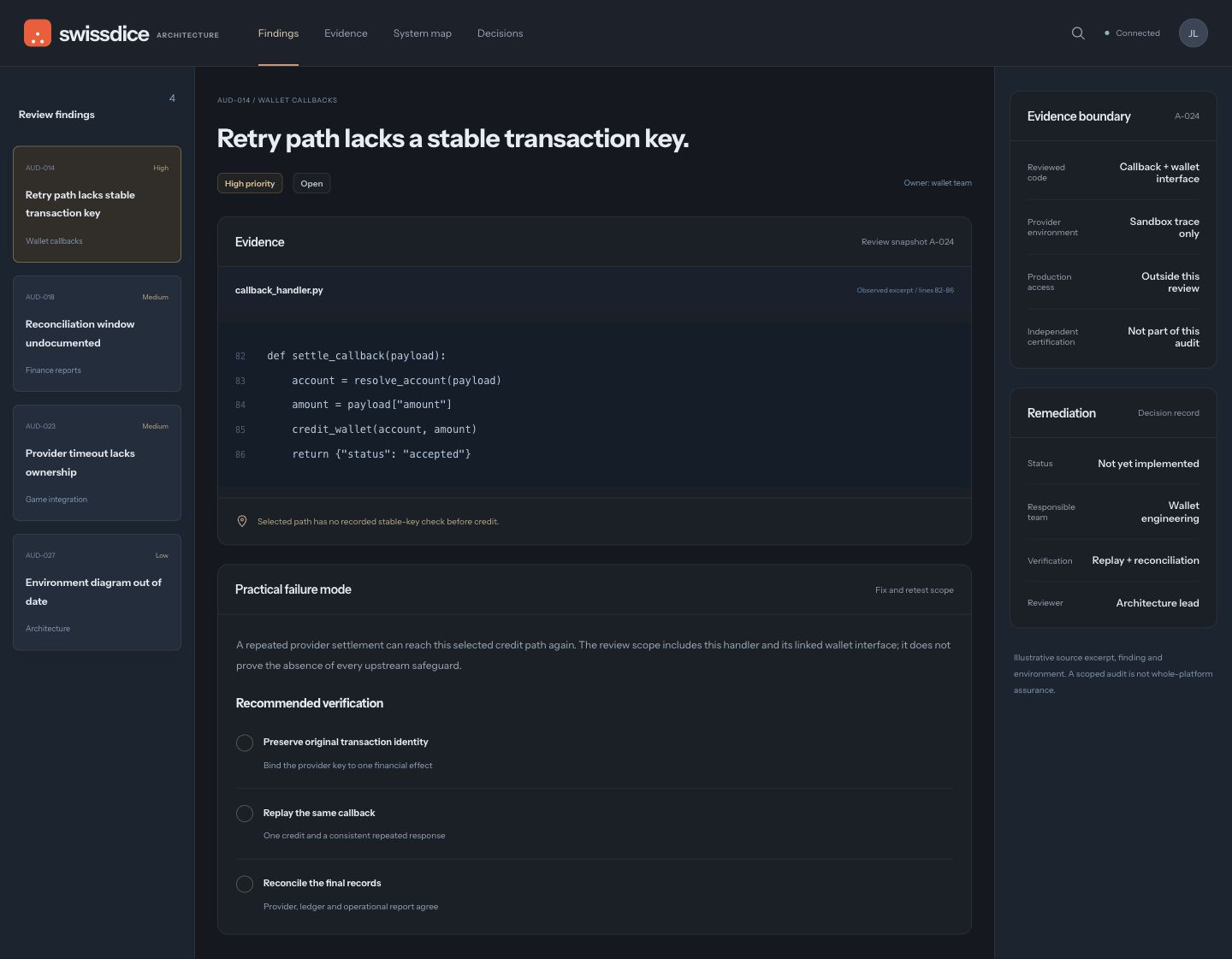
What is an iGaming architecture audit?
iGaming technical consulting evaluates how a proposed or existing system supports its operating requirements. An architecture audit can examine code, configuration, interfaces, data and production evidence within an agreed access scope. It produces decisions and actionable findings; it does not imply certification or a guarantee that every possible defect has been discovered.
Diagram.
Interface.
Code & environment.
Each layer answers different questions. Missing access stays an explicit limitation.
Architecture audit scope, system versions and evidence access
A diagram-only review answers different questions from a code and environment audit. We agree which repositories, logs, schemas, contracts and workflows are available, and record limitations where evidence is missing. This prevents a narrow review from being presented as assurance over the entire platform.
The evidence register names the reviewed build or commit, environment, configuration, observation period and representative records or journeys. Read access, personal-data handling and any active testing are agreed for that scope; missing supplier internals or production evidence remain visible limitations. We distinguish an observed behavior from a hypothesis, a reproduced defect and a conclusion based on documentation alone. Selected paths or samples do not establish assurance over every component or transaction.
- Audit scope and evidence access inventory
- Architecture and dependency reconstruction
- Known limitations and unresolved assumptions
What evidence would
explain the behavior?
One reference. One intended effect.
Provider callback → validation → wallet- Evidence to request
- Correlated request, transaction and ledger records
- Verification scope
- Compare repeated and delayed requests against the agreed contract
A role needs an explicit boundary.
Operator role → permission → recorded action- Evidence to request
- Role configuration, authorization path and audit record
- Verification scope
- Verify permitted and denied actions for the reviewed role
A total needs a traceable history.
Accepted record → posting → report- Evidence to request
- Versioned source record, adjustment link and reporting definition
- Verification scope
- Reconcile selected histories including corrections
Trace the critical account and financial paths
We follow selected journeys through identity, wallet, game or sportsbook services and back-office tools. The review looks at state authority, authorization, transaction identifiers, retries, reconciliation and privileged interventions. Findings explain the practical failure or maintenance risk, with references to the relevant components and a way to verify the proposed fix.
- Wallet and provider transaction flow review
- Authorization and operational control assessment
- Failure-mode and reconciliation analysis
Findings, supporting evidence and prioritized changes
- Scope and evidence register
- Current-state architecture and dependency map
- Prioritized findings with supporting evidence
- Remediation options and delivery dependencies
- Technical decision records
- Verification criteria for agreed fixes
Prioritized findings, remediation owners and retesting
The final plan distinguishes urgent integrity or access issues from scalability, cost and maintainability improvements. Recommendations include dependencies, implementation options and acceptance evidence, so the team can sequence work. Where a vendor constraint is responsible, we identify the required supplier question or integration change rather than prescribing an unsupported core modification.
Each finding records its evidence, affected component and version, practical impact, severity rationale, confidence and reproduction or verification steps. Options can include a targeted fix, configuration, supplier escalation or staged replacement. The review identifies dependencies, an owner able to act, effort assumptions and the evidence required to close the finding. A retest checks the identified change against the original concern and agreed regressions, while unresolved items and residual limitations remain in the handover.
- Evidence-backed findings and impact assessment
- Remediation sequence and ownership recommendations
- Acceptance checks and follow-up verification scope
- FindingObserved behavior and evidence reference.
- ImpactIntegrity, access or operational consequence.
- OwnerTeam or supplier able to make the change.
- AcceptanceSpecific verification of the reviewed change.
Architecture audit access and scope questions
Discuss your requirementsCan you audit a third-party platform?
Only to the extent your agreements and access allow. We can assess exposed interfaces, configuration and observed behavior, and review code when rights permit it. Findings clearly state where the underlying supplier system was outside the evidence boundary.
Is an architecture audit a security certification?
No. An agreed technical audit provides findings about the reviewed scope. Independent certification, penetration testing or regulatory assessments are separate functions with their own methods, reviewers and requirements.
Can the audit focus only on wallet issues?
Yes. A focused review can trace account balances, provider callbacks, adjustments and reconciliation. It should still include the connected interfaces needed to explain the issue, rather than reviewing a ledger table in isolation.
Will you rewrite the platform after the audit?
Implementation is a separate decision. The audit may recommend targeted changes, vendor configuration, integration fixes or a broader modernization plan. The evidence determines the proposed scope.
Can the audit include platform performance, infrastructure and operating cost?
Yes, when the agreed evidence and access support those questions. We review the workload, architecture, dependency behavior, telemetry and infrastructure configuration, then identify bottlenecks or cost drivers against stated targets. Active load or failure tests require their own agreed environment and window. A single request time, cloud bill or architecture diagram does not prove peak capacity, recovery or future cost. Findings distinguish measured observations, estimates and follow-up experiments.
How are audit findings prioritized and verified after a fix?
We describe the affected path, supporting evidence, impact and confidence before assigning an agreed priority. A financial-integrity issue, an access failure and a maintainability concern can need different responses. Each proposed action has an accountable team or supplier, dependencies and closure criteria. Retesting records the changed version, repeated scenario and relevant regression results; it can close that finding within scope while leaving other findings or evidence gaps open.
What is included in a technical audit handover and estimate?
The proposal identifies the system questions, accessible artifacts, environments, selected journeys, reviewers and expected outputs. Handover includes the evidence register, current architecture/dependency map, reproducible findings, severity rationale, remediation options and verification criteria in agreed formats. Third-party platform restrictions, unavailable histories and other review limits remain explicit. Implementing changes, penetration testing, independent laboratory assessment and ongoing operations are separate work unless included by agreement.
Trace the critical path before recommending changes
Agree the question and evidence access
Define the architecture, financial-integrity, integration or release concern to examine. Identify available code, configuration, documentation and operational evidence within the approved access scope.
Trace the connected system paths
Review how account state, commands, provider events and financial records move through the relevant components. Record observations and evidence gaps without treating a diagram as proof of runtime behavior.
Prioritize reproducible findings
Describe each material finding, its supporting evidence and its practical consequence. Compare remediation options, dependencies and verification criteria with the responsible technical and product owners.
Hand over decisions and verification criteria
Deliver the findings register, architecture records and proposed next workstreams. Implementing fixes or independently certifying the system is separate from the review unless expressly included.
Focus your platform architecture review
Explain the launch, migration, reliability or scale decision you need to make, with the architecture and constraints already known. We will define the review boundary, evidence to examine and the decisions the assessment should support.
Let’s build